The short answer on bathroom sconce height: mount the center of each fixture 60 to 65 inches above the finished floor, which puts it at about eye level, and set a pair 28 to 34 inches apart with a gap of 2 to 6 inches between each one and the mirror edge. Mark both heights on the wall before an electrician cuts anything, because a sconce that sits an inch low on one side is obvious every morning.
This guide covers the height, the spacing, what changes when the light has to go above the mirror, and the clearance the code asks for near a tub or shower. It also covers what a handmade copper or brass sconce leaves out: in September 2026 we read all 25 wall light listings at the five workshops we check, and 2 of them name a bulb socket.
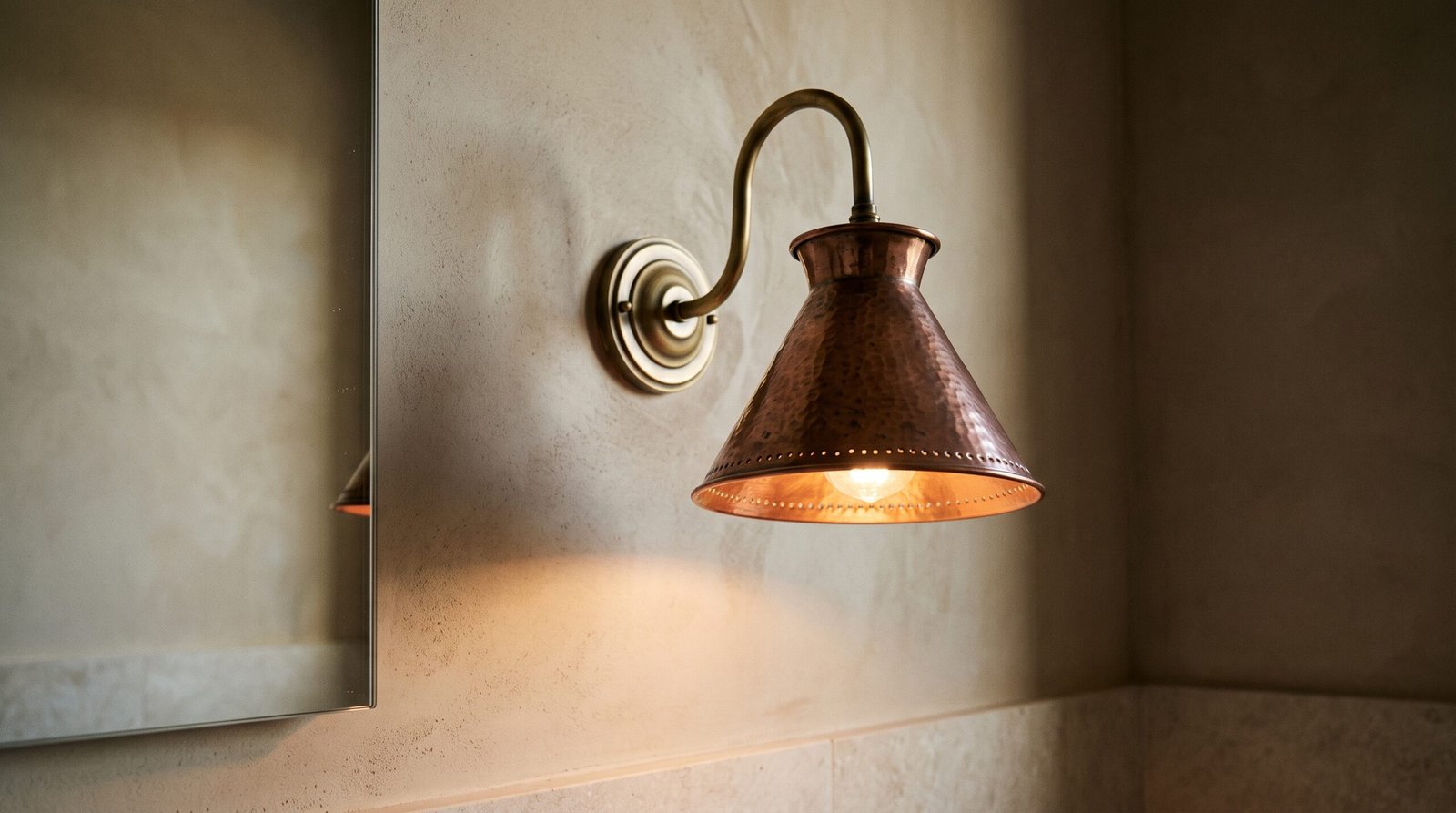
How high should a bathroom sconce be beside the mirror?
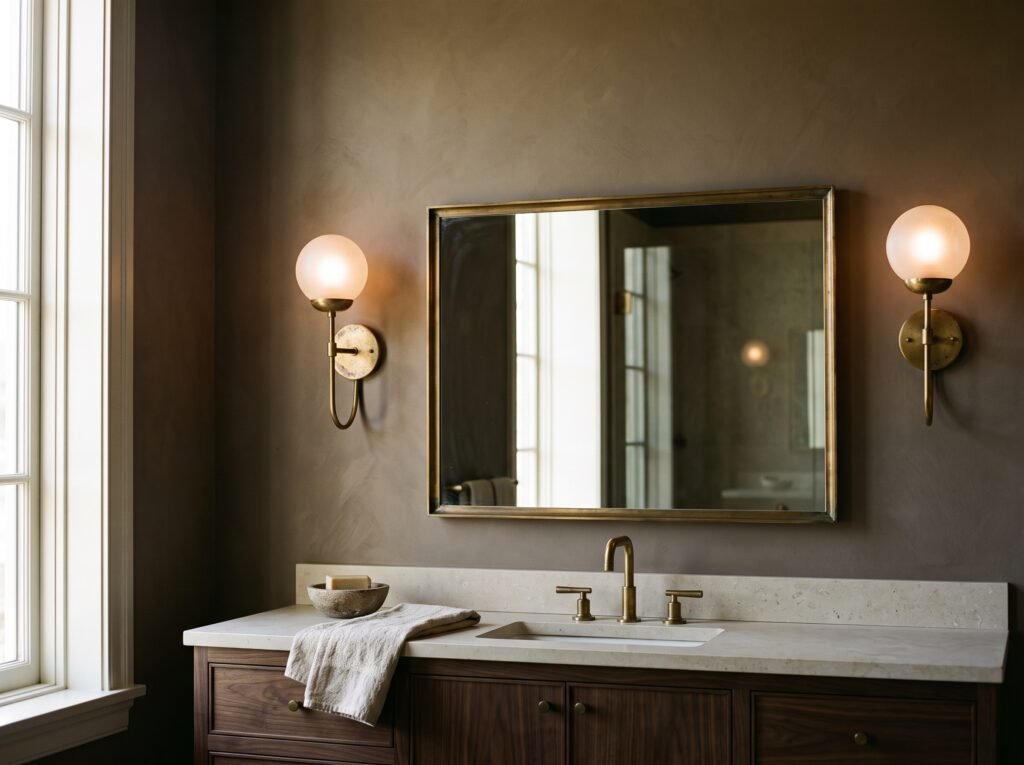
Put the center of the fixture 60 to 65 inches above the finished floor, so it sits at about eye level for most adults. Fix both sconces at exactly the same height, since the light crossing your face from two sides is the whole point of a pair.
Schoolhouse, which makes and sells wall lights, says that when installing sconces on either side of the vanity, it’s best to install bathroom sconces between 60″-65″ from the floor, and that the height of the sconce should land just around eye level, preventing unflattering shadows or harsh glares. Visual Comfort gives the same range and says where to measure it from, recommending mounting your sconce(s) just above eye level, or about 60″- 65″ from the floor to the center height of the sconce backplate.
Adjust it for the people using the room. Edward Martin, a lighting retailer, calls 65 inches the middle of that range, saying the standard sconce height for most adults is approximately 65 inches from the finished floor to the center of the light source, and suggests raising it up to 68 inches for a taller household or a high ceiling, or dropping it to around 60–62 inches for a low ceiling or a compact vanity. Golden Lighting works to much the same rule and says to center side sconces 60–66 in. from the finished floor.
For the numbers for your own mirror, our bathroom sconce height calculator works out the height, the gap and the spacing from the mirror width, and draws where each fixture lands.
One practical step before the electrician arrives: hold the fixture against the wall at the height you have chosen and look in the mirror. The bottom of the shade should be near the level of your chin or a little above, and the bulb should not be visible straight on.
How far apart should a pair of bathroom sconces be?
Space them 28 to 34 inches apart, measured from the center of one to the center of the other, and leave 2 to 6 inches between each fixture and the edge of the mirror. On a standard single vanity that usually means one sconce just outside each side of the mirror, not pushed out to the corners of the wall.
Edward Martin puts the target at 28 to 34 inches between sconces (measured from bulb center to bulb center). Golden Lighting gives the same center to center figure, narrowing the center-to-center gap to 28 to 34 inches while describing paired sconces 24–36 in. apart overall, and says to keep each fixture 2–6 in. from the mirror edge.
The mirror width decides which end of that gap you use. For a narrow mirror under 24 inches wide, Edward Martin says to mount sconces close to the mirror edges, around 2–3 inches away, and for a standard mirror 24 to 36 inches wide, to position sconces roughly 4–6 inches from the mirror edges. Work out the mirror position first, then the sconces, then the junction boxes.
Here are the numbers in this guide in one place:
| What | Number | Source |
|---|---|---|
| Sconce beside a mirror, center height | 60 to 65 in above the finished floor | Schoolhouse, Visual Comfort |
| Standard for most adults | About 65 in to the center of the light source | Edward Martin |
| Wider range in use | 60 to 66 in | Golden Lighting |
| Taller household or high ceiling | Up to 68 in | Edward Martin |
| Low ceiling or compact vanity | 60 to 62 in | Edward Martin |
| Pair spacing, center to center | 28 to 34 in | Edward Martin, Golden Lighting |
| Gap to the mirror edge | 4 to 6 in, or 2 to 3 in for a mirror under 24 in wide | Edward Martin |
| Sconce above a mirror | 75 to 84 in above the floor | Schoolhouse, Golden Lighting |
| Light above a seated vanity | 52 to 66 in above the floor | Golden Lighting |
| Linear light above a mirror | At least 3/4 of the mirror width, not past its edges | Visual Comfort |
| Clear zone around a tub or shower | 3 ft horizontally, 8 ft vertically | NEC 410.10(D) |
What if the sconce has to go above the mirror?
Mount it 75 to 84 inches above the floor, depending on how high the mirror sits. A light above the mirror casts shadows downward onto the face, so it works best alongside side lights rather than as the only light at the vanity.
Schoolhouse says that if you place the sconce above the mirror, it recommends installing it between 75″- 80″ above the ground depending on the placement of the mirror. Golden Lighting sets it a little higher for a standing user, saying to hold it to 78–84 in. AFF for standing use, and drops the centerline to 52 to 66 inches AFF where the vanity is used sitting down.
Size it against the mirror rather than the wall. Visual Comfort says the ideal linear bath light will measure at least 3/4 the width of the mirror but not extend over its edges. If you only have wall for one fixture, Golden Lighting reports the American Lighting Association’s position plainly: the best option is to place fixtures vertically on both sides of the mirror, centered at eye level.


How close to the tub or shower can a light go?
Keep suspended fittings out of a zone measured 3 feet horizontally and 8 feet vertically from the top of the tub rim or shower threshold. A fixture inside that zone has to be marked for damp locations, and for wet locations where shower spray can reach it.
EC&M, the electrical trade magazine, sets out the rule in NEC 410.10(D): no part of chain-, cable-, or cord-suspended luminaires, track luminaires, or ceiling paddle fans can be located within 3 ft horizontally and 8 ft vertically from the top of the bathtub rim or shower stall threshold. It adds that luminaires inside the tub or shower’s outer dimensions up to 8 feet must be marked for damp locations, and for wet locations where they are subject to shower spray.
This matters for handmade lights because the marking is what proves it. None of the 25 wall lights we read says damp rated or wet rated anywhere in its listing, so if the sconce is going near a shower, ask the workshop in writing and let your electrician make the call. Golden Lighting takes the same line, noting that a fixture inside that zone must carry at least a damp-location rating.
Will a handmade copper or brass sconce work in a US bathroom?
Usually yes, once an electrician wires it, but the listing rarely tells you. Of the 25 wall lights we read at these workshops, 2 name a bulb socket, 3 say the fixture is hardwired, and none states a UL or ETL listing.
Ask four things before you pay. First, the socket: a US fixture takes an E26 bulb, and one CopperKesh outdoor sconce is the single listing in our read that says it comes with E 26 Bulb. Second, how it mounts: a CopperKesh hammered sconce is listed as a hardwired wall mount (recommended install by an electrician), which is what you want to see. Third, the backplate size, since it has to cover the junction box in your wall. Fourth, the damp rating covered above.
The same questions come up with handmade ceiling lights, and we go through sockets, voltage and safety listings in more detail in our guide to copper pendant lights over a kitchen island.
Which sconce shape actually lights a face?
Pick a shade that is open at the top and the bottom, or one with a glass diffuser, so light reaches your face from the side instead of only washing the wall. Cutout shades and closed domes look beautiful and throw patterns, which is decoration rather than light to shave or do makeup by.
The workshop catalogues make the difference easy to see. One CopperKesh sconce is described as having square cutout perforations create beautiful light patterns, and another as giving an up & down light wash for flattering ambient lighting. Both are good lights. Only the second is doing much for the person in front of the mirror, and even then a pair at eye level does more than one.
A copper or brass interior helps, because the metal bounces a warm light back out. If you want the fixture to disappear into the wall instead, a narrow vertical shape beside the mirror takes up the least width, which is why the 3 inch wide brass double light above suits a small bathroom.

Copper or brass beside a mirror: which ages better in a wet room?
Both are sold unlacquered at these workshops, so the color keeps moving, and it moves faster in a room that is wet twice a day. Choose the finish you are happy to watch change, or ask for a lacquered one and accept that it will eventually need redoing.
Fourteen of the 25 listings we read say the sconce suits outdoor or covered outdoor use, which is a useful signal for a bathroom: a fixture a workshop is happy to hang on a porch is one it expects to meet damp air. Several describe the finish in those terms, one CopperKesh sconce being sold with a rustic copper finish that patinas over time (living finish).
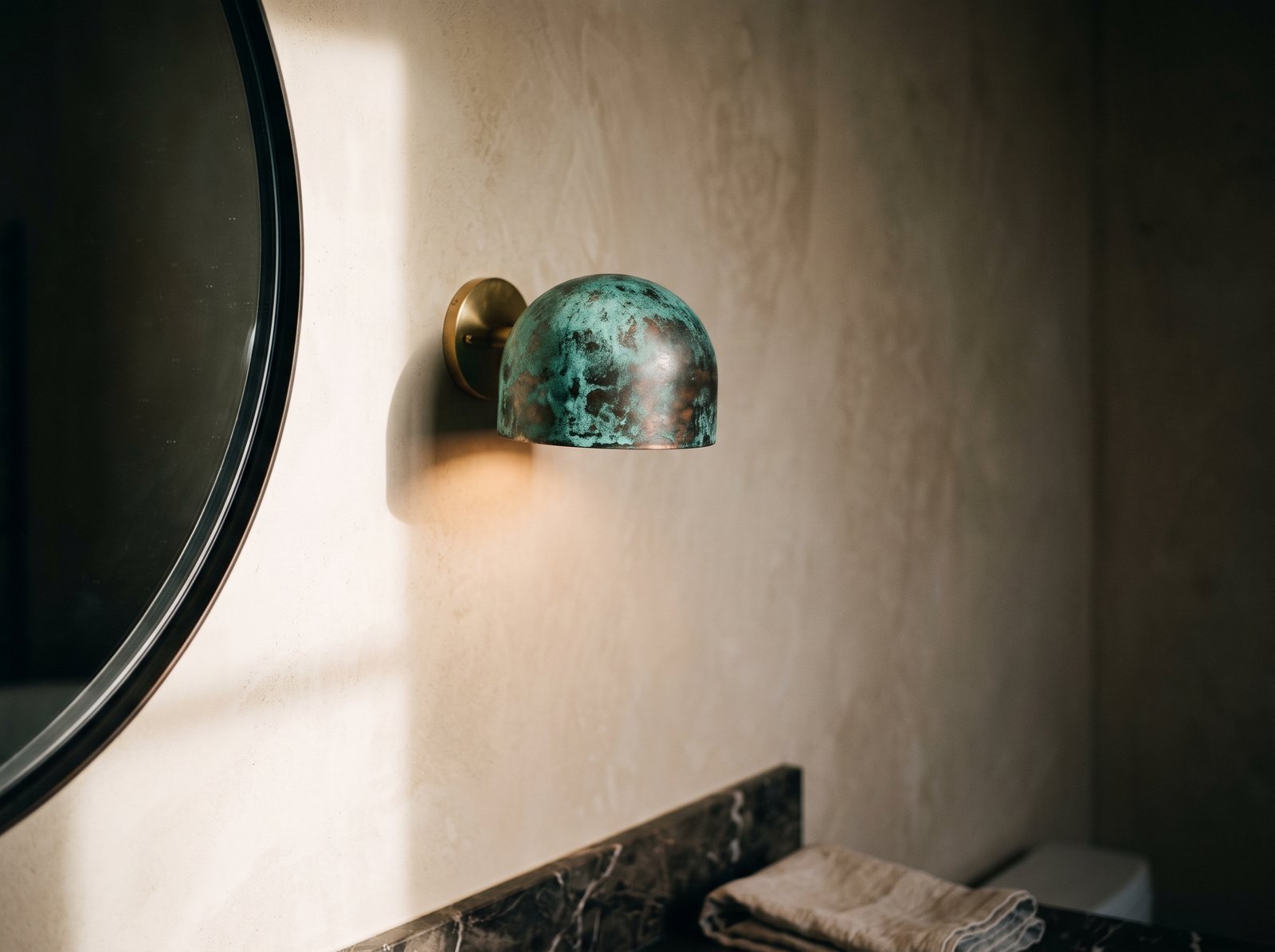
If you want the sconces to match the taps and the mirror frame, the finish question matters more than the metal. Read unlacquered vs lacquered brass before you order, and how to clean unlacquered brass for keeping them even afterwards.
What do the workshop listings tell you, and what do they leave out?
They tell you the size, the finish and the shape, and most offer several sizes. They leave out the electrics: the socket, the wiring, the safety listing and the damp rating.
What the listings say. In September 2026 we read every wall light and sconce listing at the five workshops we check: 25 in all, 15 at CopperKesh, 6 at Artihand, 3 at Zayian and 1 at Kinycraft. They start at $148 to $303, with most starting between $180 and $200, and the largest sizes reach into the hundreds. Twenty-four of the 25 give dimensions and 22 offer more than one size, which is why the height above the floor is worth settling before you choose the size. Two name a bulb socket, 1 says a bulb is included, 3 say the fixture is hardwired, none states a UL or ETL listing and none says damp or wet rated. Four mention a bathroom at all, and 14 mention outdoor use. Write to the workshop for the socket, the wiring, the backplate size and the damp rating before you pay.
Can you get a discount on a copper or brass wall sconce?
Yes at CopperKesh, which has by far the widest choice of them. In September 2026 its code took 10% off the whole store, and Zayian was offering free worldwide express shipping on its wall lights.
We put every code through a real checkout before it goes on the site. Ten percent off the $189 brass double wall light is $18.90, and off a $200 hammered copper sconce it is $20, which is roughly what a pair of junction boxes costs. Codes expire, so check the date each one was last tested on the CopperKesh and Zayian store pages, and read how we verify codes.


So where do your bathroom sconces go?
Center each fixture 60 to 65 inches above the floor, 28 to 34 inches apart, a few inches clear of the mirror edge, and outside the 3 foot by 8 foot zone around the tub or shower. Settle the mirror position first, mark both heights on the wall, and get the socket, wiring and damp rating in writing before you order.
Browse lighting with the codes we have checked, or the copper pendant lights and brass pendant lights that go with them. If the mirror is still undecided, we also list unlacquered brass mirrors.
About the authors. JGD Editors are the people who check every code on JustGetDeal in a real checkout before it goes on the site, and who read the workshops’ own listings for the facts in these guides.
*Some links on JustGetDeal can earn us a commission. The price you pay is the same. Read the affiliate disclosure.*
Get new tested codes by email
One email on Friday: the codes that passed our checkout test that week, the ones we pulled, and new guides. Quiet week, short email.