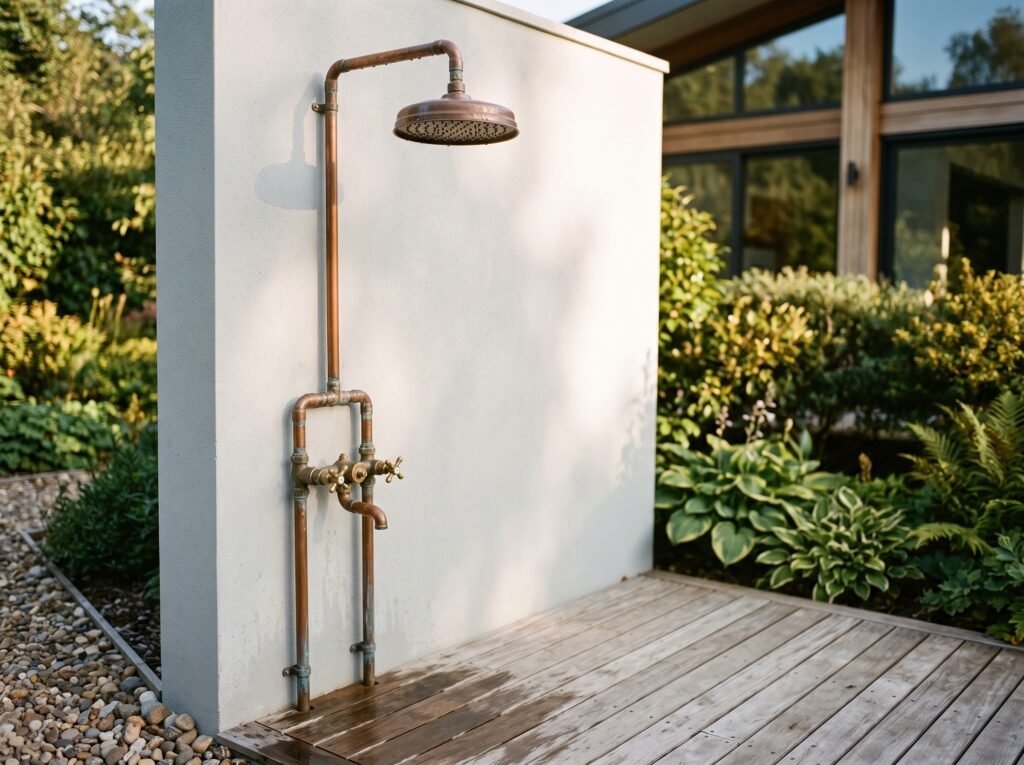
An outdoor copper shower is two different projects wearing the same name. Cold water only, running off into planting, is close to a garden tap and is often treated that way. Add hot water or a drain and it becomes plumbing, with a permit, a trap, a code compliant valve and a plan for the first freeze.
This guide covers which of the two you are building, where the water is allowed to go, the valve and backflow fittings the code asks for, how copper and brass actually behave outdoors, and what to do before winter. It also covers the supply problem: in September 2026 we read all 1,633 products at the seven workshops we check, and found one outdoor shower.
What does an outdoor copper shower actually need?
At minimum, a water supply, a valve rated for a shower, somewhere legal for the water to go, and a way to empty the pipes before the first frost. The fixture itself, the part people shop for, is the easy half.
Sonoma County’s building division splits the decision cleanly in its guidance on residential outdoor showers. A cold water only shower with no drain is the light version, and those may be allowed to run off into landscaped areas or similar areas where they will not create a nuisance. Anything more involved is treated as a plumbing fixture: showers with hot and cold water, or cold water with a drain, will require a drain connected to the building drainage (sanitary) system, the location must have a permanent roof, it must exclude rain, run off from decks, roofs or other areas, and a trap primer is required.
That is one county, and your own rules will differ. Read it as the shape of the question rather than the answer: hot water and a drain move you from garden fitting to plumbing work, with the inspection that follows.
Here is the whole planning job in one place:
| Decision | The number or rule | Source |
|---|---|---|
| Cold water, no drain | Often allowed to run off into landscaping | Permit Sonoma |
| Hot water, or any drain | Drain to the sanitary system, permanent roof, trap primer | Permit Sonoma |
| Shower valve type | Balanced pressure, thermostatic, or both, to ASSE 1016 | Plumbing code |
| Maximum valve setting | 120°F, 49°C | Plumbing code |
| Hose connection | Nonremovable vacuum breaker or backflow preventer | Plumbing code |
| Vacuum breaker height | At least 6 in above the highest point of use | Plumbing code |
| Cold climates | Listed self draining frost proof hose bibb with integral backflow protection | Plumbing code |
| Dry well size | About 16 in beyond the shower on all sides, about 4 ft deep | Outdoor Shower Company |
| French drain fall | 1 in for every 8 ft of length | Outdoor Shower Company |
| Soil test | Water standing 5 minutes or more means do not soak away | Outdoor Shower Company |
Do you need a permit and a drain?
If there is hot water, assume yes to both until your building department says otherwise. A cold water rinse that soaks into a planted bed is the one version that often escapes the rules, and even that has to avoid creating a nuisance for a neighbour.
The reason is what the water carries. Shower water is grey water, so a drain is not only about puddles, it decides whether the discharge is handled as waste. Sonoma’s sheet applies the same rule to outdoor sinks, which will require a drain connected to the building drainage (sanitary) system once they have hot water.
Ask your building department three questions before you buy anything: can the shower discharge to ground here, is a permit needed for a hot supply, and does the fixture need to sit under a permanent roof. Those three answers decide the budget, not the price of the shower.
Where does the water go?
Into planting, into a dry well, into a French drain, or into the sewer. The choice is set by your soil and your local rules, and the soil test takes ten minutes.
The Outdoor Shower Company, which sells nothing but these, describes the options plainly and gives sizes worth writing down. A dry well is a layer of gravel through which the wastewater must percolate and filter, sized to an area that extends about 16 inches beyond the shower perimeter on all sides to a depth of about 4 feet. A French drain is a trench dug with a slope in the direction you want the water to go, at a slope of one inch for every eight feet in length.
The test: pour water where the shower will stand and watch. If it sits on the surface for five minutes or more, that ground will not take shower water, and you are looking at a pan and a pipe rather than a soakaway. Clay does this, and so does a lawn over compacted builder’s fill.
What valve does an outdoor shower need?
The same kind an indoor shower needs. A plain pair of taps mixing at the head is not a shower valve, and the code is specific about the difference.
The requirement is that individual shower and tub-shower combination valves shall be balanced-pressure, thermostatic or combination balanced-pressure/thermostatic valves meeting ASSE 1016 or ASME A112.18.1, and that they are equipped with a means to limit the maximum setting of the valve to 120°F (49°C). That is scald protection, and it matters more outdoors, where a sun warmed hose can deliver a surprise on its own.
If you are feeding the shower from a garden tap rather than a plumbed line, the backflow rule applies too. Outlets with hose attachments shall be protected by a nonremovable hose bibb backflow preventer, a nonremovable hose bibb vacuum breaker or by an atmospheric vacuum breaker, the breaker sits not less than 6 inches (152 mm) above the highest point of usage, and in cold regions a listed self-draining frost-proof hose bibb with an integral backflow preventer or vacuum breaker shall be used. Without it, water standing in a shower hose can be pulled back into the drinking supply.
Will copper and brass really go green outside?
Outdoors, eventually yes, and that is the honest difference from a bathroom. Indoors these metals settle brown, but sun, rain and time push an exposed fixture further along the same road.
The Canadian Conservation Institute gives the test that matters. A healthy aged surface is stable, and stable patinas on these metals are generally coherent, adherent, and smooth. The version to watch for is loose: active corrosion of copper and copper alloys is characterized by the rapid development of a light green powder erupting in spots over the surface, and it needs damp, since bronze disease occurs where the RH is high (i.e. 55% and above).
For a garden shower that is a feature, not a fault, as long as the surface stays smooth and the moving parts are not seizing. We go through the stages, the timings and what slows them in our guide to whether unlacquered brass tarnishes. The short version outdoors: expect brown within months and a greener cast over years, and choose the metal you want to watch change.
How do you winterize an outdoor shower?
Empty it before the first frost, and take the small parts indoors. Water left in a valve body freezes, expands and splits the casting, which turns a $600 shower into a $600 ornament.
The Outdoor Shower Company is blunt that outdoor showers are susceptible to freeze damage just like all other plumbing and fixtures. Their sequence is the one to copy. Turn off the supply, and for a stop and waste valve, shut off the water by turning the valve clockwise until it won’t turn anymore, or for a ball valve, turn the handle a quarter turn so it is perpendicular to the pipe. Then remove drain caps and let water drain, use compressed air to blow excess moisture out of the pipes and valves and remove cartridges, and remove the cartridges, shower heads, valves, hand sprays, foot showers, and hose bibbs and store them indoors for the winter.
One practical note for handmade fixtures: ask the workshop whether the cartridge is a standard size before you buy. A part you can replace locally is the difference between a spring repair and a shipping wait from another continent.
What do the workshop listings tell you?
Very little, because almost nobody in this niche makes one. Reading all 1,633 products at seven small copper and brass workshops in September 2026, we found a single outdoor shower listing, against 46 indoor shower systems.
Those 46 are not generous with detail either. Seventeen name the valve type, 14 say they suit US plumbing, 5 give a flow rate and 4 state a thread size. Prices run from $440 to $1,300, median $640.
The exception is worth the mention because it does the opposite. The House of Brass lists an outdoor copper shower system with an 8 inch rain head at $471.50 and states the things that decide whether it can be fitted: a 15 inch reach, an 8 inch spread, and a thread size of half an inch, described as standard for US, Canada and Australia plumbing. It also says the finish is a living one that develops a patina outdoors, which is the honest description. Their unlacquered brass outdoor shower with a handheld at $645 ships complete with an exposed mixer and a five year warranty.
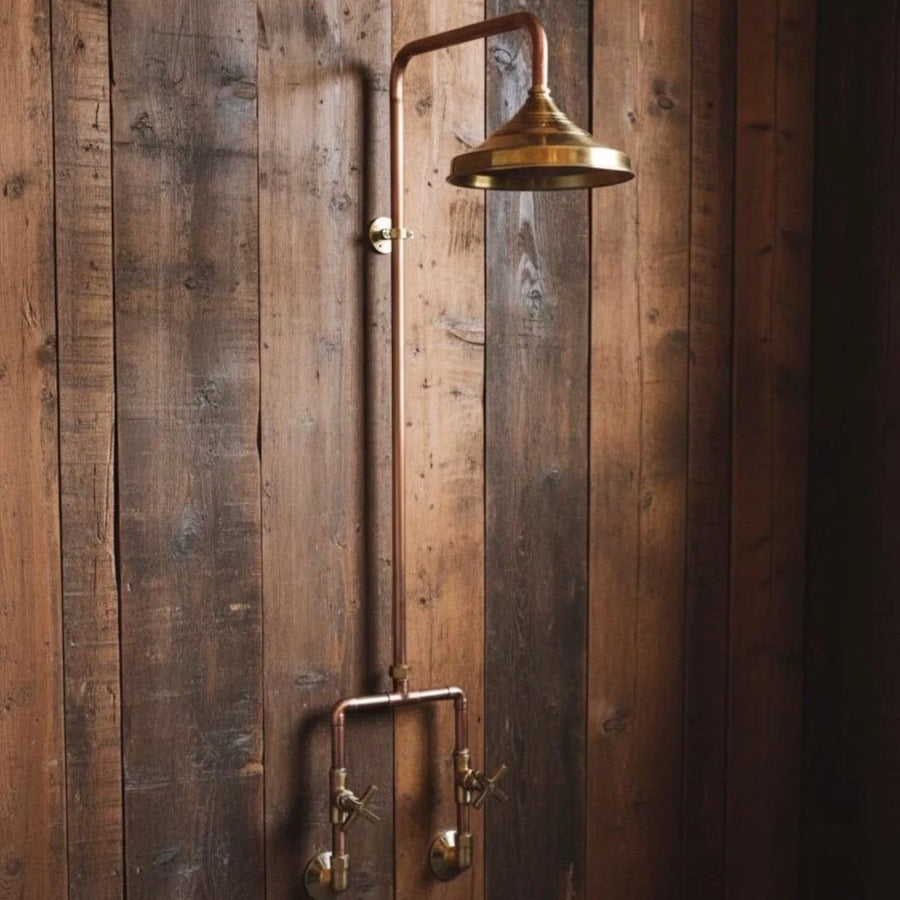
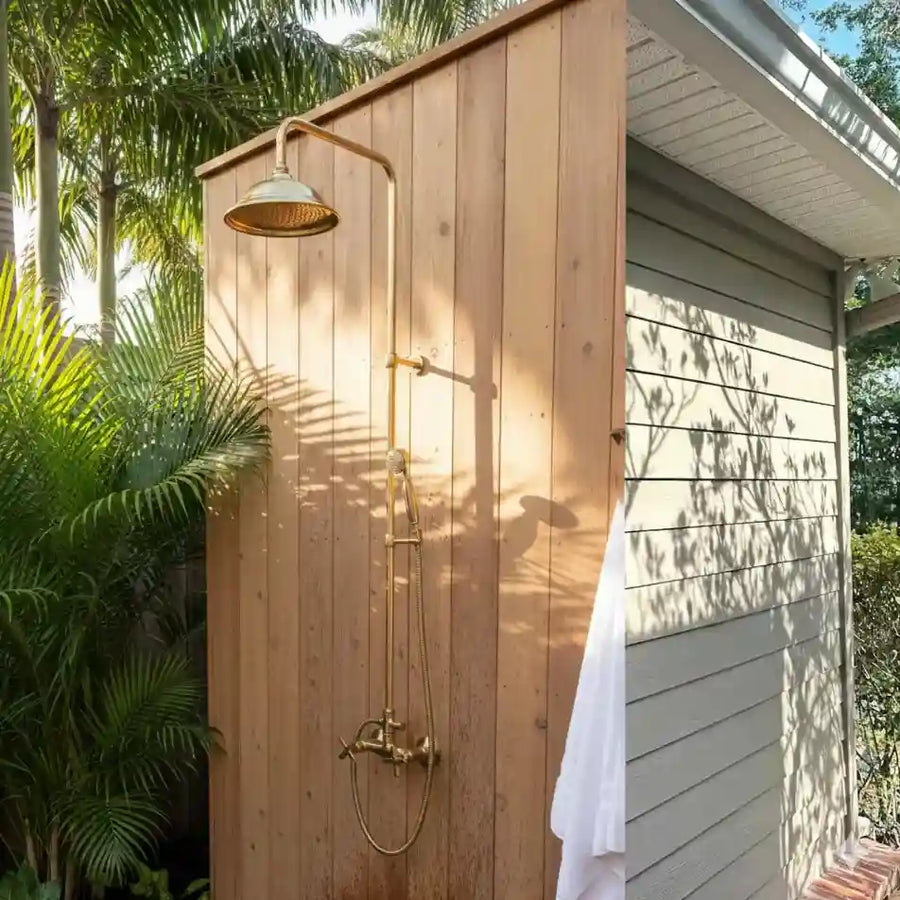
If you are buying elsewhere, ask for those same four things in writing before you pay: thread size, reach, whether a valve is included, and whether the cartridge is a standard part. Our full read of the catalogues, with the method and the dataset, is in the September 2026 listings study.
Can you get a discount on an outdoor shower?
Not at the moment, and we would rather say so than pad the page. None of the stores with a working code in September 2026 sells an outdoor shower, so there is nothing tested to offer you.
What we do have is the indoor range, where the codes work: exposed and concealed systems are covered in our guide to brass shower systems, and every code is tested in a real basket first, which is set out in how we verify codes. If an outdoor shower code appears, it will show on the outdoor copper showers page with the date it was last checked.
So, what should you settle before you buy?
Decide first whether this is a cold rinse into planting or a hot shower with a drain, because that single choice brings the permit, the roof, the trap and the inspection with it. Then sort the water: test the ground, size a dry well at about 16 inches beyond the shower and 4 feet deep, or plan the pipe run instead.
After that the fixture is simple. Buy a shower valve rather than two taps, put a vacuum breaker on any hose connection, and write the winter date in your calendar now, while you still like the idea. Browse outdoor copper showers and the wider bathtubs and showers range, and read does unlacquered brass tarnish before you decide which metal you want weathering in your garden.
Get new tested codes by email
One email on Friday: the codes that passed our checkout test that week, the ones we pulled, and new guides. Quiet week, short email.