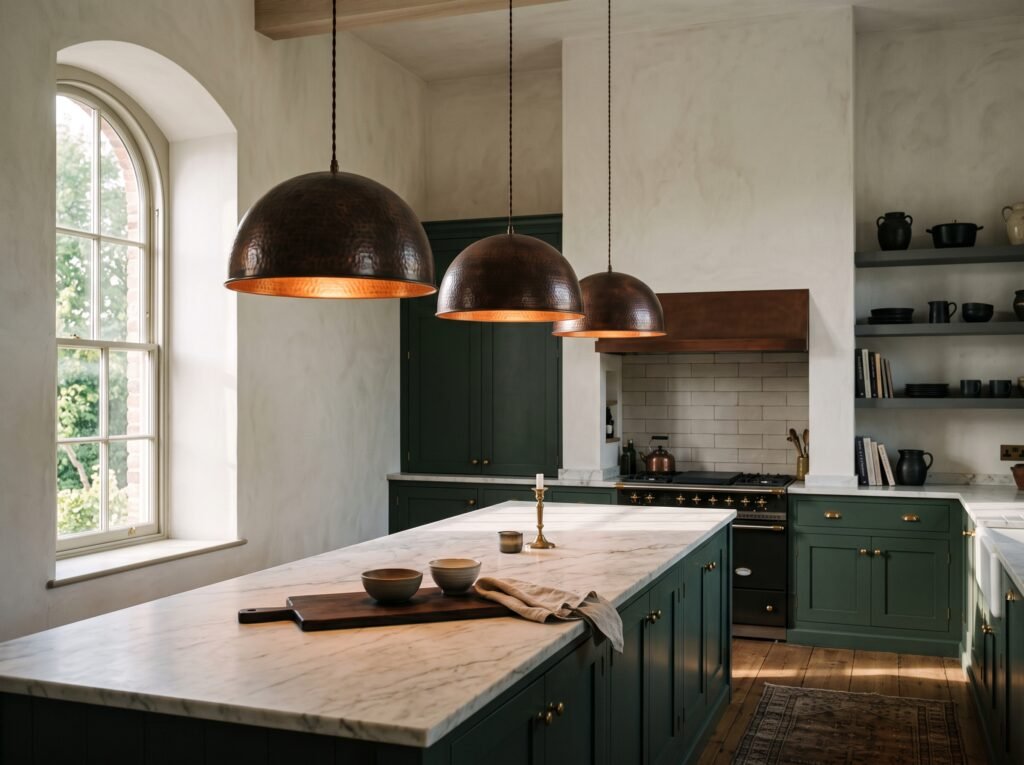
Hang copper pendant lights so the bottom of each shade sits 30 to 36 inches above the island counter, use two on a smaller island and three on a longer one, and space them evenly with the end lights well in from the edges. Before you order, check the socket, the voltage and the safety listing, because the listings for handmade pendants rarely state them.
This guide covers copper pendant lights over a kitchen island one decision at a time: height, number, spacing, size, cord length, finish, and whether the light will suit US wiring. The layout rules come from lighting makers, and in September 2026 we read every pendant listing at three workshops, 141 in all, to see what they tell buyers.
How high should pendant lights hang over a kitchen island?
Leave 30 to 36 inches between the bottom of the pendant and the top of the counter. Go toward 36 inches under a tall ceiling and toward 30 under a low one.
Visual Comfort, the lighting maker, sets the standard as 30 to 36 inches between the bottom of the fixture and the top of the counter, and says taller ceilings suit a height close to the 36-inch maximum. Schoolhouse gives the same range, at least 30 to 36 inches of clearance between the surface and the bottom of the fixture, and Kichler’s rule of thumb is the bottom 36 inches from the countertop.
Measure from the counter, not the floor, and to the lowest point of the shade. Then stand where you usually stand and check you can see the person across the island under the lights.
How many pendant lights does a kitchen island need?
Two pendants suit most smaller islands and three suit longer ones. A short island of 4 to 5 feet can also take a single large pendant.
Visual Comfort says smaller islands often do best with two pendants, while larger islands typically call for three. Schoolhouse puts numbers on it: small islands (4 to 5 feet long) usually do well with one large or two medium pendants, while larger islands can handle two larger or three medium pendants. Kichler adds that pendants look best in odd numbers, though two larger pendants can work over a larger island.
Copper is easy to buy in matching numbers. Of the 141 pendant listings we read, 18 are sold as matched sets of two or three.


How far apart should pendant lights be over an island?
Space the centers evenly, about 24 inches apart and a little more for larger shades, and keep the end lights at least 6 inches from each end of the island. For two pendants, a simple rule is to hang each one a quarter of the island’s length in from its end.
Kichler asks for between 12 and 24 inches between the widest points of mini pendants, a distance that grows with the pendant diameter, and says to place pendants at least 6 inches or more from each end of the island. Schoolhouse recommends spacing them about 24 inches apart. For two pendants, Visual Comfort’s method is to divide the island’s length by four to get each pendant’s distance from its end.
Here is how those rules work out on real islands, measured from the left end:
| Island length | Pendants | Hang the centers at | Space between centers |
|---|---|---|---|
| 5 feet (60 in) | 1 large | 30 in, the middle | One light, so none |
| 5 feet (60 in) | 2 medium | 15 in and 45 in | 30 in |
| 7 feet (84 in) | 2 | 21 in and 63 in | 42 in |
| 8 feet (96 in) | 3 | 24, 48 and 72 in | 24 in |
| 10 feet (120 in) | 3 larger | 30, 60 and 90 in | 30 in |
Check each row against your shades. Three 12-inch pendants 24 inches apart leave 12 inches of air between their edges, inside Kichler’s range; three 16-inch shades at the same spacing leave only 8, so spread them further or choose smaller ones. Mark the positions on the ceiling with painter’s tape before the electrician arrives.
What size copper pendant suits your island?
Pick the shade diameter after the number and spacing, so the gaps between lights stay open. Check your shade size against the spacing table above, and let a single pendant over a short island be the large one.
Most copper pendants at the workshops we list come in several shade sizes. Many CopperKesh and Zayian listings offer diameters from about 8 inches to 24 inches in the same design, so you can keep the style and change the size. Narrow shades are sold too: CopperKesh’s set of three verdigris pendants comes in diameters from 3.9 to 7.8 inches, which suits a long island where you want more lights without a crowded look.
Height of the shade matters as well as width. A tall cylinder hangs lower for the same cord length, so check the listed height of the shade when you work out the cord.

How long does the cord need to be?
Work it out from the ceiling height, the counter height and the height of the shade, then ask the workshop for that length. Most handmade pendants can be made with a longer cord if you ask before ordering.
As a worked example, take a 9-foot ceiling (108 inches) over a counter 36 inches high, with pendants hung 33 inches above the counter. The bottom of each shade sits 69 inches from the floor, 39 inches below the ceiling. Take off the height of the shade, say 12 inches, and you need about 27 inches from the ceiling to the top of the shade.
The listings help only some of the time. Of the 141 we read, 24 state a cord, chain or rod length and 13 say the height is adjustable. CopperKesh’s set of three states that the cord length is 3 feet, and a Zayian island pendant asks buyers directly: need a different size or cord length? Just let us know before ordering.
Will a handmade copper pendant work in a US kitchen?
It can, but ask three things before you order: which bulb socket it has, whether it is made for US household voltage, and whether it carries a safety listing. The US electrical code requires light fixtures to be listed, and none of the listings we read says so.
What the listings say. In September 2026 we read every pendant light listing at Zayian, CopperKesh and Artihand: 141 in all once listings sold at two stores were counted once, 129 of them copper, priced from $150 to $1,000 with a middle price of $199. Not one states a US voltage of 110 to 120 volts, and not one mentions a UL, ETL or similar safety listing. Only 3 name the E26 socket used in the US, while 6 name E27, the European socket. 25 say a bulb is included.
The listing question matters because of the code. EC&M, the electrical trade magazine, summarizes NEC Article 410 this way: all luminaires, lampholders, and retrofit kits are required to be “listed”, meaning included in a list published by an organization acceptable to the local authority. Ask the workshop whether the pendant has such a listing, and ask your electrician before ordering whether your inspector will accept it without one.
The socket matters less than the voltage. Zangra, a lamp maker, explains that E26 is used in the United States and E27 in Europe, that a US E26 will fit in a European E27 base, and E27 will fit in a E26 base, and that for bulbs the only difference is the voltage. Buy bulbs certified for use in the US, and have an electrician install the pendant.
Which copper finish should you choose for an island?
Choose raw or hammered copper if you want the warm metal to show and to darken slowly with time, and a patina finish if you want the green or dark look from day one. Patina finishes are made in the workshop, and they are the most common choice in the listings.
Of the 129 copper pendants we read, 57 have “patina” in the name, 36 “green”, 32 “oxidized” and 17 “hammered”. Zayian describes one of its island pendants as aged using fire, a traditional technique, which is how much of that color is made. A plain copper shade darkens with air and handling in the same way a copper sink does, which our guide on whether a copper sink is a good idea explains. Inside, many shades are left bright, so the light that falls on the counter comes out warm.
Dust the shades with the power off and the bulb cool. The light fixtures section of how to clean unlacquered brass applies to copper shades too.


Can you get a discount on copper pendant lights?
Yes, at two of the workshops we list. In September 2026 CopperKesh, whose largest range is lighting, had a working code for 10% off its whole store, and Zayian was offering free worldwide express shipping.
We put every code through a real checkout before listing it. The CopperKesh code took 10% off a single $250 pendant with nothing else in the basket, so there was no minimum to reach first. On its set of three verdigris pendants, the same 10% comes off every light at once. Codes expire, so check the date each one was last tested on the CopperKesh and Zayian store pages, and read how we verify codes.
So, how should you light your island with copper pendants?
Hang the shades 30 to 36 inches above the counter, use two or three depending on the island’s length, and space them evenly with at least 6 inches of clearance at the ends. Then get the socket, the voltage, the listing and the cord length confirmed in writing before you order.
Browse copper pendant lights and brass pendant lights, or the whole lighting page, with the codes we have checked on each.
About the authors. JGD Editors are the people who check every code on JustGetDeal in a real checkout before it goes on the site, and who read the workshops’ own listings for the facts in these guides.
Some links on JustGetDeal can earn us a commission. The price you pay is the same. Read the affiliate disclosure.
Get new tested codes by email
One email on Friday: the codes that passed our checkout test that week, the ones we pulled, and new guides. Quiet week, short email.