To clean unlacquered brass, wipe it with a soft cloth, wash it with water and a little mild soap when it needs more, and dry it straight away. Polish it only when you want the bright color back, because polish takes the patina off along with the grime.
This guide covers how to clean unlacquered brass on every kind of piece the workshops we list make: faucets and pot fillers, shower systems, towel bars and hooks, shelves, pot rails, curtain rods and light fixtures. The care advice comes from fixture makers’ own instructions, and in September 2026 we read every unlacquered brass listing at five workshops to see what they tell buyers.
What is unlacquered brass, and why does it change color?
Unlacquered brass is solid brass with no clear protective coat, so the metal itself meets the air, the water and your hands. That is why it darkens and develops a patina over time, while lacquered brass keeps its color until the coating wears.
Perrin & Rowe, a maker of unlacquered brass faucets, describes it as a “living finish” whose patina varies with exposure to sun, touch, oxygen and airborne particles. Everyday things in a kitchen or bathroom speed that up. The faucet maker Watermark warns that acidic foods like lemons and tomatoes, and bathroom staples like toothpaste, can increase the rate of tarnishing.
The change is uneven, and that is normal. The parts that get touched, splashed or handled most move fastest, so a faucet handle or a robe hook darkens before the wall plate behind it.
How can you tell if your brass is unlacquered?
Check the listing first: pieces sold as unlacquered say so, while brass described as polished, satin or brushed is usually lacquered. On a piece you already own, a surface that has darkened over the months is very likely unlacquered, because a lacquer coat stops the patina while it lasts.
Forge Hardware Studio, a hardware seller, notes that most items listed as polished brass, satin brass or brushed brass are generally lacquered, and that its lacquered hardware will not patina because of that clear top coat.
It matters before you reach for a polish. Plank Hardware warns that on lacquered brass, metal polishes such as Brasso will strip or cloud the protective coating and leave an uneven surface that is hard to repair.
Check one more thing: whether the piece is solid brass at all. A magnet helps. As the antiques seller Tickled Pink Finds explains, brass is not magnetic but steel is, so a magnet that sticks means brass plating over steel. A magnet that does not stick is not proof, because some plating sits on zinc alloy, which is not magnetic either. Go gently with polish on anything plated, since polishing wears away a little metal each time.
How do you clean unlacquered brass day to day?
Wipe it with a soft, dry cloth when you notice fingerprints or water, and wash it with warm water and a little mild liquid soap when it needs more. Then dry it, because water left to dry on brass leaves spots.
Perrin & Rowe’s instructions are to clean with liquid soap and water and pat dry after use to avoid hard water spots. Newport Brass asks owners to wipe the fixture down with a soft cloth after each use to prevent mineral build-up and water spotting.
Makers do not all agree about soap. Newport Brass is the most cautious and says that on its unlacquered finishes soaps, acidic fluids and astringent cleaners can damage the finish, while Perrin & Rowe and Watermark both allow a mild soap. If the maker of your piece gives care instructions, follow theirs.
What the workshops tell buyers. In September 2026 we read every unlacquered brass listing at Zayian, CopperKesh, Rod & Rails, Kinycraft and Artihand: 429 in all, with listings that appear at two stores counted once. 242 of them say the brass will darken or develop a patina. Only 46 explain how to clean it, 20 warn against abrasives or harsh cleaners, and 9 say it can be polished back to bright. Most listings tell you the finish will change and very few tell you what to do about it, so if yours is silent, use the routine in this guide or ask the workshop. Zayian’s care note on one of its brass-rimmed basins is typical of the ones that do: wipe with mild soap, water and a soft cloth, then dry, and avoid abrasive pads, metal polish, bleach and acidic cleaners.
What should you never use on unlacquered brass?
Never use abrasive pads, steel wool, scouring powder or harsh chemical cleaners on unlacquered brass, and do not let soap scum or toothpaste build up on it. Abrasives scratch the metal, and strong cleaners mark the finish unevenly.
- Abrasive pads, sponges and cloths. Newport Brass warns that unlacquered finishes have no protective coating and can easily be scratched or scuffed.
- Harsh cleaners. Newport’s list of what not to use includes ammoniated products, rubbing alcohol, bleach-based cleaners and harsh polishes.
- Build-up. The same maker says not to allow soap scum or toothpaste to build up on the product.
- Gritty polishes. The Canadian Conservation Institute cautions that some commercial polishes contain very hard particles which can scratch the softer copper alloys, and brass is one of those alloys.
- Soaking. Perrin & Rowe says not to soak a fixture in vinegar solution or let the solution sit on the finish.
How do you make unlacquered brass shiny again?
Rub on a brass polish or a gentle homemade paste with a soft cloth, rinse it off, and dry the piece completely. Do it only when you want the bright color back, because polishing removes the patina and a little of the metal with it.
Watermark suggests a brass cleaner such as Brasso to revive the original finish, wiped on with a soft cloth, rinsed with water and dried. Plank Hardware lists Brasso or Bar Keepers Friend, or a paste of lemon and baking soda, or of vinegar, salt and flour. Vinegar and lemon are acidic, which is exactly why they cut tarnish, so try any paste on a spot nobody sees first.
Polish takes metal as well as tarnish. The Canadian Conservation Institute describes polishing as an abrasive operation that removes tarnish and some surface metal, and says old polish shows up later as gray, white or green deposits in corners, so wipe every trace away. Watermark adds that most polish formulas are corrosive to some countertops, like marble or wood, so cover the counter before you polish a faucet.
How often is up to you. Watermark says a kitchen faucet can be polished twice a year or as often as once a month, depending on how much patina you want. The workshops agree it is your call: Zayian tells buyers its unlacquered brass may be polished whenever a brighter finish is preferred.
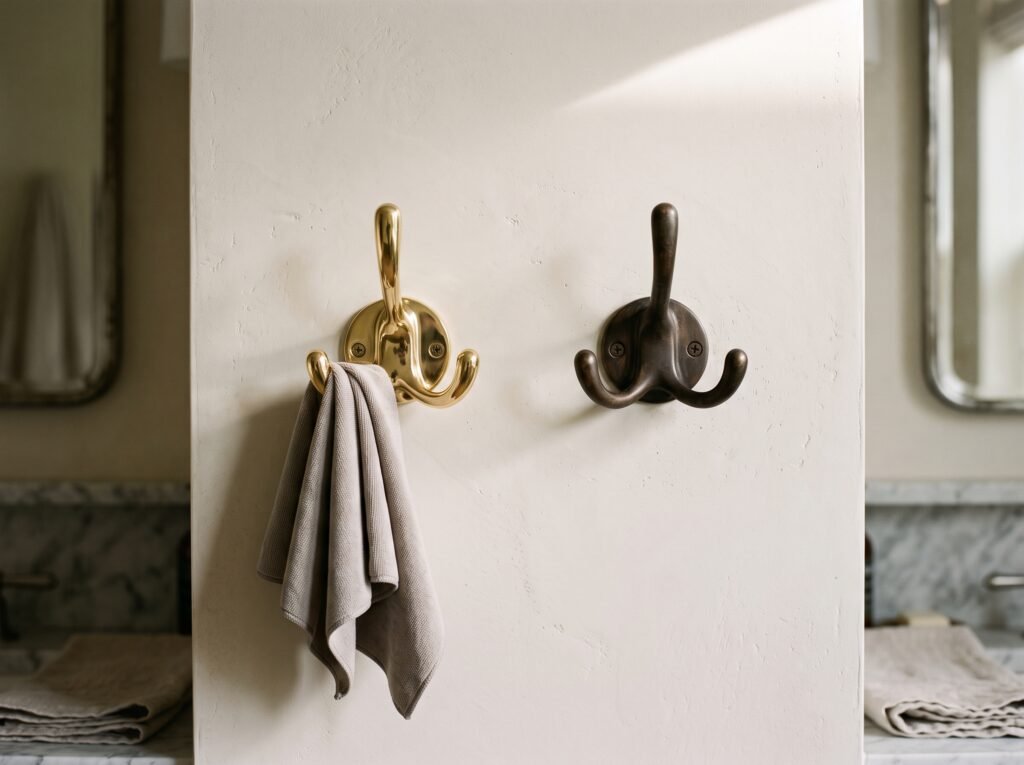
How do you keep the patina, or slow it down?
To keep the patina you have, clean only with a soft cloth and water, dry the piece, and never polish it. To slow the color change down, put a thin coat of wax on clean, dry brass and renew it now and then.
- Perrin & Rowe recommends Flitz Wax or Bruno’s Faucet Wax, patted on and patted off, not rubbed or buffed.
- Newport Brass recommends a micro-crystalline wax, with Renaissance Wax named.
- Watermark suggests carnauba car wax, which will seal the surfaces.
Wax slows the change and does not stop it. Watermark is plain about it: brass is going to change eventually, no matter what you do. If you want a finish that stays the same, lacquered brass is the better choice.
Hands matter more than people expect. Museum conservators put on clean cotton gloves to avoid transferring the moisture, salts and oils in fingers to freshly polished metal. You will not wear gloves to use a faucet, but it explains why handles and hooks darken first.
How do you clean each kind of brass piece?
The routine is the same on every piece: dust or wipe, wash gently, dry. What changes is what builds up and the one thing to be careful with.
| Piece | What builds up | Routine care | Be careful with |
|---|---|---|---|
| Faucets and pot fillers | Water spots and mineral marks | Wipe dry after use, mild soap when needed | Toothpaste, lemon and tomato; polish on a marble or wood counter |
| Shower systems and heads | Soap scum and hard water marks | Rinse and wipe dry, mild soap and water regularly | Soaking in vinegar |
| Towel bars, robe hooks, toilet paper holders | Fingerprints and damp from towels | Dry cloth, mild soap now and then | Leaving the metal wet |
| Shelves, pot rails, curtain rods | Dust, and grease near a stove | Dust with a soft cloth, mild soap for grease | Abrasive pads and degreasers |
| Light fixtures | Dust | Power off, bulb cool, then dust and wipe | Water near the socket, ammonia or alcohol cleaners |
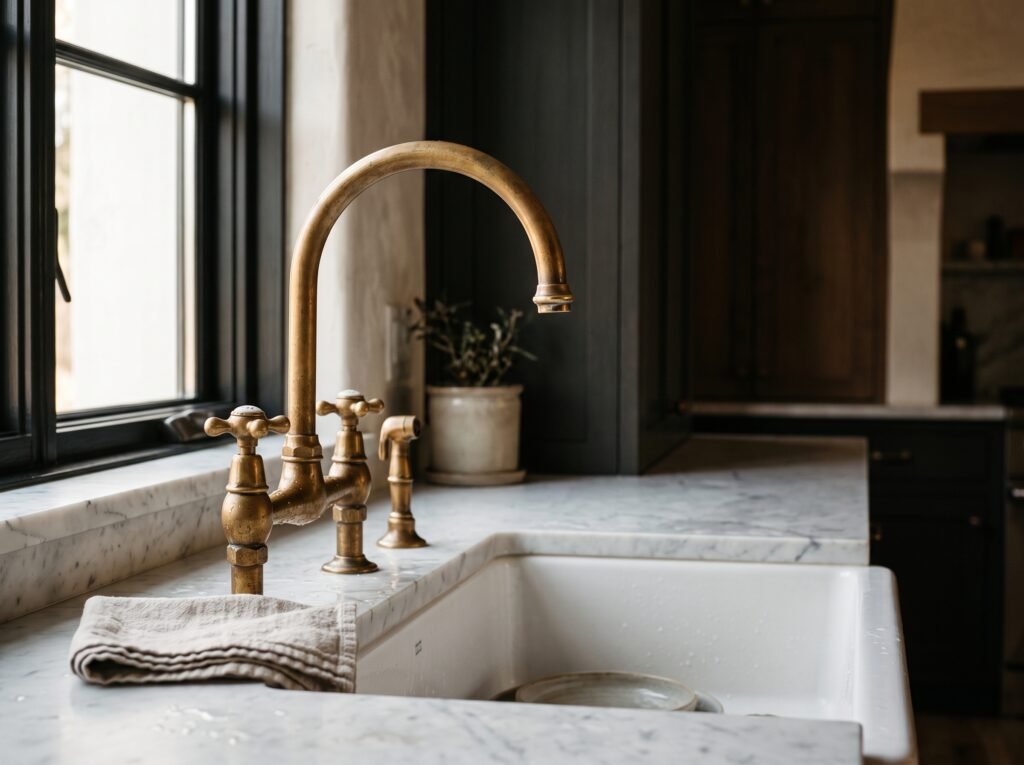
Faucets and pot fillers. These get the most water, so drying matters most. Newport Brass says not to allow water spots to dry on the fixture. Keep a small cloth by the sink and wipe the spout and handles after use.


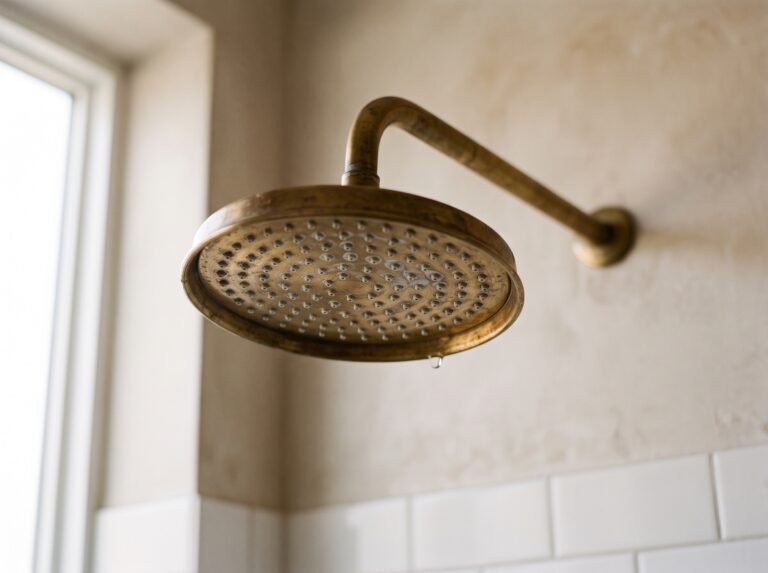
Shower systems and heads. Steam and soap leave a film that dulls brass faster than air alone. Zayian’s own note on one of its shower sets is to clean the system regularly to remove any build-up of soap scum, using a mild soap and water solution. Wipe the valve handles and the arm dry after a shower if you want the color even.


Towel bars, robe hooks and toilet paper holders. These are handled every day and often sit behind a damp towel. Plank Hardware’s advice for brass hardware is a soft, dry cloth for regular upkeep, and it lists leaving hardware wet among the things to avoid. Hang towels so they can dry, and wipe the bar when you change them.


Shelves, pot rails and curtain rods. These are touched less, so they mostly need dusting. A pot rail near the stove collects a film of grease, which comes off with warm water and a little mild soap on a soft cloth, followed by a dry one.

Light fixtures. Safety comes first. The lighting maker Pooky says to turn off the power supply and allow the bulb to fully cool down before handling a light, then dust it with a soft, lint-free cloth. It also says not to immerse brass fittings in water, and not to use cleaners containing ammonia or alcohol, and to take extra care with fittings that have a patina or an antiqued finish.

Can you get a discount on unlacquered brass pieces?
Yes, at three of the workshops we list. In September 2026 Rod & Rails and CopperKesh each had a working code for 10% off their whole store, and Zayian was offering free worldwide express shipping.
We put every code through a real checkout before listing it. The Rod & Rails code took 10% off a single $280 tub filler with nothing else in the basket, so there was no minimum to reach first, and most of that store’s catalogue is unlacquered brass: rails, shelves, hooks, pot racks, faucets and shower systems. Codes expire, so check the date each one was last tested on the Rod & Rails, CopperKesh and Zayian store pages, and read how we verify codes.
So, what is the easiest way to look after unlacquered brass?
Wipe it, wash it gently with mild soap and water when it needs it, and dry it every time. Polish only when you want it bright again, wax it if you want the color to change more slowly, and keep abrasives and harsh cleaners away from it.
If you are still choosing pieces, unlacquered brass faucets, brass towel bars and hooks and unlacquered brass cabinet hardware each have a buying guide and the codes we have checked. If copper is on your list too, read is a copper sink a good idea.
About the authors. JGD Editors are the people who check every code on JustGetDeal in a real checkout before it goes on the site, and who read the workshops’ own listings for the facts in these guides.
Some links on JustGetDeal can earn us a commission. The price you pay is the same. Read the affiliate disclosure.
Get new tested codes by email
One email on Friday: the codes that passed our checkout test that week, the ones we pulled, and new guides. Quiet week, short email.