A copper vessel sink is the one bathroom fixture that changes every other measurement around it. It sits on the counter instead of in it, so it raises the working height by the full depth of the bowl, it needs a taller faucet than the one you own, and it usually needs a drain you cannot buy in a supermarket. None of that is difficult. It is just decided before you order, not after.
The listings are very little help. We read every copper bathroom sink listing at the five workshops that sell them, 95 of them, in our September 2026 catalogue read. Sixty four give a dimension in inches. Six give the size of the drain opening. None gives a vanity height. This guide fills in the three numbers that decide whether the bowl you like will actually work: the rim height, the faucet reach and the drain.
How high should the vanity be for a copper vessel sink?
Work backwards from the rim of the bowl, never upwards from the floor. Aim to land the finished rim between 34 and 36 inches off the floor, and the vanity height follows from the depth of the bowl you chose.
The arithmetic is the whole job. One vessel sink guide puts it as plainly as it can be put: vanity height (including countertop) + vessel height = finished rim height, and for most adults a comfortable finished rim lands between 34 and 36 inches off the floor. Set the target first, then subtract.
This is where most vessel sink bathrooms go wrong, because a modern vanity is already built to the finished height of a normal basin. Put a bowl on top of a conventional 36 inch vanity and the rim lands around 41 to 42 inches, which most people find uncomfortably tall for daily use. A residential designer says the same thing with less patience: stacking a vessel on a standard cabinet results in the sink being too high for comfort for almost anyone not in the NBA.
The older, lower cabinet turns out to be the right one. Vessel sinks need to be set on top of lower countertops to get the rim of the sink to be at 35″ to 36″ above the floor, and the worked example is worth copying: a 5″ or 6″ tall sink on top of an “old-fashioned standard” vanity cabinet of about 28 1/2″ plus a 1 1/2″ thick top would set the sink rim at about 35″ or 36″ above the floor. So a cabinet plus top of roughly 29 to 30 inches is the target, not 36.

Now put the real bowls into that sum, because handmade copper is not one size. CopperKesh sells the same hammered basin in four heights, 12 Inch x 5 Inch H up to 20 Inch x 10 Inch H, and Zayian’s bucket sink runs from 13 in x 5.5 in D to 20 in x 8 in D. A 10 inch deep bowl on a 29 inch vanity gives you a 39 inch rim, which is a bar counter, not a basin. The deep bowls need a cabinet nearer 25 inches, which usually means a wall hung frame rather than a stock vanity.
Two reference points are worth holding while you decide. There is no code minimum for a domestic vanity, and the trade guideline is deliberately wide: the height of a lavatory or vanity top varies between 32″-43″ to fit the user. Where accessibility matters the number stops being advice, because the ADA standard requires that lavatories and sinks shall be installed with the front of the higher of the rim or counter surface 34 inches (865 mm) maximum above the finish floor or ground. A deep vessel makes that limit almost impossible to hit, which is a real reason to pick a shallow bowl in a family bathroom.
How tall should the faucet be, and how far should it reach?
Reach matters more than height, and the two get confused constantly. The water has to land near the middle of the bowl, so the spout has to clear the rim and then travel inwards over it.
The makers’ advice is modest. Native Trails, who have been selling copper basins for decades, say the faucet should be a few inches above the rim of the sink, but not much higher, and that the faucet must reach far enough that the water stream hits the bottom of the basin. They also ask you to think about the distance the spout reaches into the bowl and where the water falls and hits, which is the measurement nobody takes.
You will also see a much bigger number quoted, and it is a different measurement. Plenty of guides say faucets for vessel sinks should be at least 10 to 12 inches above the rim of the sink, which is really the overall height of a vessel faucet measured from the counter, not the gap above the rim. Read any figure over about 8 inches as total faucet height and you will buy the right tap. The aim in both cases is the same: a spout tall enough to arc over the bowl with the stream falling at or near the drain to minimize splashing.
Splashing is not a small complaint with copper, because these bowls are wide and shallow. The smallest size of CopperKesh’s hammered basin is 12 Inch x 5 Inch H, and the usable depth of water inside a 5 inch bowl with a curved base is nearer 3. Put a 12 inch tall faucet over that and the water has a long way to fall onto a hard, hammered surface.
Flow rate is the lever most people forget. Federal law has allowed up to 2.2 gpm at 60 psi since 1998, while a faucet earning the WaterSense label must have a flow rate that does not exceed 1.5 gallons per minute (gpm) and still deliver no less than 0.8 gpm at a pressure of 20 psi at the inlet when water is flowing. A 1.2 or 1.5 gpm aerator in a shallow copper bowl is the difference between a basin and a puddle, and it costs nothing at the point of buying the tap.
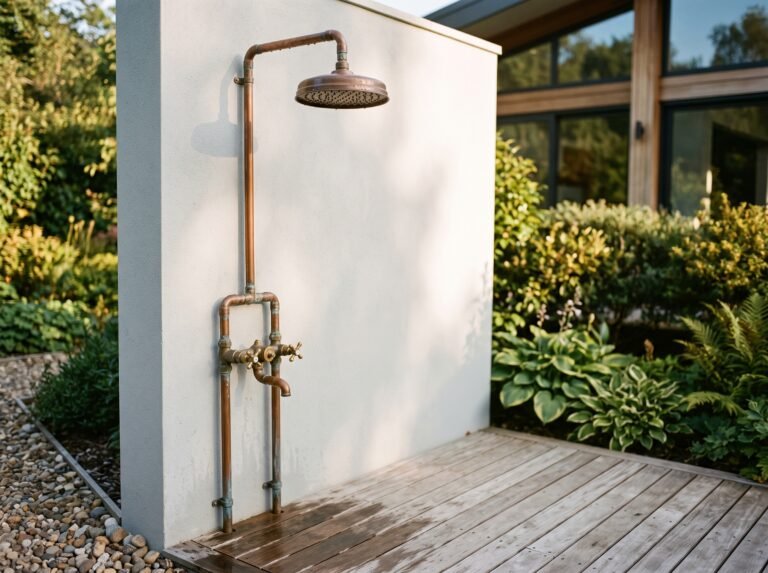
A wall mounted faucet solves the geometry rather than fighting it. It takes the tap off the counter entirely, so the bowl can be deep without the spout having to be tall, and the reach is set by where you place the outlet. That is why so many workshop photographs of copper basins show a wall tap above them.
Does a copper vessel sink need a special drain?
Usually yes, on two counts. Most copper vessel sinks have a larger drain opening than a standard basin, and almost none of them has an overflow, so the drain you buy has to match both.
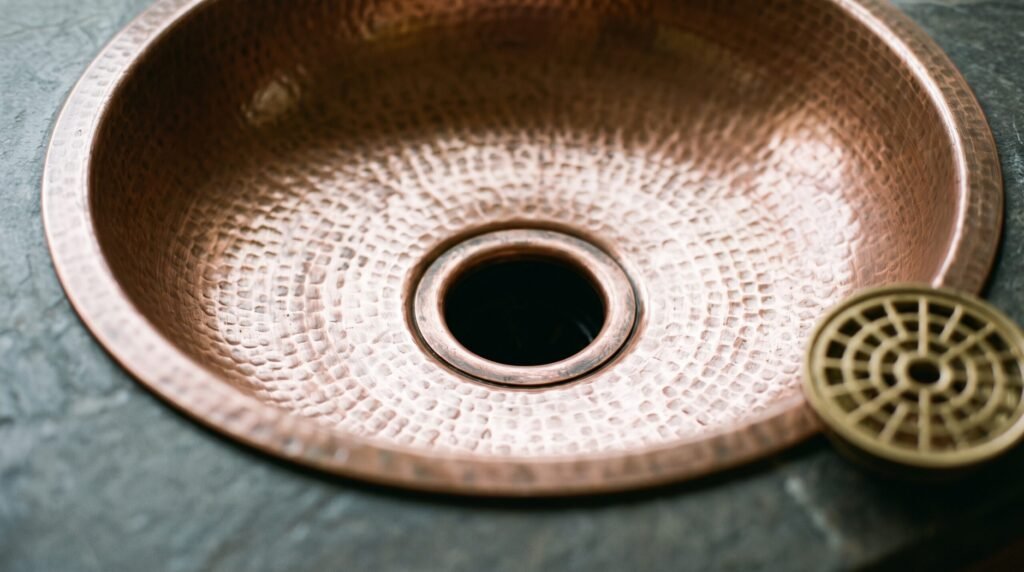
Start with the opening. In ordinary bathroom basins the most common size for the sink drain hole is 1 1/4 inches, although some cite 1 1/2 inches as the standard, and there is in fact no standard size for bathroom sink drain holes. Handmade metal basins sit at the larger end. Native Trails’ Laguna, a 16 inch round copper vessel, is specified with a 1.5″ drain opening and takes their DR120, DR130, or DR150 drains. A 1 1/4 inch pop up bought for a ceramic basin will drop straight through that hole.
The parts exist, and they are labelled by the opening they fit rather than by the pipe. A 1.5 inch grid drain lists an upper flange: 2.25″ with a down pipe width: 1.25″, which is the point that confuses people: the flange seals the wide hole in the sink while the tailpiece stays the normal 1 1/4 inch size your waste pipe expects.
Then the overflow, which is simpler than it sounds and gets ordered wrong all the time. For bathroom vessel sink you will need a drain with “No Overflow”, because a drain with an overflow has a hole drilled in the side of its body that only works if the sink has a matching channel. If your sink does not feature an overflow hole it needs to be paired with a drain without overflow. Fit the wrong one and water leaks into the cabinet from a hole that opens into nothing.
Within the no overflow family you get a choice of behaviour. A grid drain is always open and cannot be blocked, which suits a basin you only wash your hands in. An umbrella or push button drain closes, which you want if anyone in the house fills the bowl. Since the bowl has no overflow, a closing drain also means an unattended tap will put water on your floor, so grid drains are the safer choice in a children’s bathroom.
Our own reading of the listings says this is the question to ask before you pay. Of the 95 copper bathroom sink listings, 6 state the size of the drain opening and 13 say whether a drain is included at all. Some do include one: CopperKesh’s hammered basin says plainly that a brass drain is included, which is worth about $40 and removes the guesswork completely.
Will the P-trap still fit underneath?
This is the part that turns a weekend job into a plumber’s visit. A vessel sits higher than the basin it replaced, so the waste leaves the bowl higher up, and the P-trap below it can end up squeezed against the stub-out coming out of the wall.
The trade convention is to rough in the bathroom sink drain 18 to 20 inches above the finished floor, with the hot and cold supply lines 2 to 3 inches higher, around 20 to 22 inches and spaced 4 inches to each side of the sink’s centerline. Other trades work higher, quoting approximately 20 to 24 inches from the floor, so measure your own wall rather than trusting either range.
The rule for a vessel is the opposite of what people assume. A deep vessel basin sits higher on the vanity, so its drain and supply stub-outs need to land lower in the same range to leave room for the P-trap underneath. If the wall is already plumbed near the top of that range and you add a 10 inch bowl, the trap has nowhere to sit.
There is a cheap fix and an expensive one. The cheap one is an extension: use an extension tailpiece to increase its height for a short sink drain, measure the difference and buy that length. The expensive one is opening the wall to lower the stub-out, which is exactly the decision you want to reach before the sink is in the hallway rather than after.
How is a copper vessel sink fixed to the counter?
Silicone, and nothing else in most cases. The bowl is held down by a continuous bead between its base and the counter, and the drain assembly clamps through the middle.
The counter needs one hole, and it is bigger than you expect. Guides for above counter basins call for a 4″ hole saw to cut the opening rather than simply drilling a 1 1/2-inch hole for the drain as you would for a drop in, because the drain body and the tailpiece both have to pass through and be reachable from below.
Then the sealing, which is also the fixing. Use a caulking gun to run a bead of silicone caulk around the drain opening in the countertop and on all parts of the sink that will be in contact with the countertop, then apply a bead of silicone to the base of the sink and set it down. Give it time before you load it: allow the sealant to set for 30 – 60 minutes before installing the drain, and leave the water off overnight if you can.
The drain goes in the same way as any basin drain, with the rubber washer on the drain body above the counter and the nut below, and the waste connects with a 2 x 1 1/2-inch trap adapter if your pipe is the larger size. Two points are specific to handmade copper. A hammered bowl is rarely perfectly flat underneath, so check it does not rock on the counter before the silicone goes anywhere, and use a neutral cure silicone rather than an acidic one so nothing reacts with the metal. Only 5 of the 95 listings we read mention silicone or a mounting ring at all, so assume you are buying those separately.
Where on the vanity should the bowl sit?
Centred side to side, and further forward than feels natural. A vessel is a solid object you lean over, so the space in front of it matters more than the space behind.
Depth sets the limits. Standard vanity countertops are generally 22 inches deep, and the planning rule is that two inches are always left between the front edge of the sink in the front of the vanity, with whatever is left over going behind the bowl for the tap. A 16 inch bowl on a 22 inch top therefore sits 2 inches from the front and leaves 4 inches at the back, which is just enough for a deck mounted vessel faucet and a reason to consider a wall tap if your top is shallower.
Sideways, give it room. The sink’s edge should be at least four inches from walls and large objects, such as cabinets, and the NKBA asks for a centreline at least 20 inches from the wall. A round copper bowl needs this more than a rectangular ceramic one, because you cannot push a circle into a corner.
If you are drilling the top for the tap, the hole is standardised even when the sink is not. A standard sink faucet hole has a diameter of 1 3/8 inches, but because not all faucets are the same, some will require a 1 1/2-inch hole. Drill the smaller one first and open it up only if the tap demands it.
What thickness of copper should you look for?
Sixteen gauge for a bathroom vessel, and do not pay extra for fourteen. A basin never takes the punishment a kitchen sink takes, and the extra metal mostly adds weight and cost.
The numbers behind the words are small. Sixteen gauge copper is about 0.0508 in (1.29 mm), roughly the thickness of a credit card and a half, and one maker describes their range as 16 gauge copper or premium 14 gauge, which is 33% thicker. Because the lower the gauge number, the thicker and more durable the sink is, the useful advice is the floor rather than the ceiling: any sink with a gauge higher than 18 may dent easily and should be avoided.
Sixteen is what the established makers use on vessels. The Native Trails Laguna is built from 16-gauge copper for long-lasting beauty, and 22 of the 95 handmade listings we read name a gauge or a thickness, almost all of them 16. One workshop states it in the listing text itself, describing a bucket sink crafted from high-quality, 16-gauge pure copper for durability and long-lasting use. That sentence is worth more than any photograph, and 73 listings do not contain anything like it.
Weight is the gap worth closing yourself, and it is the worst answered question of all: 1 listing in 95 gives a weight. A 20 inch copper bowl in 16 gauge is heavy enough to matter if it is going on a floating vanity or a thin stone top, so ask for the shipping weight and give the number to whoever is fixing the vanity to the wall. A thicker 14 gauge version of the same bowl is heavier again, which is a second reason to stay at 16 for a bathroom.
What will the copper look like after a year of daily use?
Darker, and unevenly so. That is the finish behaving correctly rather than failing, and a bathroom basin changes faster than a kitchen sink because it meets soap and hands every day.
Unlacquered copper is sold as a living surface. A copper finish is a “living finish” and never stops changing color (with the exception of copper that has been lacquered), and it responds to what you put in it: copper reacts to acidic foods, very salty water from ice cream making and certain chemicals. In a bathroom that means toothpaste, acidic cleaners and anything containing bleach will lighten a patch, which then darkens back over weeks.
The care is almost nothing. Native Trails ask you to simply rinse with mild soap and water to maintain its living finish, and if you want to slow the change, wax rather than polish: applied every few weeks, the wax will provide a barrier between the copper and the environment and will help protect the copper finish. Our own guide on how to clean and care for a copper sink covers the products to keep away from it, and is a copper sink a good idea is the honest version of the trade off.
There is one property of copper that is genuinely useful in a bathroom rather than decorative. Laboratory testing behind the EPA registration of copper alloys shows that, when cleaned regularly, antimicrobial copper surfaces kill greater than 99.9% of the following bacteria within 2 hours of exposure, including MRSA and E. coli. Read the caveat with it, because it is part of the registration: copper surfaces are a supplement to and not a substitute for standard infection control practices. It does not replace cleaning the basin, and no workshop should sell it to you as if it did.
What do the workshop listings tell you, and what do they leave out?
We read every copper bathroom sink listing at the five workshops that sell them, 95 in total, and counted what each one states. They describe the patina at length and the plumbing hardly at all.
| What a buyer needs to know | Listings that state it | Out of |
|---|---|---|
| Any dimension in inches | 64 | 95 |
| The height or depth of the bowl | 47 | 95 |
| Any cleaning advice | 29 | 95 |
| A gauge or a metal thickness | 22 | 95 |
| Whether a drain is included | 13 | 95 |
| An overflow, either way | 12 | 95 |
| The word diameter or width | 11 | 95 |
| That the copper will darken | 6 | 95 |
| The size of the drain opening | 6 | 95 |
| Silicone or a mounting ring | 5 | 95 |
| The weight | 1 | 95 |
| A vanity or counter height | 0 | 95 |
Not one listing in 95 mentions a vanity height, which is the first thing a buyer needs and the one number that cannot be fixed later. Twelve mention an overflow either way, so for 83 of them you are guessing at the drain. Prices across the 95 run from $170 to $499 with a median of $230, which makes the drain, the tap and possibly a shorter vanity the larger part of the bill.
Three questions to send the workshop before you pay, every time: what is the diameter of the drain opening, how tall is the bowl from base to rim, and is a drain included. Any workshop that answers all three in one email is one worth buying from.


The full read, with the method and the dataset, is in the September 2026 listings study, and the counts on their own are on the statistics page.
Can you get a discount on a copper vessel sink?
Sometimes, and on a $230 basin a store wide code is worth about $23, which is most of the cost of the drain. CopperKesh has been running KESH10 for 10 percent off with no minimum, tested in a real basket, and Zayian has been running free worldwide express shipping instead of a percentage.
Codes in this category expire quietly, so we retest and publish the date rather than the promise. The current state is on the CopperKesh and Zayian store pages, each with the date it was last checked, and how we verify codes explains the method.
So, what height, which faucet and which drain?
Set the rim at 34 to 36 inches and let that decide the vanity, which for a 5 or 6 inch bowl means a cabinet and top of about 29 to 30 inches rather than the 36 inch unit in the shop. Buy a tap whose spout clears the rim by a few inches and reaches the middle of the bowl, with a 1.2 or 1.5 gpm aerator so a shallow basin does not throw water at you.
Then the drain, which is where the orders go wrong. Ask for the diameter of the opening, expect 1.5 inches, and buy a no overflow grid or push button drain to match it. Measure the stub-out in the wall before anything is ordered, because a vessel needs the waste lower than a normal basin, not higher.
When those four numbers are settled, browse copper vessel sinks with the codes we have checked, or the hammered copper sinks and unlacquered brass basins if you have not settled on the metal yet.
Get new tested codes by email
One email on Friday: the codes that passed our checkout test that week, the ones we pulled, and new guides. Quiet week, short email.