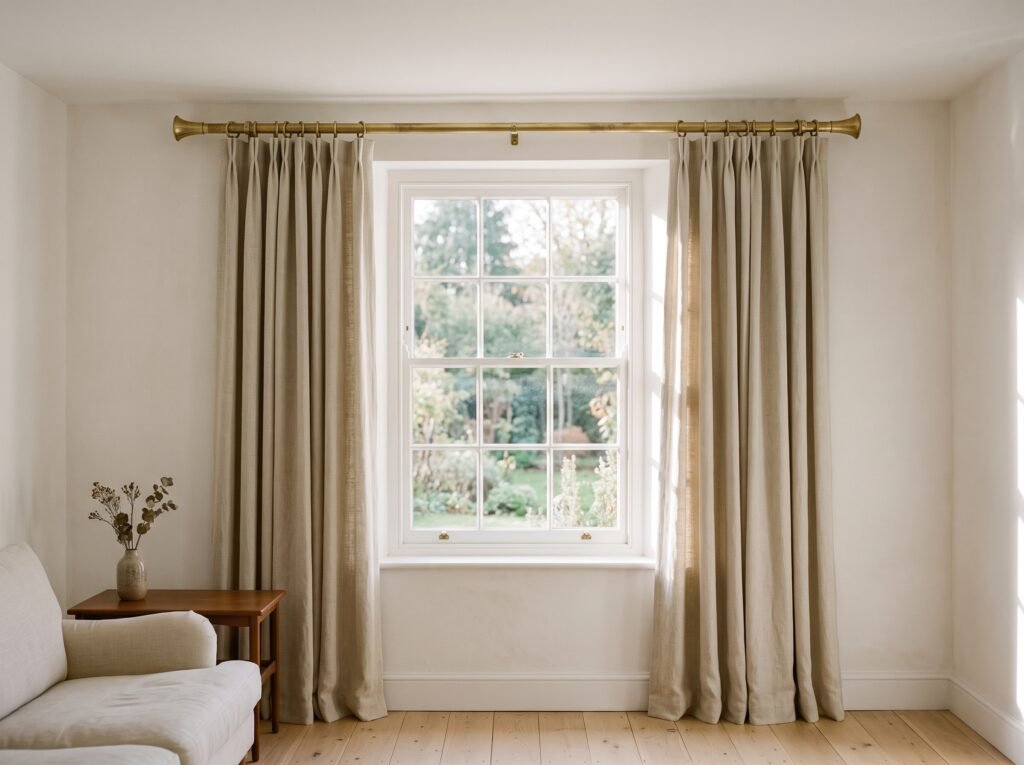
Brass curtain rods should run 3 to 6 inches past the window frame on each side and sit 4 to 6 inches above it, with curtains that add up to two to two and a half times the width of the window. Choose rings with an inside diameter about half an inch larger than the rod, and plan a center bracket for any long rod.
This guide covers the width, the height, the curtains, the brackets and the rings, then what to ask before you order. In September 2026 we also read every curtain rod listing at the seven workshops we check. Only two of the seven workshops sell curtain rods, and none of the window rods states how thick the rod is.
How wide should a curtain rod be?
Take the width of the window frame and add 6 to 12 inches, which puts 3 to 6 inches of rod past each side. Go wider if you want the curtains to clear the glass completely when they are open.
Bob Vila’s advice is to mount curtain rods to extend 3 to 6 inches, or more, past either side of the window frame. It also gives an upper limit, a third of the window’s width on each side: on a 54-inch-wide window, you could extend your curtain rods up to 9 inches on each side. So a 36 inch window takes a rod of 42 to 48 inches, and a 54 inch window anything from 60 to 72 inches.
Check how the workshop measures before you pick a size. Both workshops that sell brass rods give the overall length, end caps and all. Zayian says the selected length is the total assembled rod length, and the Rod & Rails size table lists a 48″ Overall (Rail 45.5″) pole, so about 2.5 inches of that length is fittings rather than rail the rings can slide along.
The extra width is there for the stack, the folded curtain that gathers at each side when it is open. Continental Window Fashions says that for most drapery, you should allow approximately one-third of the width of the window for the stack-back, and that heavier fabrics and wider windows require more of a stack-back than lighter-weight fabrics on narrow windows. A drapery workroom guide puts the stack a little higher, typically calculated as 40% of the window’s width. If you want the whole pane clear when the curtains are open, that is the number to plan around: on a 48 inch window, a third is 16 inches of stack, or 8 inches each side. If you would rather the folds overlap the frame a little, the 3 to 6 inch rule is enough.
Leave room for the finials too. The same maker warns that the rod dimensions will not include the additional width added by each finial, and that finials come in a wide range of sizes, from 1.5 inches to 9. Next to a corner or a wardrobe, measure the wall you have, rod plus both finials, before you order.
If the window sits in a deep recess, there is a second option: a rod fitted inside it. Highland Forge calls an installation within the recess, mounted side to side an inside mount, and notes it is common with windows having deep recesses. The rod is then cut to the width of the recess, and the curtains cover the glass even when open, so it suits a bathroom or a small window more than a living room.


How high should you hang a curtain rod?
Hang it 4 to 6 inches above the top of the window frame in a room with an 8 foot ceiling. Under a high ceiling, keep it within 8 inches of the frame rather than climbing all the way up.
Bob Vila says to hang curtains at least 4 to 6 inches above the top of the windows, and for a standard room describes the designer’s habit to mount the curtain rod about a half-foot above the top of the window frame. In a room with a tall ceiling, its advice is to hang curtains within 8 inches of the top of the window frame, because pushing the rod much higher than that just because you have the space can look awkward.
Then set the height against the curtains you will actually hang. The same guide says style now calls for curtains to either hang down to within ½-inch of the floor or even puddle slightly. With rings, the curtain hangs from the small eyelet at the bottom of each ring, not from the rod, so measure from that eyelet to the floor. Buy the curtains first if you can, then mark the rod height from their length.
Ready-made curtains come in a short list of lengths, so it helps to know them before you drill. In the US, panels run 63, 84, 95 or 96, 108, and 120 inches long, and the single most common length people buy is 84 inches, which suits a standard 8 foot ceiling. Graywind’s chart adds the catch: 84 inches is often too short for high mounting under an 8-foot ceiling. Lift the rod to just under the ceiling and you are buying 95 or 96 inch panels instead.
Work the sum backwards from the floor. Measure from where the curtain will hang, the eyelet on the ring, down to where you want the hem. Graywind’s example: if the hook-to-floor drop is 93.75 inches, a 0.5-inch float needs a 93.25-inch finished curtain. If the drop falls between two sizes, buy the longer one, because the 96-inch panel can be hemmed; the 84-inch panel cannot reach a floor-length finish. Rings add their own drop too, so hang one ring on the rod and measure from its eyelet rather than from the rod. When you mark the bracket holes, use a level and measure both marks up from the floor, not from the window frame, because frames in older houses are rarely level and the hem will show it.
How wide should the curtains be?
Add the widths of all your panels together and aim for two to two and a half times the width of the window. That gives enough fabric for full folds when they are closed.
Bob Vila puts it this way: plan for the combined width of your curtain panels to be between two and two-and-a-half times the width of the window. Continental Window Fashions, a drapery maker, calls a little less standard and a little more full, with standard fullness the width of the window in inches multiplied by 1.5 to 2 times and full fullness multiplied by 2.5 to 3 times. For a 36 inch window, that means 72 to 90 inches of curtain in total, so two panels of 36 to 45 inches each.
Ready-made panels are sold one at a time, and panel widths are usually 42, 50, 52, or 54 inches each. The same guide notes that the Window Coverings Association of America treats two times the rod width as the standard fullness for most headings, so two 50 inch panels cover a rod of about 50 inches. For the 54 inch window above, with a 66 inch rod, that means about 132 inches of curtain, three 50 inch panels, or two wider custom ones. Rings let heavier linen fold evenly, so if you are ordering custom curtains, tell the maker they will hang from rings.
When does a brass curtain rod need a center bracket?
When the rod is long, when it arrives in pieces, or when the curtains are heavy. The brass rods we read add a center bracket from about 50 inches, because that is where they start shipping in two sections.
Highland Forge, which makes iron drapery hardware, explains that rods will need middle bracket(s) to support a splice point, if they exceed a maximum suggested span, or if your drapery is particularly heavy. Its limits depend on thickness: a 1″ diameter rod → up to 90″ span between brackets, and a 1¼” diameter rod or larger → up to 105″. Those spans assume about 10 pounds of curtain, and for heavier drapes it advises that for each additional 5 lbs, we recommend deducting 15″ from the maximum suggested span to avoid sag.
The brass listings build the splice rule in. Zayian says every rod from 50 inches arrives as two separate rod sections with a center support bracket included. The Rod & Rails size table ships its pole in two rails with one center bracket from 52 inches, and in three rails with two center brackets from 100 inches. Put the center bracket exactly where the two sections meet.
Lined and blackout curtains are where the weight adds up. If yours are lined, treat the Highland Forge spans as the most you should allow and add a bracket sooner, then check that the workshop’s bracket can be fitted anywhere along the rod, not only at the joint.


What size curtain rings do you need, and how many?
Choose rings with an inside diameter about half an inch larger than the rod, and plan roughly one ring for every 5 to 7 inches of flat curtain. Space them closer for a flatter look and further apart for deeper folds.
Drapery Rods Direct gives the sizing rule: choose a drapery ring with an inside diameter that is a half-inch larger than the diameter of the curtain rod, adding that going larger than that can create a disproportionate look. Highland Forge agrees on half an inch and notes that you can also use rings that are only 1/4″ larger than the rod in most cases. The Rod & Rails ring set, the only ring listing we found, gives an Inner Diameter: 2.1 ″ (5.5 cm ), which by those rules suits a rod of about 1.6 to 1.85 inches.
For the count, Continental Window Fashions says flat panels require a ring every 5-7 inches of panel width, and that the fuller the look you seek, the further apart you should space the rings. For pleated curtains it is one ring per pleat plus the ends, and industry standards, it says, are 3 to 4 rings per foot of the width of your drapery panels. Take the 36 inch window again: 72 to 90 inches of flat curtain works out at about 11 to 18 rings. The Rod & Rails size table sends 11 rings with its 48 inch pole, which spreads 72 inches of curtain at one ring every 6.5 inches. For wider curtains, or a flatter look, order a set of extra rings with the rod.


French return, finials or ceiling mount: which suits your window?
Finials suit most windows and are what the workshops make as standard. A French return suits a bedroom that needs to be dark, and a ceiling mount suits a window that runs close to the ceiling or sits in an alcove.
The Shade Store describes French return rods as ones that feature curved ends of the rod that return and fasten to the wall, so the curtains can be pulled right up against the wall for excellent light and privacy coverage. None of the brass window rods we read is sold as a French return, but every one of the seven offers custom sizes, so ask the workshop whether it will bend the ends. If it does, Highland Forge notes that for curved French returns, a ring that is 1/4″ larger than the rod diameter will work.
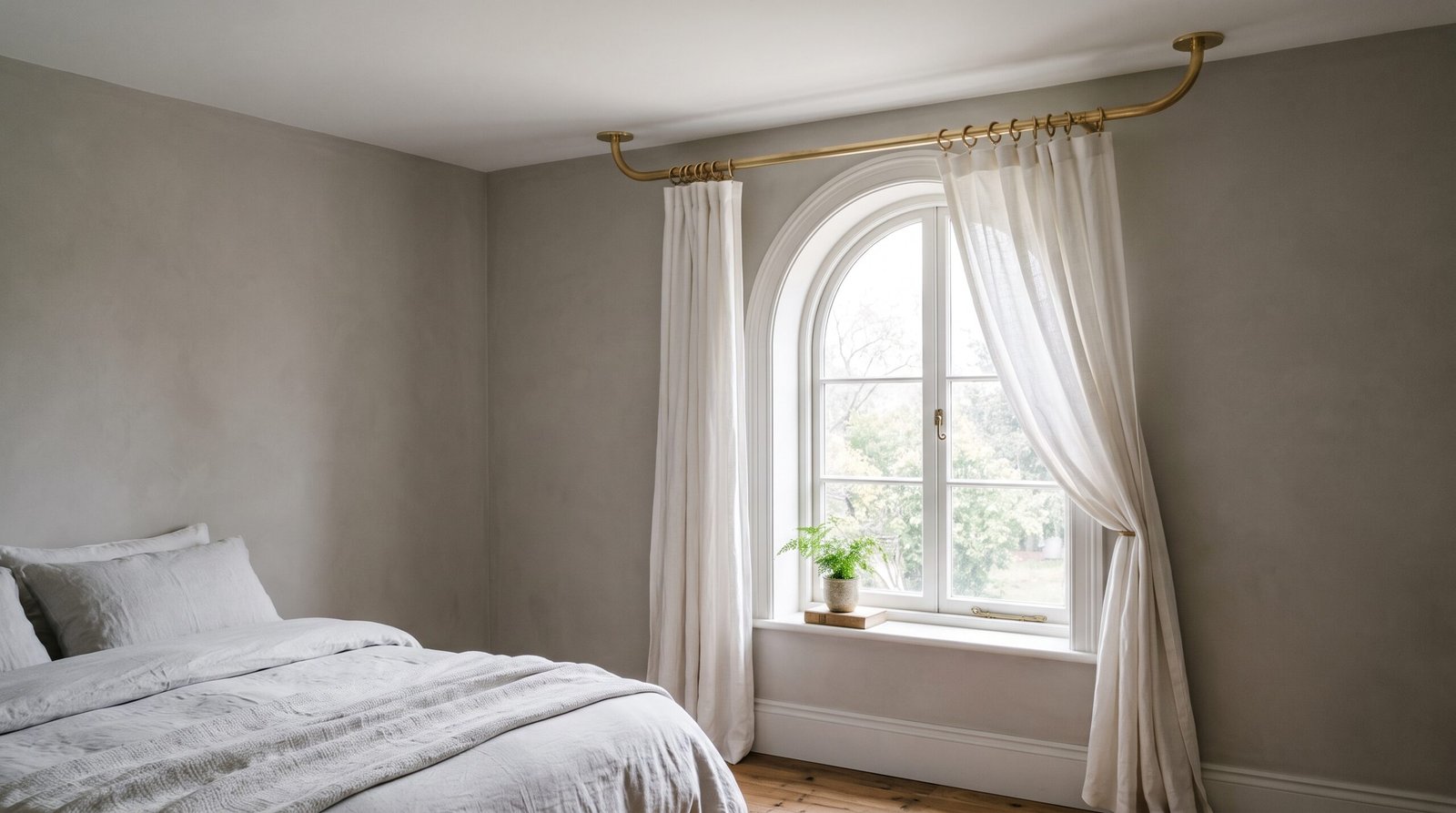
For tall windows, Bob Vila suggests that you might want to install rods designed to actually hang from the ceiling. Zayian’s ceiling rod does this with smooth curved returns that rise to circular ceiling flanges, and it is listed for windows, alcoves, doorways and room dividers.
Highland Forge’s glossary explains why returns help a bedroom: curtain rods with returns allow the fabric to be wrapped around the end of the return to block light, closing the gap at each side where a straight rod lets light in. It adds that often times returns are desired aesthetically instead of finials, which suits a plain modern window better than a decorative end.
How do you fix a brass curtain rod to the wall?
Into solid backing: a wall stud, the timber above the window, or a proper anchor for the wall you have. Set the brackets so the rod stands far enough off the wall to clear the window trim.
Zayian is plain about it: every ceiling flange on its ceiling rod, the middle support included, must be secured to appropriate structural backing, and it recommends professional installation for long spans or heavy curtains. Solid brass is heavy for its size, and our guide to brass shelf brackets explains finding studs and choosing anchors.
For the distance from the wall, Highland Forge calls it clearance, the distance from the wall to the back of the rod, and says 3″ is most common. Measure how far your window trim stands out and ask the workshop for its bracket depth, because none of the brass listings we read gives it.
Here are the numbers in this guide in one place:
| What | Number | Source |
|---|---|---|
| Rod past the frame | 3 to 6 in each side | Bob Vila |
| Widest rod | A third of the window width each side | Bob Vila |
| Rod above the frame | 4 to 6 in | Bob Vila |
| Rod above the frame, high ceiling | Within 8 in | Bob Vila |
| Curtain hem | Within ½ in of the floor | Bob Vila |
| Total curtain width | 2 to 2.5 × the window | Bob Vila |
| Span between brackets, 1 in rod | Up to 90 in | Highland Forge |
| Span between brackets, 1¼ in rod or more | Up to 105 in | Highland Forge |
| Ring inside diameter | ½ in larger than the rod | Drapery Rods Direct |
| Rings, flat curtains | One every 5 to 7 in | Continental Window Fashions |
| Bracket clearance from the wall | 3 in is most common | Highland Forge |
| Brass rods with a center bracket | From 50 to 52 in | Zayian, Rod & Rails listings |
What do the workshop listings tell you, and what do they leave out?
They give the length, the finish and whether brackets and rings come in the box. They leave out how thick the rod is, how deep the brackets stand, and how much weight it will carry.
What the listings say. In September 2026 we read every curtain rod listing at CopperKesh, Zayian, Rod & Rails, Artihand, Kinycraft, The House of Brass and Moroccan Interior. Only two of the seven sell them: 14 listings, 6 at Zayian and 8 at Rod & Rails. Eight are for windows, seven rods and one set of rings, and the other six are shower or fitting room rails. Six of the seven window rods go up to 130 inches, and the cafe rod runs from 12 to 60. At 36 inches they start at $238 to $330, and at 100 inches at $527 to $900. All seven offer custom lengths, six name rings in the title or say they are included, and three Zayian listings mention a 5-year warranty. Three of the seven explain when a center support comes in. Only the Rod & Rails pole says how many rings come with each size. None of the seven states the diameter of the rod, none gives the depth of its brackets, and none gives a weight limit. The one figure for thickness is on the ring set, 2.1 inches inside. Before you pay, ask for the rod diameter, the bracket clearance, the number of rings and what the rod will hold.
The shower rails are a different job. For those, see brass shower systems and, for a rail around a clawfoot tub, freestanding copper and brass bathtubs.
Can you get a discount on a brass curtain rod?
Yes, at Rod & Rails. In September 2026 it had a code for 10% off its whole store, and Zayian was offering free worldwide express shipping.
We put every code through a real checkout before it goes on the site. Ten percent off the $330 Rod & Rails pole at 36 inches is $33, off the 100 inch size at $900 it is $90, and off a $120 set of 10 extra rings it is $12. Two of the Zayian rods were also listed at 15% below their regular price when we read them. Codes and sale prices end, so check the date each code was last tested on the Rod & Rails and Zayian store pages, and read how we verify codes.

So what size brass curtain rod should you order?
Measure the frame, add 6 to 12 inches, and order that as the overall length. Hang it 4 to 6 inches above the frame, into solid backing, with a center bracket wherever the rod joins, and rings half an inch wider than the rod.
Get the rod diameter, the bracket depth and the ring count in writing before you pay, then browse hardware and accessories with the codes we have checked. If the brass is unlacquered, see how to clean unlacquered brass for keeping it the color you want.
About the authors. JGD Editors are the people who check every code on JustGetDeal in a real checkout before it goes on the site, and who read the workshops’ own listings for the facts in these guides.
*Some links on JustGetDeal can earn us a commission. The price you pay is the same. Read the affiliate disclosure.*
Get new tested codes by email
One email on Friday: the codes that passed our checkout test that week, the ones we pulled, and new guides. Quiet week, short email.