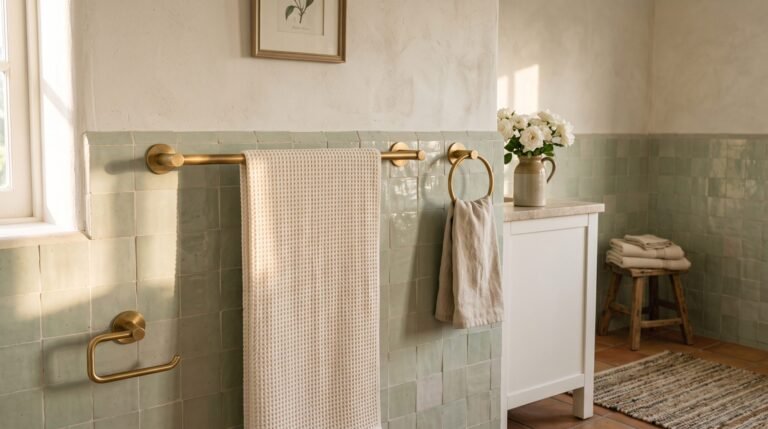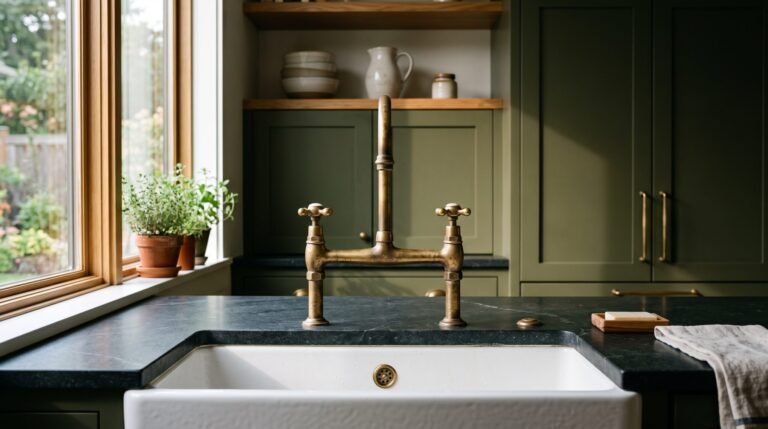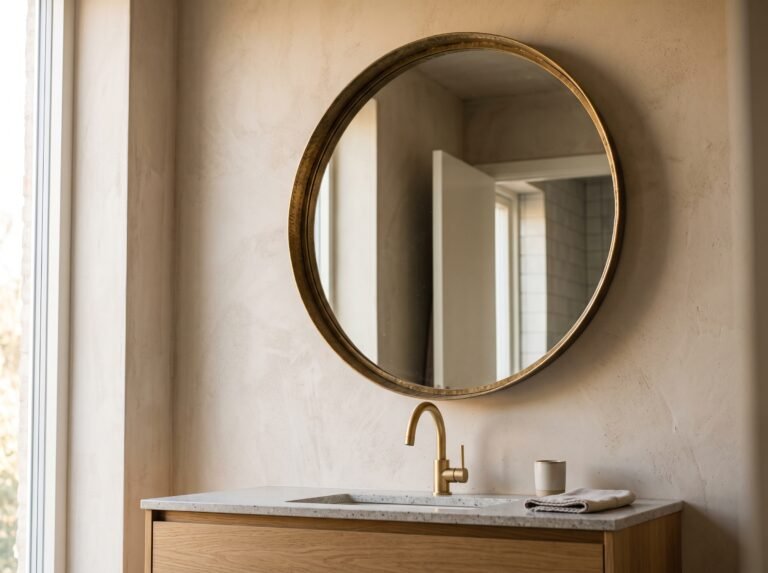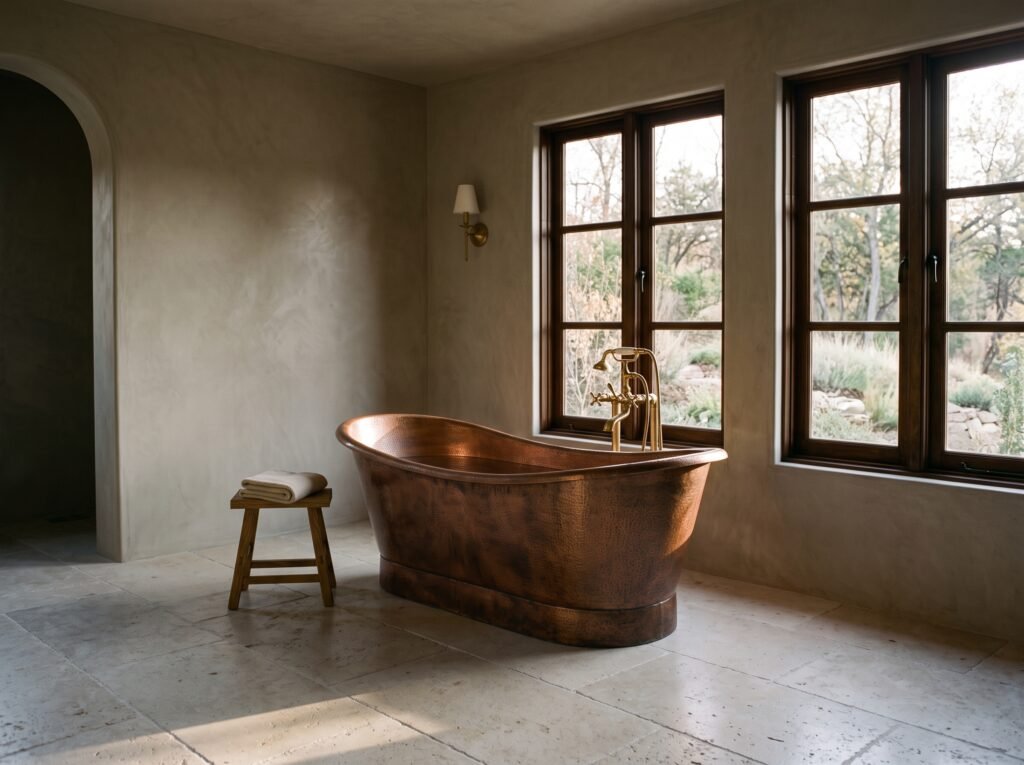
Before you order a freestanding copper bathtub or a copper clawfoot tub, settle three things: the shape, the space around it, and the tub filler that will reach over its rim. Then ask the workshop what the listing leaves out, because in our read none of them gives a gauge number, the tub’s weight or how much water it holds.
This guide covers copper and brass bathtubs from clawfoot to double slipper and soaking tubs, with sizes, clearance, fillers, drains, floors and care. In September 2026 we read every bathtub listing at five workshops, 25 in all, with starting prices from $3,200 to $5,200.
What types of freestanding copper and brass bathtubs are there?
Most are clawfoot tubs on separate feet, slipper tubs raised at one or both ends, or tubs set on a solid base. A few are deep round soaking tubs or small cold plunge tubs.
Signature Hardware, a bath fixture seller, describes the slipper shape as rising at either end so you can recline as you bathe. It says a single slipper is raised at one end, while double-slipper tubs are raised at both ends so you can relax on either side, and that clawfoot tubs come with feet such as imperial and lion paw.
Copper Sinks Online, which makes copper tubs under its SoLuna name, also sells round and square tubs designed in a traditional Ofuro Japanese style. At the workshops we list, 14 of the 25 tubs are clawfoot designs and 2 are cold plunge tubs.


How much space does a freestanding bathtub need?
Leave at least 3 to 6 inches between a clawfoot tub and the walls on every side, and up to 8 to 10 inches for a slipper tub. In front of the tub, plan 30 inches of clear floor to the nearest wall or fixture.
Kingston Brass, which sells clawfoot tubs and fillers, says clawfoot tubs still need a minimum of three to six inches of clearance on all sides, that slipper-style tubs may need up to eight to 10 inches of clearance instead, and that a bathroom built for an alcove tub may not have room for one. The National Kitchen and Bath Association recommends 30 inches of clear space from the front edge of a tub to any opposite fixture or wall, and notes a code minimum of 21 inches.
Then check the shape against the room. Signature Hardware gives single slipper tubs as 60 to 72 inches long and 30 to 36 inches wide, and double slippers as 65 to 78 inches long and 35 to 40 inches wide. The workshops we list offer most tubs in several sizes, from about 49 to 79 inches long, and most sizes stand 26 to 33 inches high.
Here are the numbers in this guide in one place:
| What | Number | Source |
|---|---|---|
| Single slipper tub | 60 to 72 in long, 30 to 36 in wide | Signature Hardware |
| Double slipper tub | 65 to 78 in long, 35 to 40 in wide | Signature Hardware |
| Clearance around a clawfoot tub | 3 to 6 in on all sides | Kingston Brass |
| Clearance around a slipper tub | Up to 8 to 10 in | Kingston Brass |
| Clear floor in front of the tub | 30 in recommended, 21 in code minimum | NKBA |
| Tub controls | Between the rim and 33 in above the floor | NKBA |
| Water in an average tub | 50 gallons | Kingston Brass |
| Weight of water | 8.34 lb per gallon | USGS |
| A 72 in, 16 gauge copper tub, empty | 49.42 kg (about 109 lb) | Coppersmith Creations |
| Spout of a freestanding filler | 31.9 in above the floor | CopperKesh listing |
Copper or brass: which metal is better for a bathtub?
Both are sold as solid, handmade tubs, and the choice is mostly about color and how it ages. What matters more is how thick the metal is and what the inside is finished with, so ask both questions whichever metal you choose.
The split at the workshops we list is even: 12 of the 25 tub names say copper and 13 say brass. Copper Sinks Online says all its tubs are crafted with the heaviest hand-hammered 14-gauge copper, and warns that some makers use thinner copper. Gauge runs backwards: Sinkology explains that a lower gauge number indicates thicker copper. None of the 25 listings we read gives a gauge number, so ask.
Ask about the inside too. Coppersmith Creations sells a clawfoot tub with a Nickel Inside & Polished Copper Outside Finish, and at the workshops we list 8 tub names mention a black exterior, a white interior or a patina interior. One Zayian listing is named a solid copper tub but describes a brass interior, which is exactly the kind of detail to confirm in writing.
If you like long baths, ask whether the tub is single or double walled. Copper Sinks Online says its double wall tubs have a double wall configuration that allows the water to stay warm longer.

Which tub filler works with a freestanding copper or brass tub?
A floor-mounted filler that stands beside the tub is the usual choice, and a wall-mounted mixer works when the tub sits against a wall. Either way, choose the filler after the tub, because it has to be tall enough and reach far enough to clear the rim.
Kingston Brass says a clawfoot tub requires a special tub filler for clearance between the tub and the faucet, which must have enough height and reach to cross the tub’s wide, curled lip. Of the experts quoted on the Native Trails blog, one says the cleanest look is the floor mount, and another that freestanding fillers are ideal when there is not a flat mountable area.
Compare the numbers before you buy. CopperKesh gives the spout of its freestanding filler as 31.9 inches above the floor, which clears a tub 26 to 30 inches high but is close for a 33 inch one. The NKBA suggests tub controls sit between the rim and 33 inches above the floor, so they can be reached from in and out of the bath. For the fillers and hand showers themselves, see our guide to brass shower systems.


What has to be ready before a freestanding tub goes in?
The drain has to come up through the floor exactly under the tub’s outlet, so the tub’s position is fixed before the plumbing is finished. Ask whether a drain comes with the tub, because most listings do not say.
Kingston Brass’s installation steps start by placing the tub where it will stand, tracing its outline, then raising it to mark the drain location, and only then telling you to rough-in drains to the appropriate height. It also stresses to follow the maker’s own instructions for the tub you buy.
Only 1 of the 25 listings we read mentions a drain: a CopperKesh clawfoot whose order includes a complimentary pop-up drain. None mentions an overflow. If you want a floor-mounted filler, fix its position at the same time as the drain.
Will your floor hold a full copper bathtub?
Usually, if the bathroom was built with a bathtub in it. It is worth checking when the room only ever had a shower, or the tub is large, because the water weighs far more than the metal.
Kingston Brass says most bathrooms that included a bathtub in the past will have enough structural support, but that reinforcement may be needed if the tub holds more than the average 50 gallons of water, and is likely needed where the bathroom was built with only a shower stall.
Water weighs 8.34 pounds per gallon, according to the USGS, so 50 gallons is about 417 pounds before anyone gets in. The tub itself is lighter than it looks: Coppersmith Creations lists its 72 inch, 16 gauge copper clawfoot at 49.420 Kg (approx.), about 109 pounds. None of the listings we read gives a weight or a capacity, so ask for both if the tub is going upstairs.
How do you care for a copper or brass bathtub, indoors or out?
Rinse and wash it with a mild, non-abrasive soap and water, and keep harsh and acidic cleaners off it. Four of the listings we read say their tubs can also go outdoors.
Copper Sinks Online says copper tubs need just non-abrasive soap and water to keep them clean, and to avoid harsh or acidic chemicals. The same routine that suits a copper sink suits a tub, so our guide on how to clean a copper sink applies, and for a brass tub see how to clean unlacquered brass.
For outdoor use, Copper Sinks Online says its 14 gauge copper allows the perfect duality of indoor or outdoor installation. A CopperKesh brass clawfoot listing says the bathtub clawfoot can be an outdoor bathtub and indoor bathtub. If you want the color to stay even, read unlacquered vs lacquered brass before choosing a finish.
Is a copper bathtub antimicrobial?
Copper alloys are registered with the EPA as antimicrobial touch surfaces, tested on regularly cleaned surfaces, not as a health treatment in bathwater. Three of the listings we read say their tub is antimicrobial, so read that as a note about the metal, not a health benefit.
The EPA stewardship site for copper alloys says that when cleaned regularly, antimicrobial copper surfaces kill greater than 99.9% of certain bacteria in laboratory tests, and that these surfaces are a supplement to and not a substitute for standard infection control practices. A tub still needs cleaning like any other.
What do the workshop listings tell you, and what do they leave out?
They give the shape, the size choices, the finish and the delivery time. They leave out the thickness, the weight, the capacity and, mostly, the drain.
What the listings say. In September 2026 we read every bathtub listing at Zayian, CopperKesh, Rod & Rails, Kinycraft and Artihand: 25 in all, counted once where two stores list the same tub, 18 at Zayian, 6 at CopperKesh and 1 at Artihand. Starting prices run from $3,200 to $5,200, with a middle price of $4,200, and the largest size option reaches $7,800. All 25 give dimensions or a choice of sizes. None gives a gauge number, a weight or a water capacity. 1 mentions a drain and none an overflow. CopperKesh listings say the tubs are made to order in 2 to 4 or 3 to 4 weeks, while Zayian listings give delivery in 3 to 5 or 5 to 7 working days. Before you pay, write to the workshop for the gauge, the weight, the interior finish and whether a drain is included.
Can you get a discount on a copper or brass bathtub?
Yes, at two of the workshops that sell them. In September 2026 CopperKesh had a working code for 10% off its whole store, and Zayian was offering free worldwide express shipping.
We put every code through a real checkout before listing it. The CopperKesh code took 10% off a $250 pendant light, and on a $4,100 CopperKesh clawfoot the same 10% is $410. Rod & Rails does not sell tubs, but its 10% code was tested on a $280 tub filler. Codes expire, so check the date each one was last tested on the CopperKesh, Zayian and Rod & Rails store pages, and read how we verify codes.


So, how do you choose a freestanding copper or brass bathtub?
Pick the shape for how you bathe, then measure for the tub plus 3 to 10 inches around it and 30 inches in front. Choose a filler that clears the rim, fix the drain position before the floor is finished, and get the gauge, weight, interior finish and drain in writing.
Browse copper bathtubs and brass clawfoot bathtubs with the codes we have checked.
About the authors. JGD Editors are the people who check every code on JustGetDeal in a real checkout before it goes on the site, and who read the workshops’ own listings for the facts in these guides.
Some links on JustGetDeal can earn us a commission. The price you pay is the same. Read the affiliate disclosure.
Get new tested codes by email
One email on Friday: the codes that passed our checkout test that week, the ones we pulled, and new guides. Quiet week, short email.