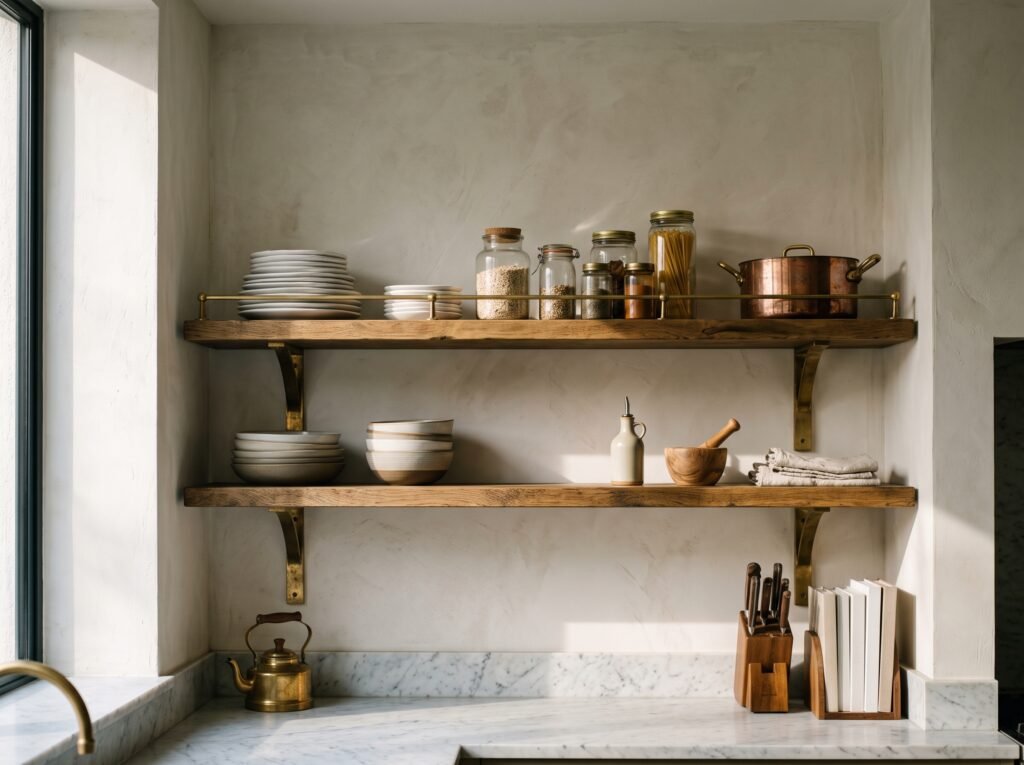
For open shelving, hang the first shelf 18 to 24 inches above the counter, space the shelves 10 to 18 inches apart, and screw brass shelf brackets into the wall studs, which are usually 16 inches apart. Then match the shelf to the span: the farther apart the brackets, the more a shelf sags, and glass has to get thicker as the span grows.
This guide covers brass shelf brackets, gallery rails and bathroom shelves for open shelving in a kitchen or bathroom, from heights and spacing to fixing them to the wall. In September 2026 we read every shelf, bracket and gallery rail listing at five workshops, 46 in all, and not one of the 46 says how much weight it holds.
How high should open shelves be above a kitchen counter?
Hang the lowest shelf 18 to 24 inches above the countertop, then space the shelves above it 10 to 18 inches apart. Go toward the top of both ranges if the shelves will hold tall jars or sit over a coffee machine.
Van Dyke’s Restorers, a hardware seller, advises you to aim for 18 to 24 inches of space between the countertop and the bottom shelf, and says most floating shelves should be spaced about 10 to 18 inches apart vertically. Shelfology, which sells shelf brackets, puts the first shelf at about 18 inches above your countertop surface and/or 54 inches from the floor.
Measure the tallest thing you plan to keep on each shelf, add a couple of inches to lift it off, and mark the lines on the wall with painter’s tape before you drill.
Depth matters as much as height. StudioDK, an interior design firm, gives a simple scale: an 8” to 9” depth will accommodate coffee mugs and glassware, and 10” to 11” will hold most dinnerware, while a 12” depth will be necessary if you want to store pots, pans, and larger items. In a kitchen, Van Dyke’s opens the gap between stacked shelves a little, saying to aim for 15 to 21 inches to accommodate kitchen essentials, from jars to dishware. Keep the everyday plates on the lowest shelf, because, as Shelfology puts it, it doesn’t make sense to place shelves that you won’t be able to reach without a stool.
How far apart should brass shelf brackets be?
Put every bracket on a wall stud, which usually means brackets 16 inches apart, or 24 inches in some newer homes. The farther apart the brackets are, the more the shelf sags between them, so a long or heavily loaded shelf needs a bracket on every stud it crosses.
This Old House explains that usually on an older house, it’s gonna be 16 on center. Some of the newer houses are 24 on center, measured from the center of one stud to the next. Van Dyke’s gives the same starting point, that wall studs are commonly spaced 16 inches apart, though some homes use 24-inch spacing.
Span is what makes a shelf sag. The WoodBin Sagulator, a widely used shelf sag calculator, notes that if shelf span is doubled, deflection is eight times greater, while if shelf thickness is doubled, deflection is reduced to one-eighth. It also warns that wood shelves sag an additional 50% over time beyond the initial deflection, and suggests a target of 0.02 inches of sag per foot or less. So skipping a stud to save a bracket costs far more than it looks: the span doubles and the sag does not. StudioDK gives a working limit for wood: the longest span for a 3/4″ thick wood shelf is 36” long. On studs 16 inches apart that means a bracket on every stud for a thin board, and a thicker board if you want to skip one. As a worked example, a 48 inch shelf on studs 16 inches apart crosses three or four studs. A bracket on each keeps every span to 16 inches, well inside that limit, and leaves only a short overhang at each end.
Here are the numbers in this guide in one place:
| What | Number | Source |
|---|---|---|
| Counter to the lowest shelf | 18 to 24 in | Van Dyke’s |
| Between shelves | 10 to 18 in | Van Dyke’s |
| Wall studs, center to center | 16 in, or 24 in in some newer homes | This Old House |
| Shallow shelf above a toilet tank | 10 to 12 in above the tank | Van Dyke’s |
| Glass shelf, span up to 24 in | 6 mm (1/4 in) | United Plate Glass |
| Glass shelf, span 24 to 36 in | 8 to 10 mm | United Plate Glass |
| Glass shelf, span over 36 in | 12 mm minimum | United Plate Glass |
| Metal toggle anchor in 1/2 in drywall | About 40 lb of pull | This Old House |
What size brass bracket does your shelf need?
Choose brackets whose arms reach most of the way under the shelf, and buy enough to put one on each stud the shelf crosses. Brass shelf brackets at the workshops we list come in square sizes from 5 by 5 to 10 by 10 inches, sold in sets of two to ten.
A short arm under a deep shelf leaves the front edge hanging, which is where the weight of plates and jars sits. A 10-inch-deep shelf is better on 8 or 10 inch brackets than on 5 inch ones.
Remember that brackets are sold alone. Rod & Rails says of its bracket that the wooden shelf shown in the photos is for display purposes and is not included, and Zayian lists its solid brass bracket as compatible with wood, marble, and stone shelving, so the board is yours to buy or have cut.
Right On Bracket, an American bracket maker, puts the sizing as a rule: the bracket should be two-thirds the depth of the shelf at minimum, so if your shelf is 12 inches deep, the bracket should have a projection of eight inches or more. Its chart pairs an 8-inch Bracket: Shelves 10 to 12 inches deep and a 10-inch Bracket: Shelves 12 to 14 inches deep. Against the brass sizes the workshops sell, the 5 by 5 inch bracket suits a narrow ledge of about 7 inches, the 8 by 8 a dinnerware shelf of 10 to 12 inches, and the 10 by 10 a deep shelf for pots.


Which shelf should go on brass brackets: wood, glass or stone?
Wood is the easiest and the most forgiving, as long as it is thick enough for the span. Glass suits lighter loads if it is tempered and as thick as the span needs, and stone is heavy enough that its brackets belong in studs.
For glass, United Plate Glass gives thickness by span: short spans (up to 24″): 6mm glass may be sufficient, 8 to 10 mm for 24 to 36 inches, and 12 mm minimum beyond that. It recommends tempered glass, which is heat-treated to increase strength (4-5 times stronger than annealed glass) and safety, and 6 to 8 mm for bathroom toiletries.
For wood, depth and thickness both help. The Sagulator notes that if shelf depth is doubled, deflection is cut in half, so a thicker, deeper board on the same brackets sags far less.
You can also skip the brackets. Zayian’s hammered solid brass floating shelf comes in lengths from 20 to 48 inches at 8 inches deep, and its listing says heavy-duty wall fixings included.

What is a brass gallery rail, and do you need one?
A gallery rail is a low brass rail along the front edge of a shelf that stops plates, glasses and jars from sliding off. It is optional, and it is the most common brass shelving piece the workshops sell: 30 of the 46 listings we read are gallery rails.
Rod & Rails sums up the job of its rail kit as a way to keep your styling sharp (and your glass bottles upright), and its kit comes with rods, brackets, finials, and all the hardware you need. As with brackets, the shelf is not included.
Zayian sells gallery rails in lengths from 8 to 40 inches. Choose a length a few inches shorter than the shelf so the end posts sit in from the edges, and on a long shelf check that the rail has a post near the middle.

Where should bathroom shelves go?
Over a toilet, leave 10 to 12 inches above the tank for a shallow shelf so the lid still lifts off. Near a shower or tub, a shelf with a towel bar underneath does two jobs at once.
Van Dyke’s advises you to leave enough room to remove the toilet tank lid without interference. A common starting point is 10 to 12 inches above the tank for a shallow shelf. It adds that deeper shelves may need more clearance, and its own table puts a shelf over a toilet often 10 to 24 inches above the tank depending on shelf depth and layout. For a shelf beside a mirror or over a towel bar, it says to keep at least 8 to 10 inches of space to prevent clutter or awkward reach.
A towel shelf with a hanging bar holds folded towels on top and damp ones below. Rod & Rails lists its version at a depth of 10 in (25 cm), so check the swing of the shower door or the bathroom door before you choose the wall. In a small bathroom the wall over the toilet is often the only free space, so measure the height of the tank and the depth of the shelf together before you mark the wall: a deeper shelf has to sit higher to clear your head when you stand up. For how high a towel bar belongs, see our guide to towel bar, toilet paper holder and robe hook heights.

How do you fix brass shelf brackets so the shelf stays up?
Screw brackets into studs wherever you can. Where you cannot, use metal toggle anchors, and plan for the whole load of the shelf, because none of the listings we read gives a weight limit.
This Old House says the simplest safe way to attach any fixture is to drive the mounting screws directly into wall studs, and that metal toggle anchors can withstand 40 pounds of pull when embedded in 1/2-inch drywall. A loaded shelf of plates or a marble board can pass that quickly, which is why studs matter more for shelves than for a towel bar.
Finding the studs is most of the job. Westlake Ace Hardware notes that most wall studs are spaced 16 inches apart, so once you find one the next is usually 16 inches along. Without a stud finder, its advice is to look near electrical outlets or light switches, since boxes are usually fixed to a stud, and to confirm it by driving a thin finishing nail through the drywall near the baseboard to see if you hit a stud. Then plan the shelf around the studs rather than the other way round: brackets 16 or 32 inches apart land on studs, and the board can overhang the outer brackets a little on each side.
Mark everything before you drill. Van Dyke’s suggests that you mark all shelf positions with painter’s tape before drilling, which lets you check the level and the spacing on the wall itself. Where a bracket truly cannot reach a stud, it is blunt about the alternative: drywall anchors alone may only be appropriate for very light decorative use. For anything heavier, move the bracket to the stud or add blocking behind the wall if it is open.
What the listings say. In September 2026 we read every shelf, bracket and gallery rail listing at Zayian, CopperKesh, Rod & Rails, Kinycraft and Artihand: 46 in all, counted once where two stores list the same piece, priced from $58 to $624 with a middle price of $89. 30 are gallery rails, 6 wall shelves, 6 bathroom shelves and 4 brackets. None states a weight limit. Twelve of the 46 say the shelf board shown in the photos is not included. Only 2 mention the screws or fixings at all, and 39 offer a choice of sizes. The workshops sell the brass; the planning and the fixing are yours.
Can you get a discount on brass shelves and brackets?
Yes, at three of the workshops we list. In September 2026 Rod & Rails and CopperKesh each had a working code for 10% off their whole store, and Zayian was offering free worldwide express shipping.
We put every code through a real checkout before listing it. The Rod & Rails code took 10% off a single $280 tub filler with nothing else in the basket, so there was no minimum to reach first, and Rod & Rails sells most of the brackets, gallery rails and towel shelves pictured here. Codes expire, so check the date each one was last tested on the Rod & Rails, CopperKesh and Zayian store pages, and read how we verify codes.
So, how should you plan brass open shelving?
Hang the lowest shelf 18 to 24 inches above the counter, space the shelves 10 to 18 inches apart, and put a bracket on every stud the shelf crosses. Choose glass by the span, add a gallery rail if the shelf holds dishes, and fix everything into studs or metal anchors.
Browse hardware and accessories with the codes we have checked. If you are still choosing between bright and aged brass, read unlacquered vs lacquered brass, and keep how to clean unlacquered brass for when the shelves are up.
About the authors. JGD Editors are the people who check every code on JustGetDeal in a real checkout before it goes on the site, and who read the workshops’ own listings for the facts in these guides.
*Some links on JustGetDeal can earn us a commission. The price you pay is the same. Read the affiliate disclosure.*
Get new tested codes by email
One email on Friday: the codes that passed our checkout test that week, the ones we pulled, and new guides. Quiet week, short email.