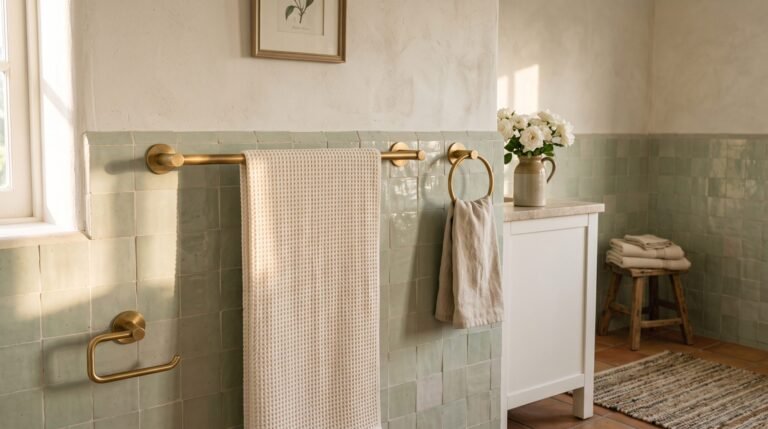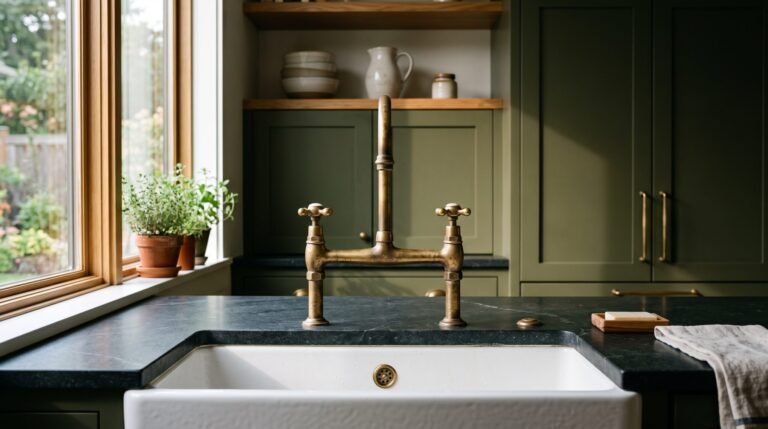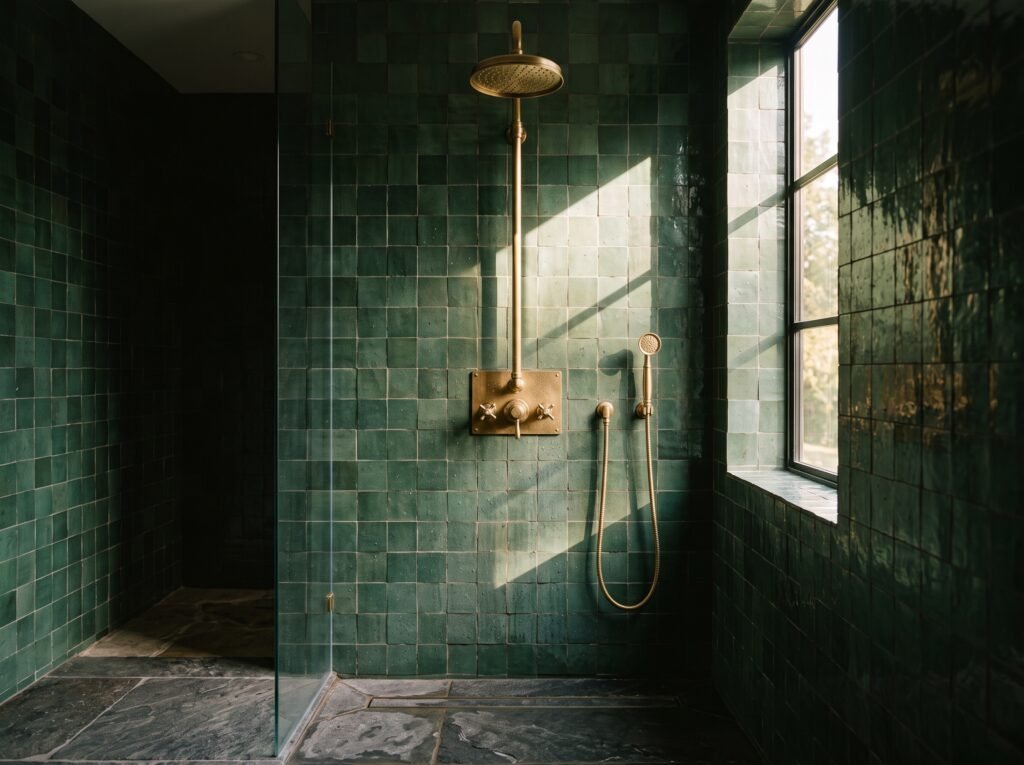
A brass shower system is a matching set of shower head, arm or riser, handheld shower and controls, and the first choice is exposed or concealed. Choose exposed if you are keeping your tiles and like the pipework on show, and concealed if the wall is being opened anyway and you want only the handles and head in view.
This guide covers that choice, what really comes in the box, which valve you need, and whether a handmade brass shower system will fit US plumbing and code. In September 2026 we read every shower system listing at five workshops, 43 in all, and the details that matter most for a US bathroom were missing from almost all of them.
What is the difference between an exposed and a concealed shower system?
On an exposed shower, the valve and the pipe up to the head are mounted on the face of the wall, where you can see them. On a concealed shower, the valve and pipework sit inside the wall behind the tiles, and only the handles, arm, head and handheld show.
Aqualisa, a British shower maker, defines a concealed shower as one with the valve and any pipework beneath the tiles where it is not seen, and an exposed shower as one whose valve is mounted on the tiles and in view. Brass suits both. Exposed systems lean vintage, with a rigid riser and cross handles; concealed ones look quieter.


Should you choose an exposed or a concealed shower?
Choose exposed if you are not retiling, because it fits on top of the finished wall with less work and usually less cost. Choose concealed if the shower wall is being opened or retiled anyway, and you want a cleaner wall and a little more room.
Aqualisa describes an exposed shower as one that can be easily added on top of your tiles with minimal fuss and calls it the economic choice when you are keeping your current bathroom. For a concealed shower it warns that existing décor may be damaged, and it can be more costly to install, and recommends choosing one when you are upgrading the tiles as well.
Think about later too. Anything behind the tiles is harder to reach if a part ever needs attention, and an exposed riser gives you more brass to wipe dry. Our guide on how to clean unlacquered brass has a section on shower systems.
What comes in the box with a brass shower system?
Most brass shower systems include a rain head, an arm or riser, and a handheld shower on a hose, and many add a tub spout. The valve is where listings differ most: some include a rough-in valve, and some include no mixing valve at all.
What the listings say. In September 2026 we read every shower system listing at Zayian, CopperKesh, Rod & Rails, Kinycraft and Artihand: 43 in all once listings shared between stores were counted once, priced from $440 to $1,190, with a middle price of $640. 31 mention a rain head, 33 a handheld shower and 11 a tub spout or filler. 17 are described as exposed and 5 as concealed or in-wall. Only 8 name a rough-in valve. And three things a US buyer needs were almost never there: 3 listings state a flow rate, 3 state a thread standard, and none names a US plumbing certification.
The valve is the one to read twice. Two exposed systems at Rod & Rails say plainly that each is an exposed unit designed to connect directly to your water supply lines; it is not a mixer and does not include an internal or external mixing valve. The same listing gives the rest of the box: a 10-inch round rain head, a handheld shower on a brass hose, the exposed riser pipes and a two-way diverter, with 1/2-inch NPT connections, 2.5 GPM and an overall height of 51 inches. That is a clear listing, and it tells you a plumber will fit a separate mixing valve. Zayian’s thermostatic set, by contrast, is sold with matching handles and a rough-in valve included.
Before you order, check these against the listing, and ask the workshop about anything it does not say.
| Check | Why it matters | Where to look |
|---|---|---|
| Is a valve included, and which type? | Some exposed sets have no mixing valve, and US code asks for a specific kind | “Package includes” and the product description |
| Is the valve certified to ASSE 1016 or CSA B125? | Most US plumbing codes require it for a shower valve | Ask the workshop; none of the 43 listings says |
| Connection size and thread | US pipes use NPT threads, and a BSP fitting will not seal on them | Specifications, often “1/2 inch NPT” |
| Flow rate | New showerheads sold in the US may use no more than 2.5 gallons a minute | Specifications |
| Overall height, arm reach and valve spread | Decide where the head lands and whether it matches the pipes in your wall | Dimensions |
| Tub spout or handheld | Decide whether the set works over a tub or in a walk-in shower | Title, photos and specifications |


Pressure balance or thermostatic: which shower valve do you need?
Both keep the water from turning suddenly hot or cold when someone flushes a toilet or runs a tap elsewhere. A pressure balance valve does it by balancing the hot and cold water pressure, and a thermostatic valve does it by measuring and controlling the water temperature itself.
Delta, the US faucet maker, describes its pressure balance valve as one that monitors water pressure to balance temperature, and its thermostatic valve as one that functions like a thermostat to precisely measure and control water temperature. Many brass systems show two or three handles on the wall, so ask the workshop what each one controls.
Among the 43 listings we read, 6 describe a thermostatic valve and none mentions pressure balance. Many say only “mixer” or “valve”, so ask which kind it is.
Will a handmade brass shower system meet US plumbing code?
It can, but the valve has to be the right kind. US plumbing codes require a shower valve to be pressure balance, thermostatic or a combination of the two, certified to a standard such as ASSE 1016, and able to limit the water to 120°F.
The 2021 International Plumbing Code puts it this way: individual shower and tub-shower combination valves shall be balanced-pressure, thermostatic or combination balanced-pressure/thermostatic valves that conform to the requirements of ASSE 1016/ASME A112.1016/CSA B125.16 or ASME A112.18.1/CSA B125.1, and those valves must have a means to limit the maximum setting of the valve to 120°F. Local codes differ in the details, so your plumber or building department has the final word.
None of the 43 listings we read names a US certification. That does not mean a valve would fail, only that the listing does not say. Ask the workshop which valve their set uses and whether it is certified. If it is not, ask your plumber whether a certified valve can supply the brass pieces you like. With an exposed set that has no mixing valve of its own, like the Rod & Rails systems above, that is how it would be installed anyway.
Will a brass shower system fit US plumbing connections?
It will if the connections are 1/2-inch NPT, the tapered pipe thread used in the United States. BSP, the British standard common in the UK and most Commonwealth countries, looks similar, and the two do not seal together.
Brennan, a maker of fittings, explains that NPT threads have a 60° angle and BSP threads a 55° angle, and that the two thread styles are not compatible due to these different thread forms. An NPT fitting will turn into a BSP one, it adds, but the joint will not seal properly and leaks along the threads.
Only 3 of the 43 listings state a thread standard. The Rod & Rails exposed systems say 1/2-inch NPT, and one Zayian rain shower system offers a choice of US rough-in (NPT) or EU / UK rough-in (BSP). If a listing does not say, ask for NPT before you pay.
How much water does a brass rain shower use?
No showerhead made and sold in the US since 1994 may use more than 2.5 gallons a minute. A WaterSense labeled showerhead uses no more than 2.0 gallons a minute.
The Department of Energy states that all showerheads manufactured and sold in the United States after January 1, 1994, must use no more than 2.5 gpm. The EPA says WaterSense labeled showerheads use no more than 2.0 gpm, and that the average family could save 2,700 gallons a year by switching to one.
The three workshop listings that give a flow rate all say 2.5 GPM, the federal maximum. A wide rain head does not change that number. If a listing gives no flow rate, ask the workshop for it before you order.
Can you get a discount on a brass shower system?
Yes, at three of the workshops we list. In September 2026 Rod & Rails and CopperKesh each had a working code for 10% off their whole store, and Zayian was offering free worldwide express shipping, which counts for something heavy and made of solid brass.
We put every code through a real checkout before listing it. The Rod & Rails code took 10% off a single $280 tub filler with nothing else in the basket, so there was no minimum to reach first. On one of its $970 exposed systems, the same 10% is $97. Codes expire, so check the date each one was last tested on the Rod & Rails, CopperKesh and Zayian store pages, and read how we verify codes.
So, which brass shower system should you buy?
Buy an exposed system if you are keeping your tiles, and a concealed one if the wall is being opened anyway. Whichever you pick, get the valve type, its certification, the thread and the flow rate in writing from the workshop before you pay.
Browse brass and copper showers and bathtubs on the bathtubs and showers page, or outdoor copper showers if the shower is going outside. Once it is installed, how to clean unlacquered brass covers the care.
About the authors. JGD Editors are the people who check every code on JustGetDeal in a real checkout before it goes on the site, and who read the workshops’ own listings for the facts in these guides.
Some links on JustGetDeal can earn us a commission. The price you pay is the same. Read the affiliate disclosure.
Get new tested codes by email
One email on Friday: the codes that passed our checkout test that week, the ones we pulled, and new guides. Quiet week, short email.