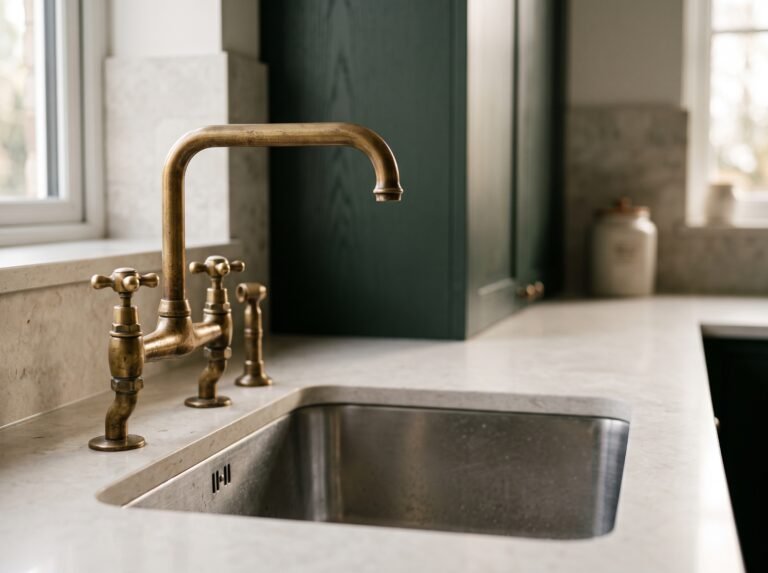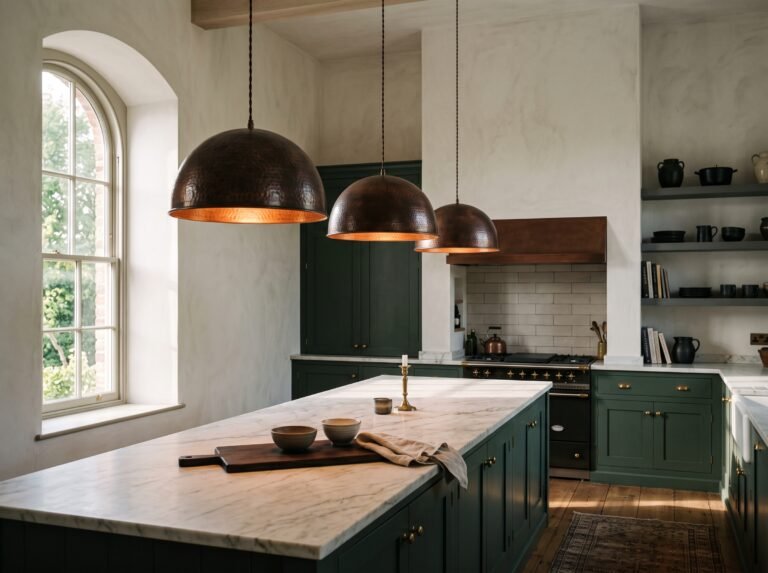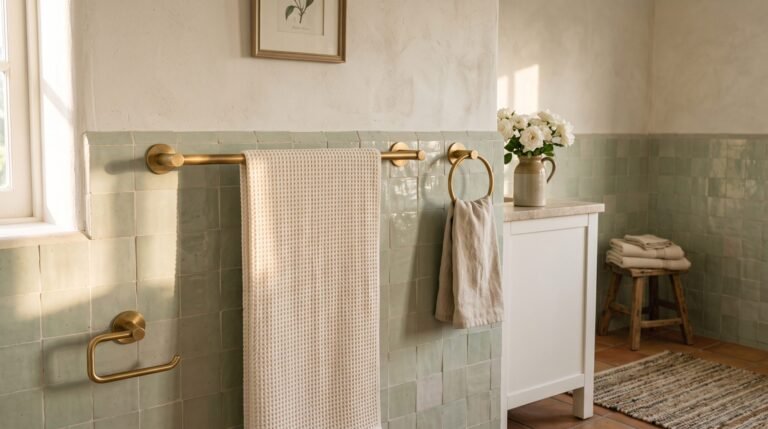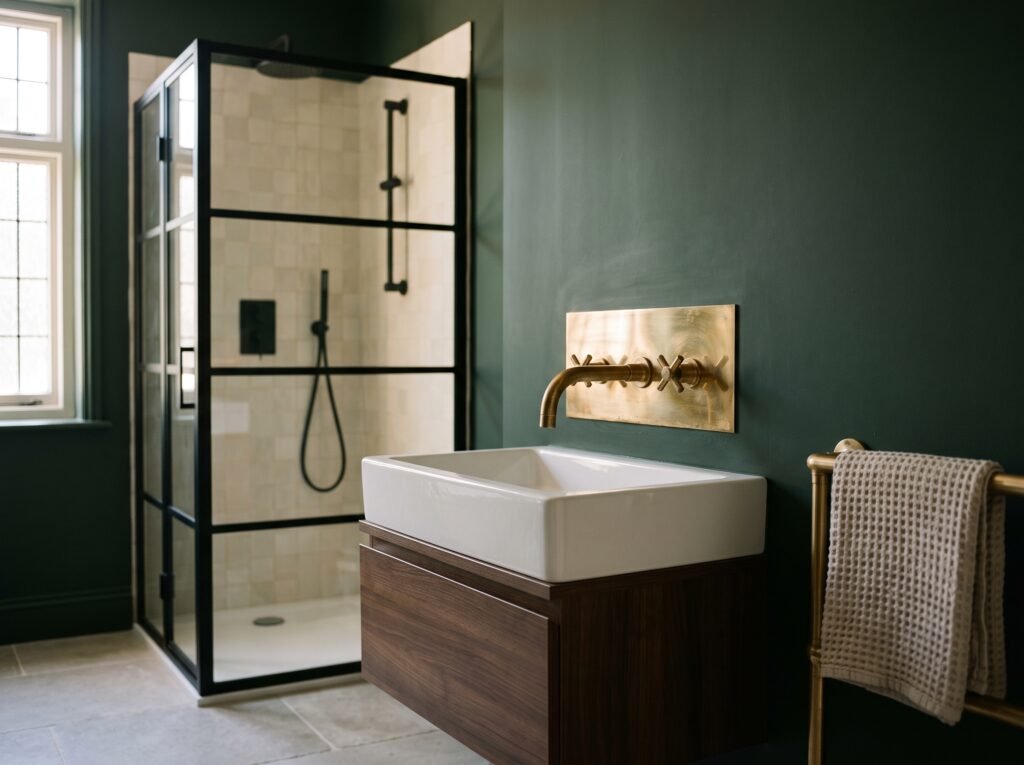
Mixing metals in a bathroom is a question of proportion rather than permission. Two finishes, three at the outside, one of them doing about two thirds of the work, and each one appearing at least twice so it reads as a decision. That is the whole rule, and everything below is detail hanging off it.
The detail worth knowing before you buy anything is this: brass fights brushed nickel and sits happily next to chrome, which is the opposite of what most people guess. And if you are shopping handmade, the choice is narrower than it looks. Of 690 bathroom listings we read across seven independent workshops in September 2026, 501 are brass and one is nickel.
How many metal finishes can one bathroom take?
Two, or three if the room is large and you are confident. Past that a bathroom stops looking mixed and starts looking unplanned, and the fix is always the same: take one out.
The trade is unusually united on this. A remodelling chain states that design consultants recommend mixing no more than three metals, and a designer puts the working version more tightly: aim for two metal finishes (three at most), and repeat each one at least twice so the design feels intentional.
That second half matters more than the count. A single brass object in a nickel bathroom does not read as mixing metals, it reads as the one thing they could not match. Repeating it twice is what converts an oddity into a scheme. This is the same rule our brass faucet with a stainless steel sink guide arrives at for the kitchen, and it travels.
One trap to name early, because it wastes the most money. Do not pick two metals from the same family. Kohler’s advice is to choose an accent by steering clear of metals in the same color family, like brass and bronze. Two warm metals that are nearly the same colour do not look mixed, they look like a failed match, and the viewer reads it as a mistake rather than a choice. That is also why the bronze question further down this page is not a pedantic one.
Which metal should be the dominant two thirds?
The one on the biggest, least movable pieces. Kohler’s split is the clearest: your dominant metal will account for around 2/3 of all metal fixtures in your bathroom, and then it’s time to choose a metal that will account for the remaining 1/3 of the fixtures.
In practice the dominant metal picks itself, because it is whatever is hardest to change. The shower fittings, the basin tap, the bath filler. The accent then goes on the pieces you could swap in an afternoon, and the usual list is knobs and pulls of vanity hardware, towel rings, lighting, mirror frames, shower trim, and accessories.
There is a sensible split by permanence underneath this. One designer recommends timeless finishes like chrome, polished nickel, or brass for permanent fixtures like faucets, shower heads, and lighting, and secondary metal finishes for mirrors, drawer and door pulls, towel bars, etc. Put the finish you might tire of on the things you can unscrew.
Temperature decides which way round it goes. Cool finishes, brushed nickel, chrome, stainless steel, suit a contemporary room, and warm ones, brass, bronze, suit a traditional one. If the room already has a lot of warmth in it, oak, terracotta, a wood vanity, the warm metal is usually the one that should dominate, because fighting the room is a harder job than joining it.
Does unlacquered brass work with brushed nickel or chrome?
Brass and chrome, yes. Brass and brushed nickel, usually not, and this is the one most people get backwards. The silver that looks warmer is the one that clashes.
The reason is undertone rather than brightness. Chrome carries a blue cast: chrome plating gives metal a slightly blue tint, which can look especially good in a cool color scheme. Brushed nickel does not. It has a slightly yellow undertone, giving it a warmer appearance than chrome, and the texture gives the finish a soft yellow or white shine.
So brushed nickel is a warm silver, which puts it a few steps away from brass on the same side of the colour wheel rather than safely opposite it. That is the same-family trap from the first section, wearing a different hat. The two read as an attempted match that missed, and the eye keeps returning to it.
Chrome does the opposite. Its blue sits cleanly against warm brass, the contrast is obvious enough to be legible as deliberate, and nobody wonders whether you tried to match them. Chrome is also usually considered more modern than brushed nickel, which is the other half of what you are choosing.
Two practical notes before you commit to either silver. Chrome shows everything: bright and shiny chrome highlights everyday blemishes, and it wants blot dry after each use rather than leaving water drops to evaporate, leading to spotting. Brushed nickel hides them, with its satin finish hiding any fingerprints, smudges, or dirt build-up, though in a wet room it can develop a milky white tarnish, particularly in humid bathrooms.
Polished nickel is the third silver and it behaves differently from both. It is bright like chrome rather than satin like brushed nickel, but it keeps nickel’s warmer cast, which makes it the one silver that sits comfortably beside brass without competing with it. It is also on the way back, named alongside unlacquered brass among the finishes replacing matte black, offering warmth without requiring constant maintenance. It costs more than chrome, which is the reason most bathrooms do not have it.
There is also a wear argument that cuts against the obvious choice. Chrome is hard but brittle in one specific way: once chrome is cracked or damaged, it loses its protective abilities, whereas brushed nickel is super resilient to scratches. In a family bathroom that is a real consideration, and it is the strongest case for keeping nickel and treating brass as something for another room.
If you already own brushed nickel and love the brass, the honest answer is to make the brass numerous rather than apologetic, or to move it to a different room.
What about matte black?
It still works with brass, and it is the easiest second metal there is, because black is not really competing on temperature. The caution is about how common it has become rather than how it looks.
Black pairs in both directions. The 2026 reading is to use matte black for structural, highly visible elements (like shower framing and cabinet pulls) and brushed brass on the pieces you want noticed, or to run it the other way with brass as the hero.
The reason to think twice is saturation. One trend write up puts it bluntly: matte black hardware became so common after the pandemic that it started reading as a builder-grade default rather than a design choice, and what is replacing it is unlacquered brass and polished nickel. The same piece is fair about what that means for you: it isn’t necessarily wrong to keep if you already have it and like it and is simply plateauing rather than vanishing entirely.
Black is also not maintenance free. It shows water spots and mineral buildup more visibly than alternatives, which in a hard water area is a daily wipe rather than a weekly one.
Which pieces have to match, and which do not?
Two pieces have to agree: the tap and the drain under it. Everything else is a choice, as long as each finish appears more than once.
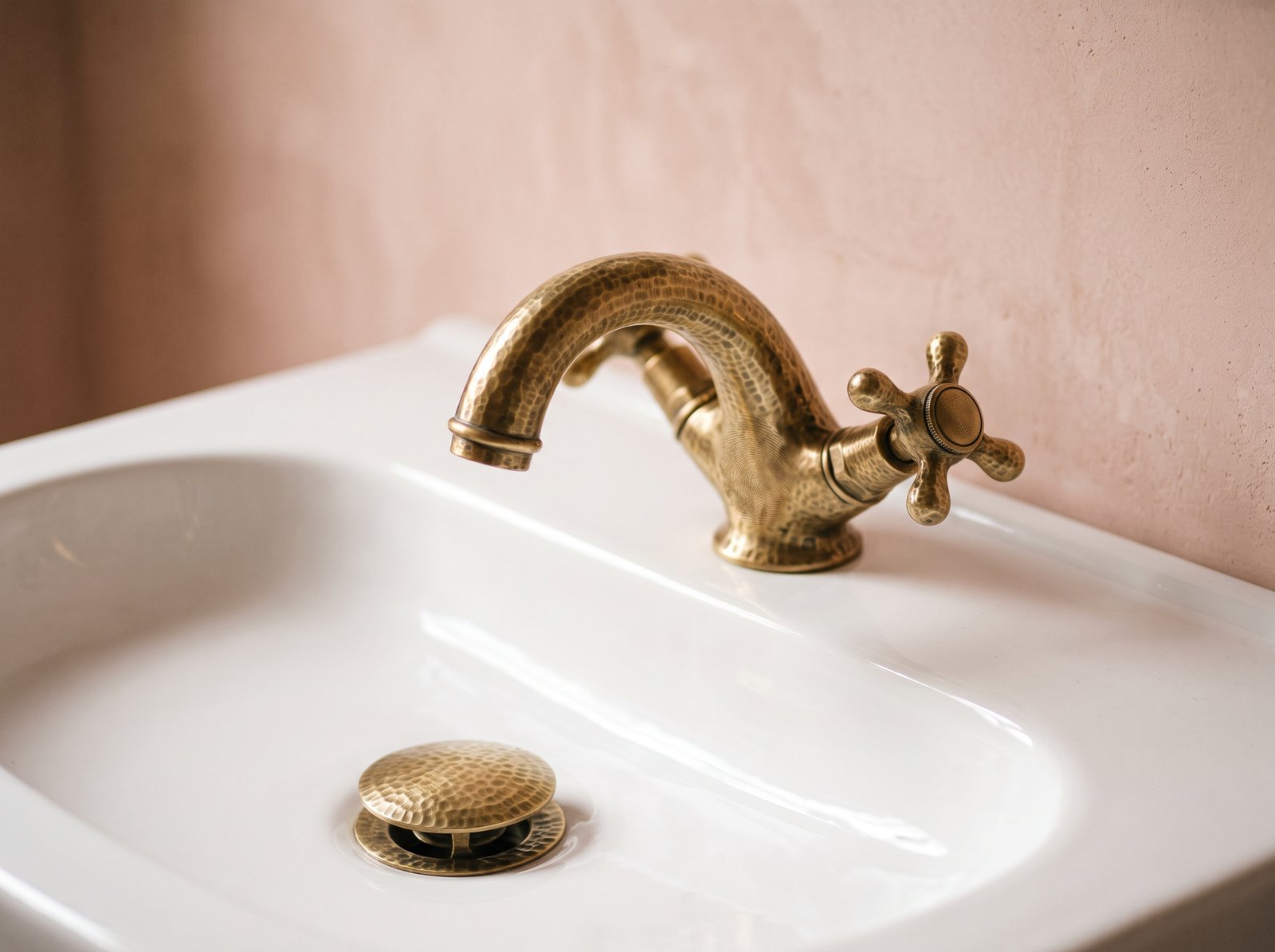
The tap and the drain sit in the same glance, inches apart, with nothing between them. A brass tap over a chrome waste is the single most common mixed metal mistake in a bathroom, and unlike the others it is not readable as intentional. The same goes for a shower valve plate and the shower head above it.
After that, the rules loosen a long way. Cabinet hardware doesn’t have to match your faucet, but there is a condition attached: repeat that hardware finish somewhere else in the room, in the mirror frame or the lighting, so it has company. That is the repeat rule doing its work again.
A short way to plan it. Write down every metal thing in the room, the tap, the drain, the shower fittings, the towel bar, the ring, the robe hook, the roll holder, the mirror frame, the vanity pulls, the light. Assign about two thirds of that list to the dominant finish and the rest to the accent, and check that no finish appears only once. If one does, either add a second piece in it or move that piece to the dominant metal.
What do you do about a shower valve you cannot change?
Change the trim instead of the valve. The finish you see is a separate part from the plumbing in the wall, and swapping it is an afternoon job rather than a renovation.
The numbers are friendly. Replacing tub and shower faucet trim runs to 1 hour or less at a cost of $20-$150, and it does not involve opening the wall, since you are replacing the handle and the trim rather than redoing any plumbing.
The catch is compatibility, not difficulty. A plumber’s write up notes that when a valve is unusual, if your valve model is older or not commonly found, a universal trim kit might be your best bet, and that those kits are typically adjustable and come with components that can fit various valve types. The low tech way to find out is the one Family Handyman gives: take the old handle and trim to a plumbing supply store to find a matching replacement.
This changes the order you should spend in. The shower is usually assumed to be the fixed point that everything else has to match, and for about a hundred dollars it often is not.
Is that bronze actually bronze?
Probably not, and it matters here more than anywhere, because the one firm rule is not to pair two metals from the same family. If your bronze is brass, you have not mixed anything.
We counted this. Of 30 listings with the word bronze in the title read across seven independent workshops in September 2026, 26 describe the item as brass in the listing text, and not one says the item is solid or cast bronze. The word is being used for a colour rather than an alloy, which is normal in the trade and fine in itself, but it means a bronze towel bar and a brass tap may be the same metal in two shades.
The two are genuinely different metals. Brass is an alloy of copper with zinc added, commonly about 55% to 95% copper and 5% to 45% zinc, while bronze is an alloy of copper and tin, typically about 88% copper and 12% tin. You can often see it: bronze metal often has a slightly reddish or pinkish hue compared to the more yellowish color of brass.
The practical test is to read the description rather than the title, and to ask the workshop which alloy it is if the description is silent. Our guide on copper, brass and bronze sets out how the three actually differ in colour, cost and ageing.
Oil rubbed bronze is the version most often paired with brass in the design press, and the pairing does work visually, because the finish is dark enough to read as a different thing. Just know that you are combining a dark warm finish with a bright warm one rather than combining two alloys.
What can you actually buy from a workshop?
Warm metal, almost exclusively. If your plan needs a handmade cool finish, the plan needs changing, because that side of the market barely exists.
We read all 1,633 listings at the seven workshops JustGetDeal follows in September 2026 and counted what finish each one names. Of the 690 bathroom listings among them, 501 name brass and 175 name copper. Twenty two name black, 13 name bronze, 11 name chrome, and one names nickel.
| Finish named in the title | Bathroom listings | Out of |
|---|---|---|
| Brass | 501 | 690 |
| Copper | 175 | 690 |
| Black | 22 | 690 |
| Bronze | 13 | 690 |
| Chrome | 11 | 690 |
| Gold | 3 | 690 |
| Nickel | 1 | 690 |
That is worth setting against what the mass market is doing, where chrome is one of the most popular bathroom finishes for 2026 and 2027 and brushed nickel isn’t one of the top metal finishes for 2027. The two halves of the market are pulling in opposite directions, and that is useful rather than awkward.
One nickel listing in 690 is the number to plan around. It means a mixed metal bathroom built on handmade pieces will have a warm dominant finish and take its cool accent from a mass market brand, or the other way round: the big brand supplies the shower and the basin tap, and the workshop supplies the two or three warm pieces that make the room look like nobody else’s.
That is not a compromise. It is the cheapest version of this whole idea, because the warm pieces that carry the character are the small ones. Hooks start at $49 and a towel bar at $80, against $300 and up for a tap.
Here are the two ways that plays out, priced.
If brass is the dominant two thirds. The tap is the piece that sets the room and the one you are least likely to change, so it carries the finish. Then the rule asks for the brass to appear again, twice, on things you can fit yourself. About $608 for the three.


If brass is the accent third. The bathroom already has chrome or black on the tap and the shower, and you are adding the warm metal rather than leading with it. Not one of these needs a plumber or touches a pipe, which is why this is the version that suits a rented flat or a room you are not ready to redo. About $535 for the three.


The full read, with the method and the dataset, is in the September 2026 listings study, and the counts on their own are on the statistics page.
Can you get a discount on brass bathroom fittings?
Usually, and it matters most on the accent pieces, because those are the ones you buy two or three of. Ten percent off a pair of hooks and a towel bar is most of the cost of a third piece.
CopperKesh has been running KESH10 for 10 percent off with no minimum, and Zayian has been running free worldwide express shipping instead of a percentage. Codes here expire quietly, so we retest and publish the date rather than the promise: the current state is on the CopperKesh and Zayian store pages, and how we verify codes explains the method.
So, which metals and in what proportion?
Pick two. Give one of them about two thirds of the metal in the room, on the pieces that are hardest to change, and make sure the other appears at least twice. Keep the tap and the drain in the same finish, because those two sit in one glance and nothing else in the room does.
If the warm metal is brass, put it against chrome or matte black rather than brushed nickel, since nickel is the warmer silver and lands too close to brass to read as a contrast. Check that anything sold as bronze is not simply brass in a darker shade. And before you assume the shower dictates everything, price a trim kit, because an hour and $20 to $150 may move the fixed point.
Then browse aged brass bathroom taps for the dominant piece and brass towel bars and hooks for the two accents that make it a scheme.
Get new tested codes by email
One email on Friday: the codes that passed our checkout test that week, the ones we pulled, and new guides. Quiet week, short email.