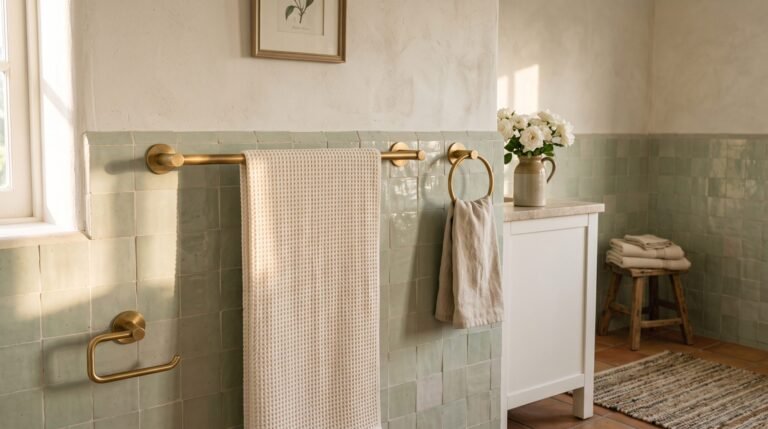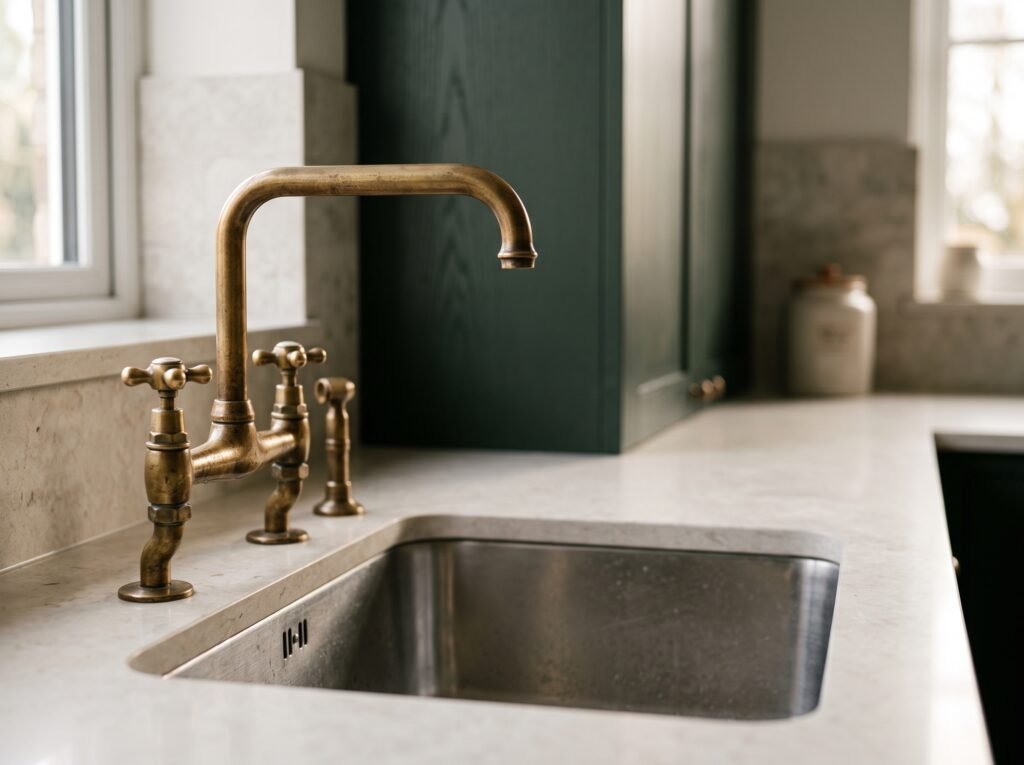
Yes. A brass faucet with a stainless steel sink under it is a pairing designers choose on purpose, and it has been in good kitchens for as long as both metals have existed. The worry that the two finishes clash is the one thing on this page you can stop worrying about.
The real problems are the ones nobody asks about until the box arrives. Will the shank go through the hole your sink already has. Is the deck thick enough to clamp against. Can the faucet legally be fitted to drinking water in the United States, and can the seller prove it. We read all 308 handmade brass sink faucet listings at the seven workshops we follow on 17 September 2026 to find out how many answer those questions. Three of those 308 brass faucet listings state a hole size.
Does a brass faucet actually look right on a stainless steel sink?
It looks better than a brass faucet on a brass sink, because the stainless gives the warm metal something cool to sit against. Designers treat this as a basic move rather than a risk, and the advice is consistent enough that it has become a rule of thumb.
The starting point is that stainless is not a neutral absence of colour, it is a finish with a temperature. Designer Sarah Gibson writes that in her own kitchen she mixed antique brass, polished nickel, and yes… even a little stainless, which is three finishes in one room and reads as deliberate rather than accidental. If you already own stainless appliances, the advice is to consider stainless steel as one of your metal finishes rather than pretending it is invisible. Count it, and you have used one of your three before you buy anything.
Three is the ceiling most designers give. Most interior designers recommend selecting no more than three metal finishes for one room, and Gibson puts the same limit more bluntly: sticking with 2-3 metals. A kitchen with a stainless sink, a stainless range, brass cabinet pulls and a brass faucet has used exactly two, which is why that combination keeps appearing.
The rule that makes it look intentional rather than accidental is repetition. I also like to repeat each finish at least twice in the room, Gibson writes, which is the difference between a brass faucet that looks chosen and a brass faucet that looks left over from the last kitchen. One brass object in a stainless room is an orphan. A brass faucet with brass cabinet pulls, or a brass faucet with a brass pot rack above the island, reads as a decision.
There is one case where the pairing genuinely fights itself, and it is worth naming. Jane at Home lists chrome, polished nickel, and brushed nickel together as the cool metals, and says that with stainless appliances it’s a good idea to consider stainless steel as one of your metal finishes. Brushed nickel sits so close to stainless that a kitchen with stainless appliances, a nickel faucet and brass hardware has not really mixed three metals, it has mixed two and blurred one. If you want the brass to be seen, put it against the stainless, not beside a metal that is almost stainless.
Brushed or unlacquered brass is the other choice to settle, and the rule is to pick one and repeat it. Gibson is clear on it: I’d never mix satin brass with polished or living brass, and you should stick to the same finish for each metal you incorporate. Both sit well against stainless. The difference is time: a brushed brass faucet keeps the finish it came with, while unlacquered brass darkens where hands and water touch it, which our guide to lacquered and unlacquered brass explains. What looks wrong is a brushed faucet beside unlacquered cabinet pulls, two golds that almost match.
Will the brass and the stainless corrode where they touch?
In a domestic kitchen, no. Galvanic corrosion needs three things at once, and a faucet sitting in a sink deck has at most two of them for a few minutes a day.
The definition is precise. Galvanic corrosion is an electrochemical process in which one metal corrodes when it is in electrical contact with another, different metal, and both are in the presence of an electrolyte. All three conditions are required: two dissimilar metals, an electrolyte, and a conducting path between them. Tap water is a weak electrolyte, a wet sink deck dries within the hour, and in most installations the faucet does not touch the steel directly anyway.
That last point is the one that settles it. Every deck mounted faucet ships with a gasket or an O ring between its base and the sink, plus a washer and nut underneath, and those parts are rubber or plastic. The textbook prevention is exactly that: electrically insulate the two metals from each other. If they are not in electrical contact, no galvanic coupling will occur. A faucet installed with the parts it came with is already insulated, without anybody planning it.
Even with bare metal on bare metal, the pairing is a mild one. In the galvanic series, stainless steel 304 (passivated) and 316 sit near the noble end, and the brasses sit a little below them, which is a short distance rather than a long one. The rate of attack depends on the electrolyte, the difference in nobility, and the relative areas of the anode and cathode, and here the difference is small and the wet time is short.
The corrosion you will actually see in a stainless sink has nothing to do with the faucet. It comes from chlorides sitting still. Sink makers warn plainly: do not leave standing solutions of chlorine bleach and water in the sink for extended periods of time, and do not leave wet sponges, cloths, cleaning pads, rubber mats or dishpans in the sink. This could lead to surface rust or possible pitting. Chlorides are in most all soap, detergents, bleaches and cleansers, so the rule is to rinse and not to leave things sitting. A brass faucet has no part in that, and a rubber mat left overnight does more damage than the faucet will in a decade.
Will the faucet fit the holes your stainless sink already has?
This is where handmade faucets actually go wrong, and it is the question the listings are worst at answering. A stainless sink arrives with its holes already punched, so the faucet has to suit the sink rather than the other way round.
The usual figure is 1-3/8 inches, about 35 mm. Kohler states that unless a model says otherwise, the hole size of the sink should be 1-3/8″ in size, and stone fabricators drilling a counter work to the same number, because a standard single-hole faucet almost always needs a 1-3/8″ (35 mm) opening. A slightly oversized hole is not a problem, since the base or the escutcheon covers it. A hole that is too small is a problem, and on a stainless sink you cannot enlarge it neatly without the right hole saw and a steady hand.
Hole count matters as much as diameter. A single hole sink takes a single hole faucet. A three hole sink usually wants an 8 inch spread, which is the distance between the outer hole centres, and a bridge faucet is built for exactly that. Put a single hole faucet on a three hole sink and you are buying a deck plate to cover the other two. This part the workshops do handle: of the 308 listings we read, 116 name a hole configuration such as single hole, three hole, widespread or an 8 inch spread. It is the only installation fact most of those 308 listings state.
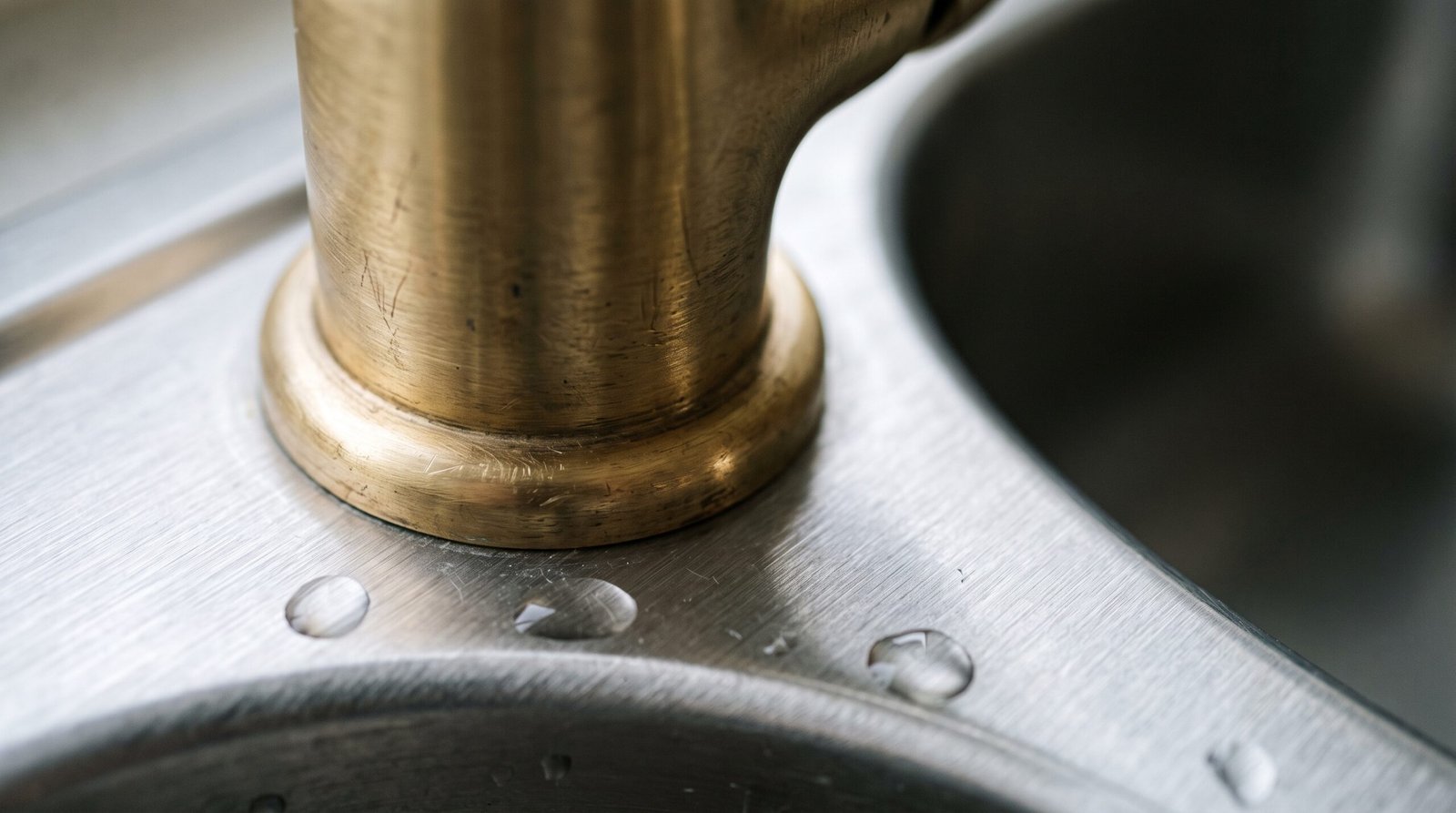
The second trap is the deck itself. A stainless sink deck is thin metal, not stone. Sink gauges run 16 gauge: 1.5 mm, 18 gauge: 1.2 mm and 20 gauge at roughly 0.95 mm, so the material your faucet clamps to is about a millimetre thick. Faucets built for a 30 mm stone counter can have a threaded shank so long that the nut runs out of thread before it grips, and heavy handmade brass on a thin unsupported deck is the combination that eventually works loose. Thickness matters most where there is nothing underneath, which is why choose 16 gauge (1.5 mm) when the steel has to carry itself.
One listing in 308 states a deck thickness. Three state a required hole diameter, and the one that does gives 1.25 inches, which is smaller than the usual punch, not larger. If you are ordering a handmade faucet for a sink you already own, measure the hole with a ruler, measure the deck, and send both numbers to the workshop before you pay. That one message prevents almost every version of this problem.
What if your sink is undermount and the faucet goes in the counter?
Then the sink has no holes at all, and every hole question moves to the countertop. An undermount stainless sink is fixed below the worktop, so the faucet is drilled into stone, quartz or timber behind it.
That changes the numbers in your favour. You are no longer matching a punched hole, you are specifying one, so a handmade faucet with an unusual shank can simply have the hole drilled to suit it. The standard bit is still 1-3/8″ (35 mm), and position is a choice rather than a given: standard faucet placement sits 2″ to 4″ behind the sink rim, centered side to side unless the faucet says otherwise.
It also changes the deck problem completely. Stone is 20 to 30 mm thick, so a shank that was too long for a 1.2 mm sink deck is now the right length, and a shank built for thin metal may be too short. This is the one case where a handmade faucet’s odd dimensions stop mattering, as long as you tell the fabricator before the stone is cut.
The warning worth repeating is about drilling after the fact. With an undermount sink, the area near the rim has no support below. Prop a brace or an adjustable rod up from the cabinet floor to the underside of the stone at the drill point. Drilling a finished worktop is a job for someone with a wet drill and something to lose, and it is cheaper than a replacement slab.


Is a handmade brass faucet legal to fit in a US kitchen?
Only if it is certified lead free, and this is the single biggest risk in buying a handmade brass faucet from a small workshop abroad. The law is not vague and it is not new.
The Safe Drinking Water Act defines lead free as a weighted average of 0.25% lead calculated across the wetted surfaces of a pipe, pipe fitting, plumbing fitting, and fixture and 0.2% lead for solder and flux. It applies to any pipe, any pipe or plumbing fitting or fixture, any solder, or any flux used in plumbing that provides water for human consumption. A kitchen faucet is the clearest possible example of that.
Certification is the part buyers miss, and it reaches the seller rather than you. Manufacturers and importers who introduce into commerce plumbing products that are not certified as “lead free” may be subject to enforcement and penalties under the Safe Drinking Water Act. Importers buying from manufacturers with ten or more employees must demonstrate compliance by obtaining third-party certification by an ANSI accredited third-party certification body. Those certification requirements became enforceable on September 1, 2023, and the penalty is not symbolic: as of January 8, 2025, a person may be liable for a maximum civil penalty of $71,545 for each day in which such violation occurs.
Sixteen of the 308 listings we read mention lead free at all, and mentioning is not certifying. Forty claim US compatibility, usually as a phrase like “Standard US Plumbing (1/2 inches)”, which describes a thread and says nothing about lead. Ask the workshop one question in writing: is this faucet certified to NSF/ANSI 372, and who issued the certificate. A yes with a certifier’s name is worth more than any product description.
Flow rate is the smaller half of the same question. Faucets sold in the United States have had to meet 2.2 gpm at 60 psi maximum flow rate standard for all faucets (both kitchen and bathroom) since 1998, and the federal rule covers everything manufactured and sold in the United States after January 1, 1994. A WaterSense labeled bathroom faucet goes further at 1.5 gpm against a standard flow of 2.2 gallons per minute. Nineteen of the 308 listings state a flow rate. In practice the aerator decides this, and an aerator is a five dollar part you can change, so it is a question to ask rather than a reason to walk away.
Will hard water eat the zinc out of the brass?
Probably not, but the answer depends on an alloy the seller almost never names. Dezincification is the one corrosion problem that belongs to brass rather than to the pairing, and it is worth understanding before you assume that heavy solid brass is automatically the durable choice.
It is the process where the zinc leaches out of the alloy and leaves a weakened, porous copper structure behind. The old rule of thumb was that any brass above 15 percent zinc was at risk, and that rule is now disputed by the people who make the alloys: brasses with zinc greater than 15% show no dezincification problems when using the metallurgical advancements of the last 100 years, and C36000, a 35+% zinc leaded brass served potable water for decades.
What makes an alloy genuinely resistant is specific and small. Resistance comes from minor alloying additions (0.20% max): Arsenic (As), Antimony (Sb), Phosphorus (P), from larger additions of nickel, tin or aluminium, or from thermal treatments such as high temperature annealing or forging. None of that is visible in a photograph, and none of the 308 listings we read names an alloy at all.
The practical reading is this. Aggressive or very soft water plus a cheap unspecified alloy is the risk case, and it shows up as a pink tinge on the metal or a fitting that crumbles at a thread years later. A workshop that can name its alloy, or that sources its cartridges and waterway parts from a certified supplier, is telling you something real. One that says only “solid brass” is telling you the colour.
Should the drain and strainer match the faucet or the sink?
Match the faucet. The strainer sits in the sink, but the eye reads it as part of the tap set, and a brass strainer in a stainless bowl is the small detail that makes the whole pairing look planned.
The sizes are standardised in your favour. A standard kitchen drain is 3 1/2 inches in diameter with a connecting pipe of 1 1/2-inch diameter, so a brass basket strainer bought separately will fit almost any stainless kitchen sink sold in North America. Bathroom basins are different, where most bathroom sink drain openings are 1 1/4 inches, so do not buy one set expecting it to serve both rooms.
There is a caveat that the care instructions make for us. A brass strainer left sitting wet in the bowl is exactly the kind of metal object the sink makers warn about, since leaving wet items in a stainless sink could lead to surface rust or possible pitting. A fitted strainer that lives in the drain is fine. A loose brass basket left in the bowl overnight with water around it is not, and unlacquered brass will mark the steel with its own oxide as well.
If you would rather not commit, stainless strainer with a brass faucet still works. It is the single brass object problem again: with brass cabinet pulls or a brass pot rack in the room, the faucet has company and the drain does not need to do that job.
How will the brass look in a year, next to stainless that never changes?
Different, and this is the decision most people are actually making when they ask about mixing the two metals. Stainless steel looks the same in ten years. Unlacquered brass does not, by design.
Of the 465 unlacquered brass listings we read across all categories, 330 warn that the finish darkens, so the workshops are honest about it. Beside a stainless sink the change is more visible than it would be in an all brass room, because the steel gives your eye a fixed reference. The faucet goes from bright yellow to a deeper, browner gold, and the areas your hand touches stay brighter than the areas it does not.
That is either the point or the problem. If you want the pairing to hold still, buy a lacquered or a satin brass finish and accept that it will never develop character. If you want the living finish, the honest expectation is that the faucet will look noticeably different by the second winter and settle after that. Our guide on whether unlacquered brass tarnishes covers the timeline, and how to clean unlacquered brass covers the part where you decide whether to polish it back.
One thing that makes the pairing easier: the two metals want the same care, which is to rinse and dry. The sink makers ask for THOROUGH rinsing of your sink after each use to remove any chloride residue, and that is the same habit that keeps water spots off raw brass. One cloth does both, and the pairing asks nothing of you that the sink did not already ask on its own.


What do the workshop listings tell you, and what do they leave out?
On 17 September 2026 we read every sink faucet listing at the seven workshops JustGetDeal follows, 308 listings in all, and counted what each one states. The pattern is consistent: they describe the look in detail and the plumbing barely at all.
| What a buyer needs to know | Listings that state it | Out of |
|---|---|---|
| Hole configuration, such as single hole or 8 inch spread | 116 | 308 |
| Spout reach | 156 | 308 |
| Cartridge type | 29 | 308 |
| Flow rate | 19 | 308 |
| Any mention of lead free | 16 | 308 |
| Thread or connection standard, such as NPT | 5 | 308 |
| Required hole diameter | 3 | 308 |
| Maximum deck thickness | 1 | 308 |
| Any mention of a stainless steel sink | 2 | 308 |
Two listings out of 308 mention stainless steel at all, which tells you how little help the seller will be with the question this guide answers. The three questions worth asking before you pay, every time: what hole diameter does the shank need, what is the maximum deck thickness it clamps to, and is the faucet certified lead free.
The whole question is which holes your sink already has, so here is one of each, with the hole it needs.


The full read, with the method and the dataset, is in the September 2026 listings study, and the counts on their own are on the statistics page.
Can you get a discount on a brass kitchen faucet?
Yes at the stores we test, and on a $600 bridge faucet the difference is worth two minutes of checking. CopperKesh had a store wide code in September 2026 and Zayian was running free worldwide express shipping, both tested in a real basket before this guide went out.
Codes in this category expire quietly, which is why we retest twice a day and publish the date rather than the promise. Current offers are on the Zayian and CopperKesh store pages, and how we verify codes explains the method if you want to see it.
So, does a brass faucet work with a stainless steel sink?
Yes, and the looks were never the risk. Count the stainless as one of your finishes, keep the room to three, repeat the brass at least twice so it reads as chosen, and the pairing takes care of itself.
Spend the attention on the three facts the listings do not give you. Measure the hole and the deck before you order, ask for the lead free certificate in writing, and expect unlacquered brass to darken while the steel stays exactly as it is. Then browse brass kitchen faucets with the codes we have checked, and read the copper farmhouse sink buying guide if you are still deciding on the sink itself.
Get new tested codes by email
One email on Friday: the codes that passed our checkout test that week, the ones we pulled, and new guides. Quiet week, short email.