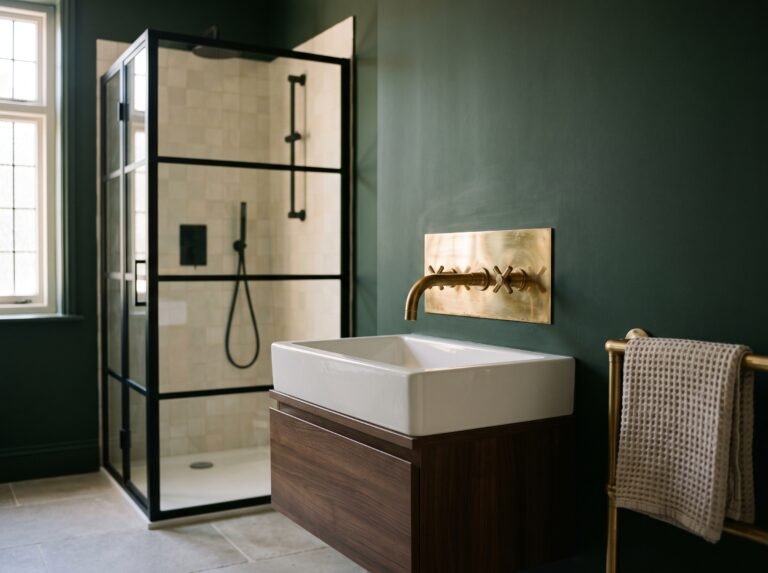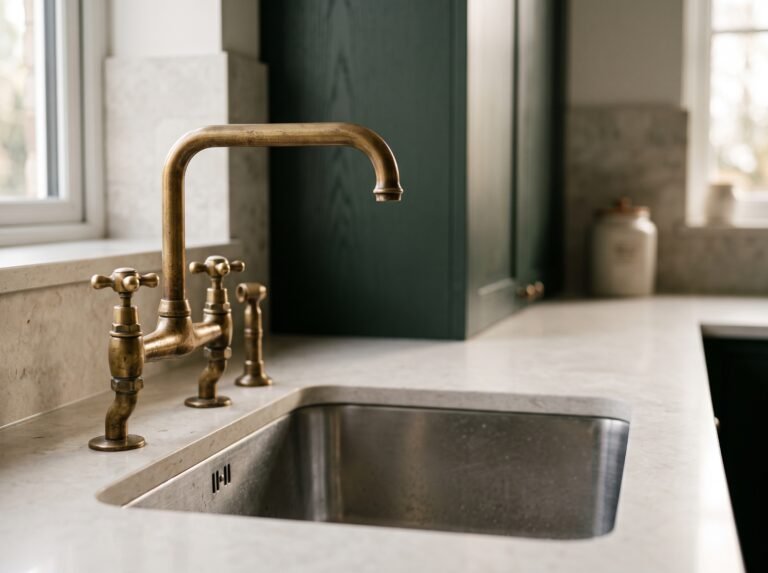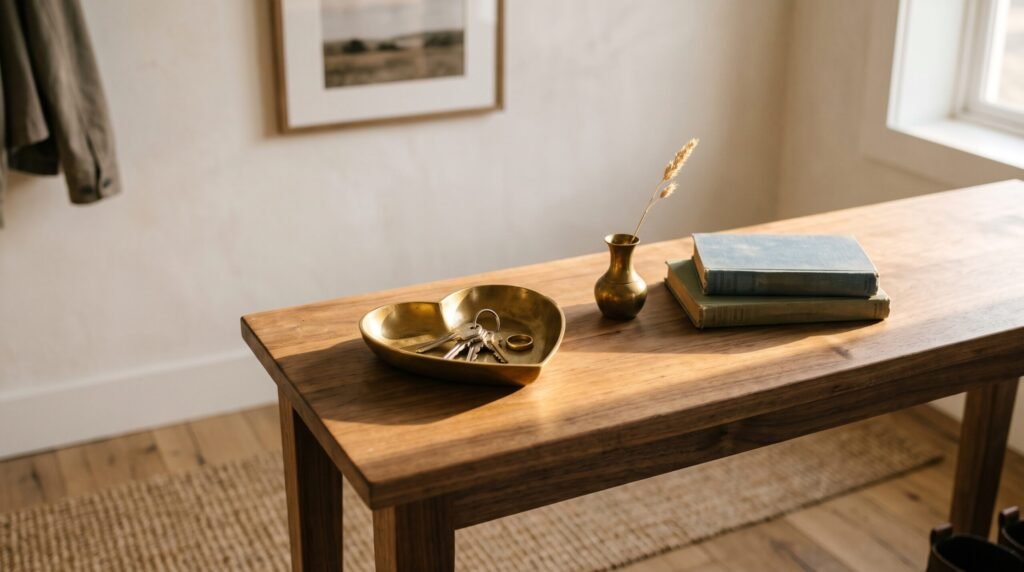
Solid brass decor is brass all the way through, so it gets better with age instead of wearing through to a gray metal underneath. A solid brass vase, tray or catchall bowl darkens slowly where the air reaches it, stays bright where hands rub it, and can be polished back to gold at any point in its life. Plated pieces look the same in a shop and very different after a few years.
This guide covers how to tell solid brass from plated, what happens to the color, whether a brass vase can hold fresh flowers, what a tray or catchall is for, how to clean brass without stripping it, and which pieces make a good gift. We also read every brass vase, bowl, dish, tray and candle holder listing at five small workshops in November 2026, and the numbers are near the end.
What counts as solid brass decor?
Solid brass decor is any decorative piece made from a brass alloy throughout, rather than a cheaper metal with a thin brass coat. The word “solid” is about the whole object, not the finish on top.
Brass itself is a simple metal. It is an alloy of copper and zinc, in proportions which can be varied to achieve different colours and mechanical properties, which is why one brass bowl can look rosy and another pale and yellow. The Canadian Conservation Institute, which advises museums on metal care, notes that freshly polished brass is usually yellow, although sometimes it may be red. More copper gives the warmer, redder tone. More zinc gives the paler one.

“Solid brass” is a claim about what the object is made of. A guide to antique brass puts it plainly: the term means an item made from brass alloy throughout, not just a surface coating. The same guide adds a warning that applies to new decor too: many antique brass pieces are solid, but some are merely plated with a thinner brass coating. A plated vase is usually steel, iron or zinc alloy with a brass skin a fraction of a millimeter thick.
Much of the world’s handmade brass decor comes from a few craft towns. One of the best known is Moradabad in northern India, which is sometimes called Pital Nagri (“Brass City”) for its brass handicrafts, which are exported across the world, and whose metalcrafts industry accounts for more than 40% of total handicraft exports from India. That is why “brass vases from India” is one of the most common searches people type. Morocco, Turkey and Indonesia have the same tradition, and the small workshops whose codes we check are mostly in Morocco.
Brass has been a decorating metal for a long time because it looks warm and lasts. The thing that makes solid brass worth paying more for is that it can be repaired. A scratch on solid brass is brass underneath. A scratch on a plated piece shows the base metal, and no polish brings the gold back.
How can you tell solid brass from brass plated?
Start with a magnet: solid brass will not hold one, so if a magnet sticks, the piece is plated over steel or iron. If the magnet does not stick, the piece might be solid brass, or it might be plated over zinc, so check its weight and look at any worn spot.
The magnet test is the old standard. The Old Farmer’s Almanac gives it in two lines: to tell if your brass objects are solid or plated, touch them with a magnet, because solid brass won’t attract a magnet, but the metal beneath brass plating will. It works because brass is not ferromagnetic, which is the same property scrap yards use to sort it from iron with a magnet.

The test has one big blind spot. House Digest explains that a magnet sticks only when some other magnetic material underneath the brass plating is attracting the magnet. So a magnet can help you quickly rule out some brass-plated pieces, but it will not help you if there are nonmagnetic materials inside the brass plating. Zinc alloy is the common one. A cheap cast vase or tray in zinc with a brass coat passes the magnet test and is still plated.
So use three checks together:
1. The magnet. If it sticks anywhere, the piece is plated or has a steel core. Test the base, the rim and any handle, because the antique guide notes that some brass objects have iron or steel parts hidden inside. 2. The weight. Solid brass is dense. The same guide says brass is relatively heavy for its size compared to many other metals or brass-plated items. A brass catchall bowl five inches across should feel surprisingly heavy in the hand, and a hollow-feeling piece is a warning. 3. A worn or hidden spot. Look under the base, inside the rim, and on the edges that rub. The guide’s rule is that solid brass will show the same color underneath, while plated items will reveal a different metal. Gray or silver showing through a gold surface is plating wearing off.
There is a stronger test that dealers use, a drop of acid on a hidden spot. House Digest notes that it will turn green on a brass surface, and other metals beneath the brass will change the color. It damages the surface, so it is not for a new gift. For a new piece, the honest shortcut is the listing: a maker selling solid brass says “solid brass” in the title or description, and will tell you the weight if you ask. If a listing says only “brass finish,” “brass tone” or “gold,” assume it is plated.
Does brass decor tarnish, and is that a bad thing?
Yes, unless it has been lacquered, brass darkens over months as it reacts with the air, and the parts you handle stay brighter than the rest. Whether that is a bad thing is taste: many people buy unlacquered brass decor because of the way it ages.
The change is ordinary chemistry. Suffolk Latch, a hardware maker, says unlacquered brass reacts with air, moisture and regular handling because it has no coating. The Canadian Conservation Institute explains what darkens it: the tarnish on copper alloys is caused by sulfur-containing gases (e.g. from pollution, rubber, wool) in the air. How fast it happens varies with the room. Suffolk Latch says some hardware begins to show signs of change within weeks, while other pieces remain brighter for longer. A bowl near a kitchen or a bathroom will change faster than one on a dry bookshelf.

Handling makes the change uneven, and that unevenness is the look. Graff, which sells brass in what it calls living finishes, says areas that are regularly touched will tend to lighten, while less frequently used parts will gradually darken. Aston Matthews describes the same thing on handles, where the lighter brass will begin to show through. On a catchall bowl, that means a bright rim and a darker outside. On a tray, the edges you pick it up by stay gold.
Lacquered brass is the other option. A clear coat seals the metal so it stays bright, but it changes how the brass looks and it does not last forever. The Canadian Conservation Institute warns that no matter how well lacquer is applied, it always alters the appearance of an object, and when lacquer chips, the exposed patch tarnishes while the rest does not. We cover the trade-off in full in lacquered vs unlacquered brass and the timeline in does unlacquered brass tarnish.
Three things are not normal tarnish and are worth knowing. Fingerprints on a freshly polished piece leave marks, because the oils and salts in skin react with the metal, which is why the conservation note suggests cotton gloves after polishing. Green spots mean moisture or acid sat on the brass, often under a damp cloth or a leather coaster. And brown rings inside a vase come from water left standing too long. All three can be cleaned, and none is a reason to avoid brass. The way designers use it now leans into the aging: Homedit’s 2026 trend piece says muted, satin, or unlacquered brass fixtures feel calmer and more architectural.
The workshops describe it the same way. Rod & Rails sells a heart shaped dish made from solid unlacquered brass that develops a natural patina with time, and Kinycraft says of its copper fruit bowl that copper is a living material that naturally darkens and develops a unique patina over time.
Can you put fresh flowers and water in a brass vase?
Yes, if the vase is sealed inside or you change the water often, and you dry the outside when it gets wet. Standing water and plant sap are what stain brass, not the flowers themselves.
Many brass vases are coated inside for this reason. A homeware shop selling a brass vase explains that the brass is varnished to cope with being in contact with water, and gives the risk if you forget: if the water in the brass vase is not changed often, then plant fluids/particles can damage the brass, leading to discoloration. Skultuna, a Swedish brass maker, tells owners of its vases to keep the outside dry and to dry the surface immediately to avoid stains. Ask the maker whether a vase is sealed inside before you fill it.


The good news is that the habits that protect the brass are the same habits that keep flowers alive. Iowa State University’s extension service says to begin with a clean vase, that regular water changes are one of the most effective ways to prolong the vase life of your cut flowers, and to completely change the water if it becomes cloudy or begins to smell. The University of Illinois Extension adds that bacteria starts to build up in the vase water over time, so change the water every few days to prevent this, and that leaves below the waterline make it worse.
You will read online that a copper or brass vase keeps flowers fresh longer because the metal kills bacteria. Brass does have a long record here: the bactericidal properties of brass have been observed for centuries. But a sealed vase never lets the water touch the metal, and we found no florist or extension service that recommends a brass vase over a clean glass one for vase life. Buy a brass vase for how it looks. Keep the flowers alive with clean water.
If you want no water risk at all, use dried stems, branches or a glass liner inside. Wall vases suit dried flowers well, because the vase never needs emptying. Rod & Rails says its wall vase is perfect for dried flowers, fresh stems, greenery, or as a decorative multi-function organizer.
What do you put in a brass tray or catchall bowl?
The small things that otherwise end up everywhere: keys, rings, earbuds, coins, a candle, or a few pieces you want to show. A catchall is a dish that gives clutter one place to land, and a tray does the same job for a bigger group of objects.
Designers recommend one by the door more than anywhere else. A piece on Joanna Gaines’s entryway essentials says a catchall dish is a small but mighty addition to any entryway, because it keeps essentials like keys, sunglasses, or earbuds from disappearing into the depths of a coat pocket or bag. In a Hunker round-up of entry decor, designer Lauren Lerner picks a bowl because it can hold keys and other items easily by the door without looking cluttered, and Michelle Lisac chooses a small tray that is perfect for any entry to hold mail, keys or sunglasses.

Brass suits this job better than most materials, for a plain reason. Keys and coins scratch, and a scratch on solid brass is more brass. It darkens with the rest of the bowl. A painted or plated dish shows every key mark in its second year.
Where to put each size:
– A small bowl, 3 to 4 inches across, on a nightstand for rings and earrings, or by the sink for a ring you take off to wash. – A medium dish, 5 to 6 inches, by the front door for keys, or on a desk for clips and a pen. – A tray, 10 inches or more, on a coffee table or an ottoman to group a candle, a small vase and a book, or on a dresser for perfume bottles. It also keeps a damp glass or a candle off the wood.
On a coffee table, the 2026 advice is to do less. Homedit’s trend piece says one bold brass object in a room feels intentional, and that five small brass accents feel dated. Western Living traces the bad reputation brass carries to decades ago, quoting designer Robert Bailey on the habit of using brass in a very glitzy way everywhere. One good tray or bowl in a room reads as a choice. A shelf of them reads as a collection that got away from you.
The bowls below are sold as candle holders and work as catchalls too. CopperKesh says its brass bowl is not only for candles, it can hold keys, nuts and jewelry or accessories.
How do you clean brass decor without ruining it?
Dust it with a dry soft cloth, wash it in mild soap and water when it needs more, and dry it fully. Polish only if you want the bright gold back, and use the gentlest polish that works, because every polish takes a little metal and all of the patina with it.
Most of the time, cleaning means not polishing. Suffolk Latch says that if you like the aged look, leave it and wipe it with a soft dry cloth. Brass maker Skultuna is firm on one rule: brass should never be placed in a dishwasher, no matter the surface treatment. Aston Matthews advises against using scouring powders and abrasive cloths on brass of any kind, because they scratch the surface you are trying to keep.

If you do want it bright, start mild. The Canadian Conservation Institute, which writes these notes for museum staff, says the gentlest polish is to lightly rub the metal surface with a paste of precipitated chalk and water on a soft cloth. It also warns that many metal polishes contain ammonia, which can dissolve copper in some conditions, and that repeated polishing results in loss of surface detail. A heirloom with fine engraving deserves the chalk. A plain modern bowl can take a commercial polish now and then.
A household brass polish is the quick route for a piece that has gone dark and needs to shine for a party. Stylent Decor sells Brasso and tells buyers to test on a small, inconspicuous area first, which is good advice for any polish on any piece. Skultuna recommends a gentle non-abrasive metal polish, and adds: don’t use too much polishing paste at once.
Three rules protect the result:
1. Never polish plated brass hard. On a plated piece, polish removes the plating and shows the metal underneath. Skultuna says the same of its gold plated items: don’t use metal polish as this may cause the gold to come off. 2. Dry everything. Water spots and rings come from water drying on the surface. Wipe a vase, a tray under a glass, or a soap dish after it gets wet. 3. Wax if you want the shine to last. The conservation note describes a protective coat of a bleached micro-crystalline paste wax, which slows the next round of tarnish and comes off easily if you change your mind.
Our full routine, with what to use on fingerprints, green spots and dark rings, is in how to clean unlacquered brass.
Is solid brass decor a good gift?
Yes, and it is one of the few gifts with a tradition behind it. Brass is the material for a 21st wedding anniversary, and a small brass bowl or candle holder suits a housewarming, a host, or someone who is hard to buy for.
The anniversary lists disagree on the label but not the metal. Bridebook says the traditional 21st wedding anniversary gift is brass, a metal known for its durability and strength, and Love and Lavender, which calls brass and nickel the modern options, notes that there is no ‘traditional’ 21st anniversary gift. Either way, a brass vase, a pair of candle holders or a heavy bowl fits the occasion, and Love and Lavender suggests both a brass table vase and brass candlesticks as 21st anniversary gifts.


For other gifts, think about what the person will touch. A catchall dish for someone who loses their keys, a bud vase for someone who brings home a single stem, a candle bowl for a host. Solid brass pieces are also easy to give because they are hard to get wrong on size, unlike hardware or a faucet that has to fit a hole.
If you are giving a candle holder, pass on the safety basics with it, because brass gets hot. The National Fire Protection Association advises people to keep candles at least 12 inches from anything that can burn, to use candle holders that are sturdy and won’t tip over easily, and to put candle holders on a sturdy, uncluttered surface. Skultuna also says to burn within sight and to stop a candle before it burns down into the holder. A heavy brass bowl is a stable holder, which is one practical reason to choose solid over a light plated one.
Order handmade pieces early. The workshops we check make many items to order and ship from Morocco, so a December gift ordered in mid December may not arrive in time. Most list free express shipping, and CopperKesh quotes delivery to most countries within 5-7 working days, but add the making time on top.
What do the workshop listings say about brass decor?
That small brass decor is mostly solid brass, mostly under $100 at the small end, and rarely explained. On 1 November 2026 we read every brass vase, bowl, dish, tray and candle holder listing at Rod & Rails, CopperKesh, Zayian, Artihand and Kinycraft, and counted what each one says.
The five stores list 18 brass decor pieces between them: 4 at Rod & Rails, 3 at CopperKesh, 9 at Zayian, 2 at Artihand and none at Kinycraft, whose decor is copper. Of the 18 listings, 16 say “solid brass” in the title or description, and none of the 18 says “plated” or “brass finish.” Of the 18 listings, 6 say the brass is unlacquered, and none of the 18 says it is lacquered, so for the other 12 you have to ask. Only 3 of the 18 listings tell you the brass will develop a patina, all 3 at Rod & Rails.
Prices start low. The cheapest of the 18 listings is $60 and the most expensive is $390, the middle is about $95, and 10 of the 18 start under $100. Two pieces appear at two different stores with the same name, a sculptural bud vase and a candle bowl, at CopperKesh and Artihand, which suggests they come from the same workshop.
| Piece | Typical price at the workshops we read | Best for | Gift fit |
|---|---|---|---|
| Tealight or candle bowl | $60 to $150 | A table, a bath, a host gift | Easy, under $100 for one |
| Catchall or ring dish | $72 to $140 | An entry table, a nightstand | Easy, under $100 |
| Taper candle holder | $95 to $145 | A dining table, a mantel | Good in pairs |
| Bud vase or table vase | $300 to $390 | One stem, a shelf, a desk | A bigger gift, 21st anniversary |
| Wall vase | About $300 | Dried flowers by a door or in a hall | A bigger gift |
| Tray | Rarely listed by these shops | A coffee table, a dresser | Ask a workshop for a custom size |
Trays are the gap. None of the 18 listings at these five workshops is a tray, so a brass decorative tray from a small maker is a custom order or a search elsewhere. Every listing that gives a size also accepts custom sizes, so it is worth asking. Zayian lists 9 of the 18 pieces, but its code no longer works, so we do not link to it. Counts were read from each store’s full catalog on 1 November 2026.
Can you get a discount on brass decor?
Yes, at three of the workshops above. Zayian, which also makes brass dishes and tealight holders, has no working code right now, so its prices are the full price. Ten percent off the $96 Rod & Rails heart dish is about $9.60, and off the $390 CopperKesh bud vase it is $39.
Rod & Rails has been running COUPOON10 for 10 percent off, CopperKesh KESH10, and Stylent Decor, which sells the Brasso polish, JUSTGETDEAL. Codes in this category expire quietly, so we retest them and print the date rather than a promise: the current state is on the Rod & Rails, CopperKesh and Stylent Decor store pages, and how we verify codes explains the method.
So, which brass piece should you buy?
Buy solid brass, check it with a magnet and its weight, and choose unlacquered if you like the way metal ages. A small bowl or dish under $100 is the safest first piece and the easiest gift.
Choose a vase if you will keep it dry or change the water often, a catchall if keys and rings end up everywhere, and a tray only if you can order the size you need. One good piece in a room is better than five small ones. Then browse the hardware and accessories with codes we have checked, or read does unlacquered brass tarnish if the color is the part you are still deciding.

Get new tested codes by email
One email on Friday: the codes that passed our checkout test that week, the ones we pulled, and new guides. Quiet week, short email.