Bathroom mirror size is arithmetic rather than taste. You start with the width of the vanity, take a percentage of it, check the height it lands at, and the answer is a range of about four inches. Everything after that is shape and metal.
The part that catches people out is a handmade brass mirror, because the number in the listing may be the outside of the frame or it may be the glass, and those are not the same. We read every brass and copper mirror listing at the five workshops that sell them, 32 of them, in our September 2026 catalogue read. Two of the 32 give you both numbers. One of them, at 18 inches across, has 15 inches of reflection in it.
What size mirror should go over a bathroom vanity?
Between 70 and 80 percent of the vanity width, which lands the mirror two to four inches inside the cabinet on each side. Measure the vanity, take 75 percent as your first guess, then check the shape against the wall.
The rule is quoted almost identically across the trade. One bath brand puts it as the mirror should span 70-90% of the vanity’s width, and a glazier who cuts them for a living says a vanity mirror should be about 70 to 90 percent of the vanity’s width, which usually works out to two to four inches narrower than the cabinet on each side. Designers on Houzz give the same band and explain what it buys you: make the mirror about 70 to 80 percent as wide as the vanity so the mirror appears a bit smaller, but not shrunken.
There is a second rule that reads differently and is not in conflict. It says to go 4 to 6 inches narrower than the width of your bathroom vanity whatever the size. On a 30 inch vanity the two rules agree. On a 60 inch one they do not, because 70 percent gives 42 inches and a fixed 6 inches gives 54. The percentage is for a mirror that hangs as an object, which is what a framed brass mirror is. The fixed margin is for a mirror that reads as built in, edge to edge glass with no frame. Pick the rule that matches the mirror you want, not the other way round.
The full width option is also legitimate and worth naming, since a common approach is to make the mirror exactly as wide as the vanity so the two line up perfectly, but note the ceiling on it: typically, vanity mirrors are not wider than the vanity itself. Wider than the cabinet reads as a mistake rather than a choice.
Here are the common vanity widths worked through. Single sink cabinets come at 24″ (compact), 30″ (entry level), 36″ (most popular), 48″ (generous), and doubles at 60″ (entry double sink), 72″ (standard master bath).
| Vanity width | Mirror at 70 to 80 percent | With sconces beside it | Round mirror, two thirds |
|---|---|---|---|
| 24 in | 17 to 19 in | 14 to 17 in | 16 in |
| 30 in | 21 to 24 in | 18 to 21 in | 20 in |
| 36 in | 25 to 29 in | 22 to 25 in | 24 in |
| 48 in | 34 to 38 in | 29 to 34 in | two mirrors, not one |
| 60 in, one basin | 42 to 48 in | 36 to 42 in | two mirrors, not one |
| 60 in, two basins | two at 20 to 24 in | two at 18 to 21 in | two at 20 in |
| 72 in, two basins | two at 25 to 29 in | two at 22 to 25 in | two at 24 in |
For a double vanity the sizing is done per basin rather than per room. Each mirror should be inset an inch or two from the edge and centered over each basin, and the calculator version of the same idea is to subtract 8 inches from the vanity’s width and split what is left.
Height is the part people forget to check. A useful floor is that a functional mirror needs only to reach about a foot above and below the eye line of the people who will be using it, and a useful target is to try to reach at least 4 to 7 feet above the floor. In stock sizes that usually means a mirror that is about two-thirds the height of your vanity or 30-40 inches tall.
Does the stated size mean the frame or the glass?
On a handmade brass mirror you cannot assume, and the difference is large. A frame heavy enough to be the reason you bought it takes its width out of the reflection, not out of the wall.
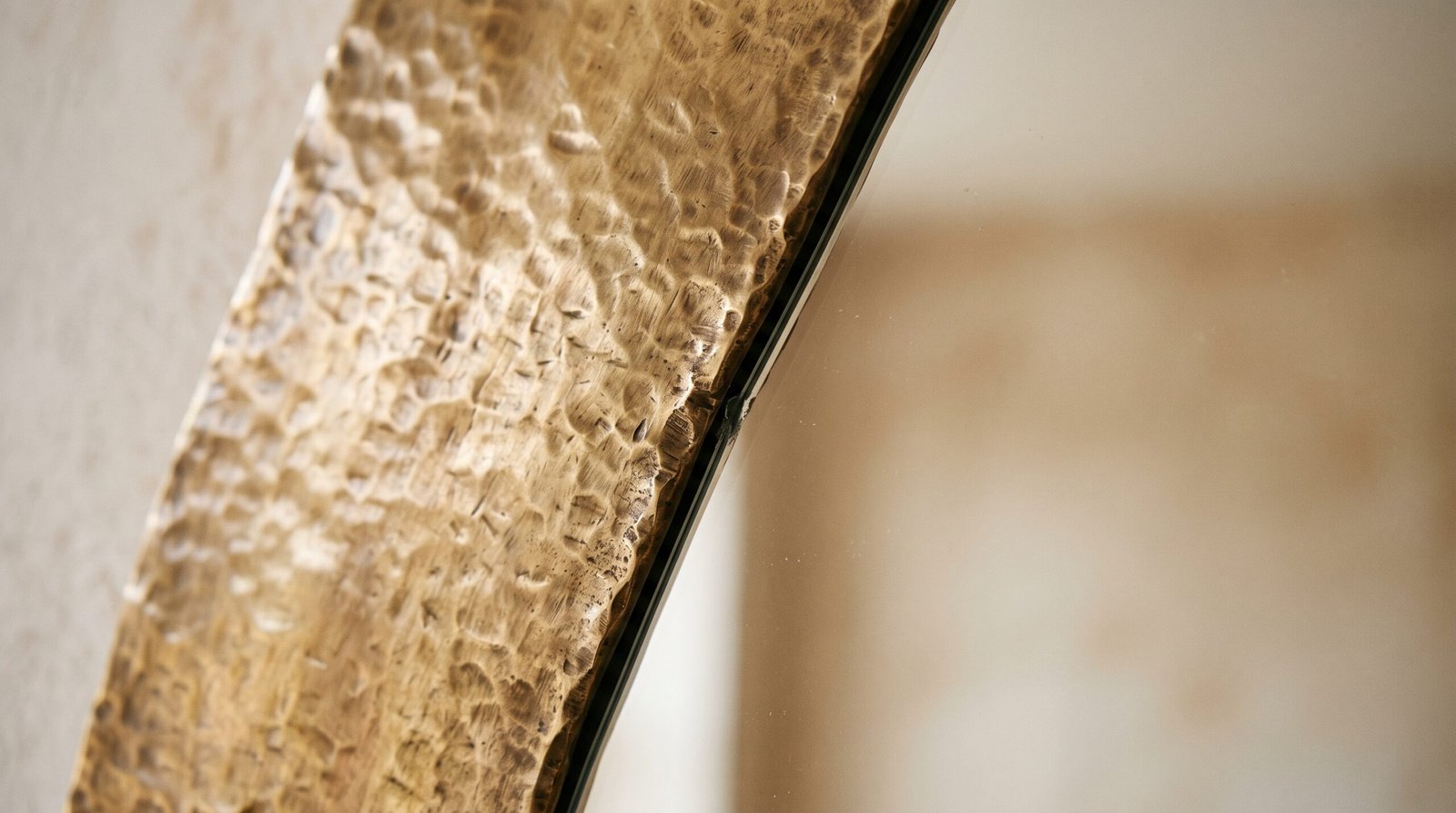
This is measurable in the catalogues rather than a matter of opinion. One CopperKesh listing sells the same round brass mirror in sizes written as 18 In / 15 In and 23 In / 20 In, which is the outside of the frame followed by the glass inside it. Three inches of brass all the way round, on every size. Buy the 18 and you have hung an 18 inch object holding a 15 inch reflection.
Two listings out of the 32 we read state it that way. The other 30 give a single number, and a typical example reads 18 inches (45cm) 24 inches (61 cm) 30 inches (76cm) 36 inches (91cm) with nothing to say which measurement that is. On a wide frame the ambiguity is worth about 20 percent of the reflecting surface.
It matters because every sizing rule above is written about the mirror as an object on the wall, so the outside diameter is the number to put into them. The glass number is the one that decides whether two people can use it, or whether you can see your whole face while standing back. Ask the workshop for both before you order, in writing, and treat a listing that gives both as the more careful seller.
How big should a round brass mirror be?
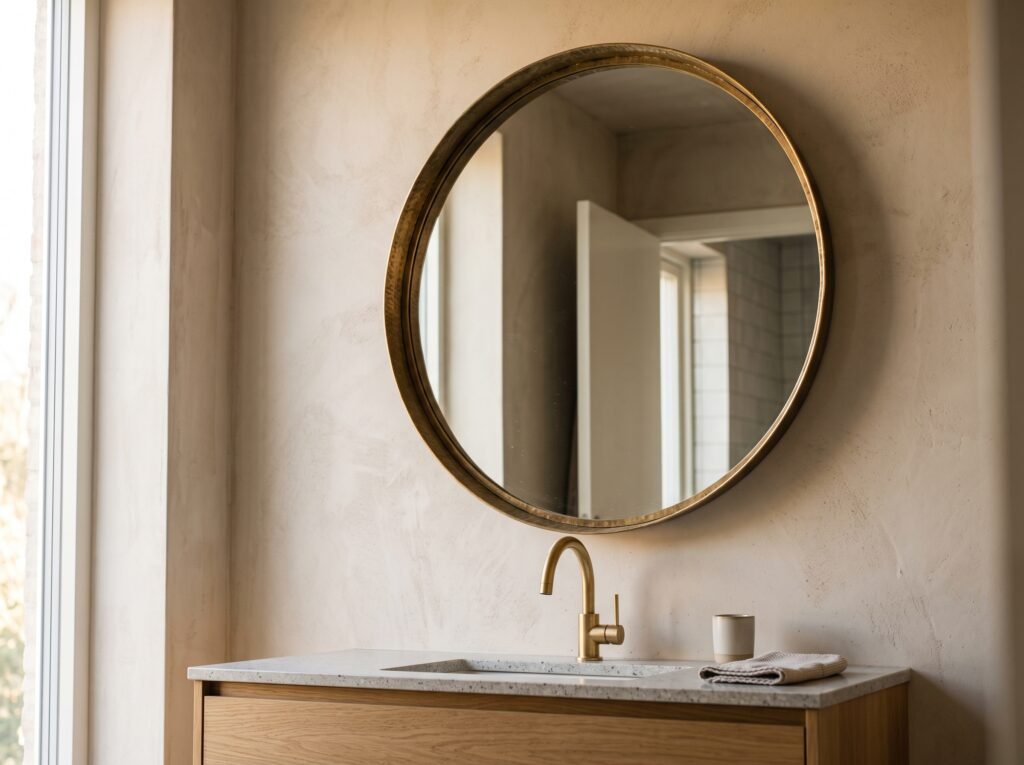
Two thirds of the vanity width, which is smaller than the rectangular answer. A circle sized like a rectangle overwhelms the wall, because its diameter is its height as well.
The rule of thumb is that the diameter should be roughly two-thirds of the vanity width, so a 36 inch vanity takes a 24 inch mirror and a 30 inch vanity takes a 20 inch one. That is the size band nearly every handmade brass mirror in this category is sold in, which is not a coincidence: the workshops make what fits a normal vanity.
The trade off is vertical. A round mirror sized for correct width can feel short on a tall ceiling, since you cannot stretch a circle upward the way you can a rectangle. In a room with a nine foot ceiling a correctly sized round mirror leaves a lot of empty wall above it, which is a reason to hang it slightly higher, or to put the brass into a taller arched frame instead.
Round mirrors also have a shape limit rather than only a size limit. They work best on single vanities up to about 36 inches, and past that you are choosing between two round mirrors or a different shape. Designers reach for them for a specific reason, which is that they bring some softness and relaxed appeal to a bathroom, which often has a lot of hard surfaces and crisp lines, and they are a great companion to pedestal sinks, as they often have curved lines themselves.
How high should the mirror hang above the vanity?
Centre it near eye level and leave a hand’s width of wall above the counter. The two checks are the centre height and the gap at the bottom, and they are easier to hit than they sound.
The centre goes at eye level, typically 60-65 inches from the floor, and a glazier gives a slightly lower band at 57 to 60 inches from the floor, with the bottom edge sitting 4 to 10 inches above the sink or backsplash. Somewhere between 5 and 10 inches above the countertop clears the backsplash and the tap while keeping the mirror visually attached to the basin, and about 5 to 10 inches above the countertop is the number most often repeated.
Going lower than that costs you the mirror rather than the look. Hang it too close to the basin and it catches water splashed off the sink, which shortens the life of the backing, which is the same failure covered further down this page.
If the bathroom has to be accessible the height stops being a preference. The ADA standard requires mirrors above lavatories or counters to be installed with the bottom edge of the reflecting surface 40 inches (1015 mm) maximum above the finish floor or ground, and where there is no counter under it, 35 inches (890 mm) maximum above the finish floor or ground. A small round mirror centred at 63 inches can easily breach that, so check the bottom edge, not the middle.
What changes if sconces go beside the mirror?
The mirror gets smaller, by about ten percentage points. The wall has to hold three objects instead of one, and the mirror is the one that gives way.
The sizing adjustment is specific: when leaving room for sconces, choose a mirror that is closer to 60 to 70 percent of the width of the vanity (divided by the number of mirrors if you have more than one). On a 36 inch vanity that takes the mirror from about 27 inches down to about 23, which is the difference between the lights fitting and the lights being crammed against the frame.
Do the whole wall as one sum before you order anything. On a 36 inch vanity a 23 inch mirror leaves 13 inches of wall, which is two sconces of about four inches each and a clear gap on either side of the frame. If the arithmetic does not close, the answer is usually to mount the lights on the mirror itself rather than to shrink the mirror again, which also keeps the two brass objects touching so they read as one fitting.
Then leave a real gap. A glazier asks for 3 to 5 inches of clearance from any sconces or light bar, measured from the frame rather than from the glass, which on a brass mirror is another few inches you have to find. Our guide on bathroom sconce height and placement has the mounting heights and the spacing for a pair, and it is worth reading before you buy the mirror rather than after, because the mirror is the easier thing to change.
Will a brass frame survive a bathroom?
Yes, and it will not look the same in a year. Solid brass does not rot or swell the way a painted MDF frame does, so the question is only whether you want the colour to move.
Unlacquered is what most of these workshops sell, and they are open about the behaviour. One listing describes an unlacquered finish that warms to a unique look over time, which in a steamy room happens faster than it would in a hallway. Eleven of the 32 listings we read say somewhere that the metal will darken or patina, and four offer a lacquered version.
Our own guides cover the choice properly, since it is the same decision as a tap: unlacquered versus lacquered brass sets out what each one commits you to, and does unlacquered brass tarnish covers the timeline. The short version for a mirror specifically is that a frame is touched far less than a tap, so it darkens evenly rather than developing bright patches where hands go. That tends to flatter it.
There is also a quiet structural advantage to a metal frame in a wet room. A framed mirror from a chain store is usually glass on an MDF or particle board backing, and that backing is the part that swells and delaminates in steam. Solid brass has nothing in it to absorb water, so the frame outlives the glass rather than the other way round. A wide frame also sits over the edge of the mirror, which happens to be the exact part that fails first.
One thing to avoid on a brass framed mirror is the glass cleaner, and that is covered next.
What makes the black edges on a bathroom mirror?
Moisture getting behind the glass, and it starts at the edges because that is where the backing is exposed. It is called desilvering, and it is the normal way a bathroom mirror dies.
The mechanism is simple chemistry. Moisture or chemicals penetrate the protective backing. Silver begins to oxidize, just like rust on metal, and what you see is those small black spots you see on your bathroom mirror’s edge is a process known as desilvering, where the silver backing on your mirror begins to wear away due to moisture. No amount of cleaning takes them off, because the damage is behind the glass rather than on it.
The cleaners most people reach for make it worse, which is the part worth knowing before it happens. Many common household glass cleaners contain ammonia. The ammonia seeps behind the glass and dissolves the paint and silver backing, and vinegar-based cleaners can have the same effect. Spray the cloth rather than the mirror, and keep both away from the frame, since ammonia and vinegar are also the two things you should never put on unlacquered brass.
Three things actually extend the life of the mirror. Ventilate, which means running an exhaust fan during a shower and for about 15 minutes after you finish. Seal the edge before it goes up, since you can apply clear nail polish or a specialized mirror edge sealer to the edges of the mirror before installation. And buy the right backing in the first place, because a humid, poorly ventilated space benefits from a copper-free backing that resists the black edge spots steam causes over time.
Thickness is not one of the three, and it is worth saying because it gets sold as if it were. A quarter inch mirror is the better buy for other reasons, since the thicker edge also stands up better to normal cleaning and accidental contact than a narrow, delicate edge, but mirror thickness does not protect the reflective backing from moisture. The back of the mirror should stay dry.
When it does happen there is no cheap repair. Professional mirror desilvering repair can restore some mirrors, but it is expensive and time-consuming. For most homeowners, replacement or framing is more practical. A brass frame deep enough to cover an inch of edge is, in that sense, a repair kit you bought early.
How heavy is it, and what holds it on the wall?
Heavier than you expect, and the fixing is the part to get right. Not one of the 32 listings we read gives a weight, so you have to work it out before the parcel arrives.
Start from the glass, which is most of the load. A quarter inch mirror runs to about 3.3 pounds per square foot, so a 24 inch round is about three square feet and roughly 10 pounds of glass before the frame. Solid brass then adds a great deal more than a wooden moulding would. As a general band, most framed mirrors between 24 by 36 inches and 36 by 60 inches weigh between 25 and 80 pounds, and large floor-length mirrors with thick frames can exceed 100 pounds.
The fixings sort themselves by weight once you know it. The thing to stop using is the one in the box, since plastic anchors rate at only 10 to 15 pounds in drywall. Above that, a 3/16-inch toggle bolt holds 50 to 75 pounds in 1/2-inch drywall, snap toggles are rated for 80 to 265 pounds depending on size, and a stud beats all of them, since a single 2×4 wood stud can support well over 100 pounds. For anything large, a 36-inch French cleat mounted into two studs can hold over 200 pounds.
Buy more capacity than you need, because the failure is not gradual. As the same guide puts it, a toggle bolt rated for 80 pounds holding a 30-pound mirror will never be a problem, but a hook rated for 25 pounds holding that same mirror is a wall repair waiting to happen. Eight of the 32 listings say anything at all about how the mirror hangs, so assume the hardware is your problem and ask for the weight in the same email as the two diameters.
What do the workshop listings tell you, and what do they leave out?
We read every brass and copper mirror listing at the five workshops that sell them, 32 in total, and counted what each one states. This is the thinnest category we have measured, and it repeats itself.
Sixteen of the 32 give any size in inches. Fifteen name a diameter or a width and height. Two give both the frame and the glass. Four say how wide the frame itself is. Eight say how it hangs. Two mention the glass at all. None gives a weight. On the metal they do better: 23 mention a bathroom or damp, 11 say the brass will darken, 9 give cleaning advice and 4 offer a lacquered option. Twelve will make it in a custom size, which is the useful line in the whole set, because a mirror sized to your vanity is worth more than a mirror sized to a shelf. Prices run from $360 to $650 with a median of $500.
The other thing our read turned up is that this category is smaller than it looks. The same photograph appears at three different stores, and one round brass mirror is sold at $430.00 by Zayian, at $430.00 USD by CopperKesh and at USD $430.00 by Artihand, all three checked on 26 September 2026. Compare before you buy, because the same mirror is not always the same money. CopperKesh lists one vintage brass mirror twice in its own shop, at $429.00 USD on one page and $475.00 USD on another, both live on 26 September 2026. That is $46 for knowing which link to open.


The full read, with the method and the dataset, is in the September 2026 listings study, and the counts on their own are on the statistics page.
Can you get a discount on a brass bathroom mirror?
Often, and it is worth more here than in most categories, because the median mirror is $500. Ten percent off a $500 mirror is $50, which is more than the fixings and the sealer together.
CopperKesh has been running KESH10 for 10 percent off with no minimum, and Zayian has been running free worldwide express shipping rather than a percentage. Codes in this category expire quietly, so we retest and publish the date rather than the promise: the current state is on the CopperKesh and Zayian store pages, and how we verify codes explains the method.
So, what size mirror and how high?
Take your vanity width and multiply by 0.75, or by 0.65 if sconces are going beside it, or by 0.67 if the mirror is round. Hang it with the centre at 60 to 65 inches and the bottom edge 5 to 10 inches above the counter, and check that bottom edge against 40 inches if the bathroom has to be accessible.
Then ask the workshop three things before you pay, because the listings will not tell you: the outside diameter, the glass diameter, and the weight. Seal the edges before it goes on the wall, fix it into a stud or a toggle rather than the plastic plug in the box, and keep ammonia and vinegar away from both the glass and the brass.
When the numbers are settled, browse unlacquered brass mirrors with the codes we have checked, or the mirrors category for the whole set.
Get new tested codes by email
One email on Friday: the codes that passed our checkout test that week, the ones we pulled, and new guides. Quiet week, short email.