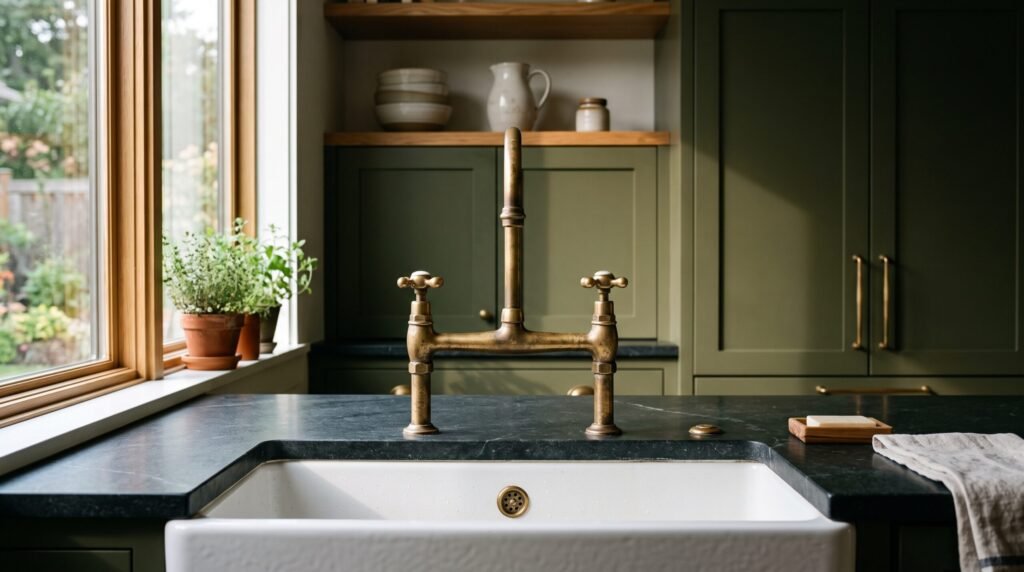
A brass bridge faucet stands on two posts and joins them with a horizontal tube, so the hot and cold supplies meet above the counter rather than underneath it. That single piece of geometry decides everything about whether one will fit your kitchen, because the two posts sit a fixed distance apart and your counter has to have holes at exactly that distance.
The number is 8 inches, centre to centre, on almost every model sold. Across seven independent workshops we read in September 2026, 54 faucet listings give a figure for the spread, and 42 of those 54 listings say 8 inches. Six inches is the only real alternative, named in 9 listings.
The problem is that half the bridge faucets on sale do not tell you. Of the 53 bridge faucet listings we read across those seven workshops, 26 state a spread and 27 do not. That is the one fact you cannot fix after the box arrives, and it is the fact the sellers are worst at publishing.
What does a bridge faucet need in the countertop?
Two holes at 8 inches apart, and nothing else if you skip the sprayer. A supplier of traditional tapware puts the rule plainly: bridge faucets are designed around an 8-inch center-to-center spread between the hot and cold mounting holes.
Centre to centre means you measure from the middle of one hole to the middle of the other, not from the near edge of one to the near edge of the next. On a three hole sink drilled for a conventional mixer, the two outer holes are usually the pair you want and the middle one gets covered or used for the sprayer.
This is where a bridge faucet differs from the pull down mixer it usually replaces. A single hole mixer arrives with a deck plate, a flat oval cover that hides whatever holes it is not using. A bridge faucet has no deck plate, because the bridge itself spans the gap. The look is the reason people buy them, and it is also the reason there is nowhere to hide a hole that does not line up.
Count your holes before you count anything else, because the number you have decides which half of the catalogue is open to you. A sink drilled for one hole cannot take a bridge faucet without new holes cut in the counter beside it. A sink drilled for three can take almost any bridge faucet, with the spare hole used or covered.
Four hole sinks are common on older American kitchens, drilled for a mixer, a sprayer and a soap dispenser. The two outer holes are still your pair, and the two in the middle become the sprayer and whatever else you want, or brass covers.
There is one measurement people get wrong here, and it costs a counter. The 8 inches is the distance between the two holes you will use, not the total width of the faucet. A bridge faucet with an 8 inch spread is 11 or 12 inches wide overall, because the handles sit outside the posts. Check the run of counter you have between the sink and the wall before you order a wide one.
Two hole models are the simplest fit and the easiest to plan around, because there is no third hole to find.


How do you find the spread before you buy?
Measure your own holes first, then ask the workshop for theirs in writing. Both halves matter, because the listing may not have the number and a handmade faucet may not match a factory drawing.
To measure, put a tape across the counter and read from the centre of the left hole to the centre of the right hole. If you have a three hole sink, the outer pair is almost always 8 inches and the centre hole sits between them at 4 inches from each. If you get 6 inches, you are not stuck, because some workshops make both.
One of the seven workshops sells several of its bridge faucets in both sizes, so the spread is a variant you pick at checkout rather than a fixed property of the design. Its antique bridge faucet is offered at 8 inch standard with 6 inch also available, and its gooseneck bridge comes in 6 inch or 8 inch as two variants. Ask before you assume you need to redrill.
The second number is the diameter of each hole. Kohler states that the hole size of the sink should be 1-3/8″ in size, and a stone fabricator agrees that a standard single-hole faucet almost always needs a 1-3/8″ (35 mm) opening. Handmade brass does not always follow that. One workshop lists a sprayer that is optional, with or without a matching side sprayer, and another will fit a side sprayer or cover the hole with a matching brass hole cover, if you say so at checkout. That hole cover is the detail worth knowing, because it is how you use a three hole sink with a two hole faucet and still have it look deliberate.
One warning about what the sprayer actually does on a handmade faucet. A CopperKesh listing describes a sprayer that has one line of water, cold or hot. A single supply sprayer is not a mixer, so it gives you one temperature and not a blend. If you rinse dishes with warm water that is a real difference from the pull down mixer you are replacing.
Sprayers are also the least documented part of the category. Of the 338 faucet listings we read, 39 mention a sprayer at all.
 See it at Zayian


Cross handles or lever handles?
Both work, and the choice is about hands rather than looks. Cross handles are the shape people picture on a bridge faucet, four spokes that you turn. Levers are a single arm you push.
The accessibility standard is the useful guide here, because it was written by measuring what hands can actually do. The US Access Board requires that operable parts be usable with one hand and not require tight grasping, pinching, or twisting of the wrist, or more than 5 pounds of force (lbf) to operate. It also notes that standard U-shaped pulls and lever-shaped handles are acceptable.
A cross handle can pass that test, because you can turn one with a flat palm or the side of a fist rather than a pinch. A small, tight, decorative cross on a stiff valve cannot. So the question to ask a workshop is not which shape it is, it is how much travel the valve has and how hard it turns. On a handmade faucet, that varies between pieces in a way it does not on a factory mixer.
There is a second reason to think about it before you commit. Two handles means two hands, or one hand used twice, every time you change temperahandle one first if you can.
A third arrangement exists and is worth knowing about. Some bridge faucets put the handles on the front of the posts rather than on top, which puts them further from the splash and lower down.


10 inches of reach, and let the space above the sink decide the height.
Reach is how far the spout comes out over the bowl. It decides whether the water lands near the drain or near the front rim. A farmhouse sink makes this harder than a drop in, because the bowl is wider and the faucet sits further back. A copper sink specialist notes that a farmhouse sink can protrude approximately 2 1/2 inches at the front of the cabinet, which pushes the whole bowl forward relative to the tap.
The workshops that publish a reach cluster between 7 and 10 inches. One tall bridge lists a spout reach of 10 inches, and a low profile model in the same range lists the same 10 inch reach at 9.5 inches of overall height. That pair is the clearest illustration of the point: the same reach, at half the height.
Height is about what is above the sink, not about the sink. A tall gooseneck lets you fill a stockpot, and a supplier notes that high-arc (gooseneck) faucets provide generous clearance for filling tall stockpots and maneuvering oversized cookware. The cost is splashing, because water falling further hits harder, and a window sill or a low shelf above the sink can stop a tall faucet fitting at all.
Published heights in this category run from about 9.5 inches to 19 inches, so the range is wide enough that guessing is a mistake. Reach is the better documented of the two. Of the 338 faucet listings we read, 159 give a spout reach and 15 give a spout height.
| Workshop | Bridge faucets read | State the spread | Typical spread | Reach published |
|---|---|---|---|---|
| The House of Brass | 20 | 17 | 8 inches, 6 on request | 7 to 10 inches |
| Kinycraft | 14 | 0 | not stated | not stated |
| Zayian | 13 | 3 | 8 inches | rarely |
| Moroccan Interior | 5 | 5 | 8 inches | 7.5 to 10 inches |
| CopperKesh | 1 | 1 | 8 inches | 10 inches |
| Artihand | 0 | not applicable | not applicable | not applicable |
| Rod and Rails | 0 | not applicable | not applicable | not applicable |
Read across seven independent workshops in September 2026, covering 53 bridge faucet listings in total.


Deck mount or wall mount?
Wall mounting solves the hole problem by leaving the counter alone. It moves the difficulty into the wall instead, where the pipes have to be in the right place before the tiles go on.
A deck mounted bridge faucet stands on the counter or on the sink deck. A wall mounted one comes through the tiles behind the sink, so the counter needs no holes at all and the area behind the tap is a flat surface you can wipe. For a stone counter you do not want to drill, or a sink with no tap deck, that is the answer.
The cost is that the supplies have to be in the wall at the right height before the tiles go on. Getting that wrong is an expensive correction, and it is not a job you can defer. Wall mounted models are also normally sold at a fixed spread in the same way deck models are, so the two posts still have to line up with the two pipes.
Prices here are lower than you might expect, because a wall mount bridge has fewer parts than a deck mount with a sprayer. A