Copper sink patina is the colored film that grows on the metal as it meets air, water and whatever you wash in it. It starts the day the sink is made, it never fully stops, and it is the reason two copper sinks bought on the same day look different a year later. You do not get to choose whether it happens. You do get to choose how much of it you keep.
This guide covers what the patina is, how each finish you can buy will move over time, why an indoor sink almost never turns the green of a copper roof, and the three things you can do about the color: let it go, hold it with wax, or push it lighter or darker by hand. In October 2026 we also read 121 copper sink listings at four small workshops to see what they tell you about it, and the short answer is not much.
What is copper sink patina, and why does it form?
It is a thin layer of copper compounds that forms on the surface when the metal reacts with oxygen, moisture and anything else in the air or the water. It is not dirt and not damage, and on a copper sink it is the finish you are paying for.
CopperSmith, a maker of copper sinks and range hoods, puts the chemistry in one line: the different patinas are the reaction of copper with moisture oxygen and sulfur-based compounds, and the patina acts as a barrier protecting the copper underneath against corrosion. Van Dyke’s Restorers, which sells copper sinks to restorers, says the same thing in plainer words: it builds overtime and works as a protective coating.
What the layer is made of depends on what reaches it, and that is why the color varies so much. The usual first product on bare copper is cuprite, a reddish oxide, and in polluted outdoor air it later turns into green sulfates; a study of copper corrosion names the two main products as mainly brochantite and cuprite. The general rule is set out in the reference account of patinas: for copper alloys, exposure to chlorides leads to green, while sulfur compounds (such as ” liver of sulfur “) tend to brown. In clean country air the green comes from a different route, the slow chemical reaction of copper with carbon dioxide and water, producing a basic copper carbonate.
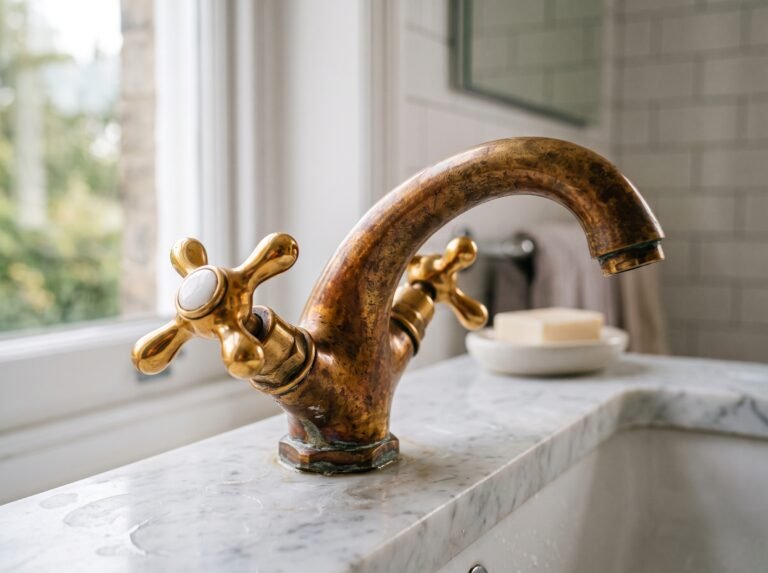
A sink lives in a narrower world than a roof. It sees tap water, soap, food acids, toothpaste and very little sulfur dioxide, so it mostly builds the brown oxide layer and rarely gets far enough to go green. A UK sink retailer describes the usual path: a new copper sink will have a shiny reddish-brown finish, and over time, the sink forms a patina leading to a dark brown hue.
The practical point for a buyer is that the patina is the surface itself. Anything that removes it, a cleaner, a polish or an acid, takes you back to bright metal, and the metal immediately starts building the layer again.
How fast does a copper sink change color?
The shine goes in weeks, the browns arrive over a few months, and most sinks look settled after about a year. Nothing about it is sudden, and on a sink used every day the change is faster than on a bathroom basin in a guest room.
Fossil Blu, which sells copper kitchen sinks, gives the clearest timeline we found. After 30 days the shine is reduced patina begins color becomes warmer and more varied, and after months to a year, many copper sinks develop: a deep, antique finish, varied tonal layers. The same page notes that the change is uneven at first, with slight unevenness appears (especially around the drain and faucet area), because those are the places that stay wet longest.
CopperSmith tested it rather than guessing. Brushing raw copper sinks every day with plain water, salt water or food waste, it found that after about a month, the water mixture would turn the copper a dark bronze color, while the salt mixture brought out reds and greens, and the food waste brought out a reddish bronze color. So what you wash shapes the color as much as the calendar does.
The quickest way to picture where a natural sink ends up is in your pocket. Copper Sinks Online, which sells the SoLuna range, suggests pulling a few pennies out of your pocket: you will find some bright, some with a few darkened spots, and some that appear to have been dipped in milk chocolate. That mix of bright, spotted and brown is a fair picture of a natural copper sink in its first year.
It also never fully stops. The same maker says that whether your sink has a natural patina or an applied patina finish, copper never stops changing color. After the first year the movement is slower and mostly local: lighter where hands and pans rub, darker where water sits.
Which copper sink finishes can you buy, and how does each one age?
Four, in practice: raw or polished copper that starts bright, an aged brown made by heat or chemicals, a green verdigris made the same way, and any of those sealed under lacquer. Each one starts in a different place and moves a different distance, so the finish you pick decides how much change you will see.
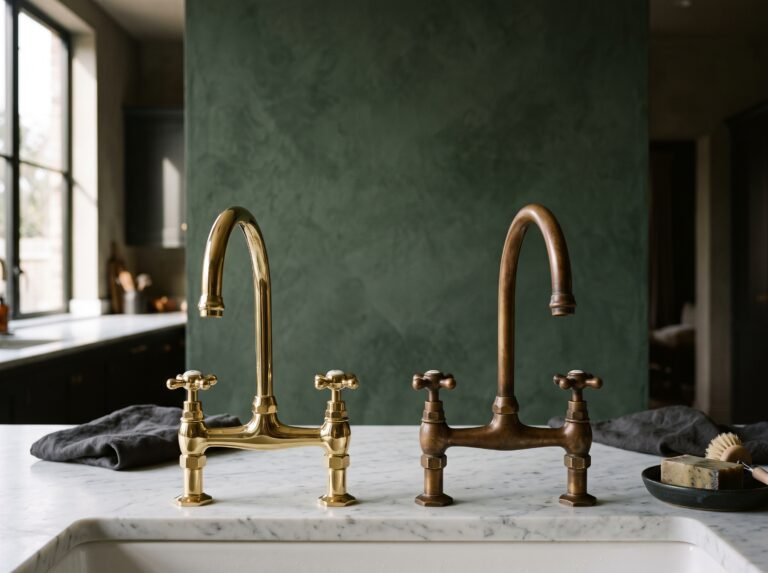
Raw, natural or polished copper starts as bright metal and does all of its aging in your house. Native Trails says plainly that Polished Copper will begin to patina as it reacts with its environment, and CopperSmith says its raw sinks do not feature any sealants or lacquers, allowing the copper to naturally change over time. This is the finish that changes most, and the one where you have the most control, because you can scrub it back to bright at any time.
Aged, antique or dark finishes are made in the workshop so the sink arrives already brown. Native Trails describes its antique color as achieved through a hand-applied patina process, and Copper Sinks Online says its darkest finish is a darker patina than would naturally occur on a copper sink, made by an accelerated aging process using high heat. Two things follow. These finishes change less, and CopperSmith says of a chemically aged sink that since the patina is artificial, it won not change much. But when something lifts them, they do not come all the way back on their own, because the same maker warns that natural darkening will not result in as dark a finish as the Dark Smoke patina. On a dark sink, with use the color will lighten slightly.
Verdigris and turquoise finishes are the green of an old roof, put on by hand rather than by decades of weather. They are a look, not a stage your sink will reach, and they are sold almost entirely for bathrooms.
Sealed or lacquered copper holds whatever color it left the workshop with, until the coating is scratched. CopperSmith calls lacquer an excellent way to lock in patina and prevent further color changes, then explains why it will not sell it for kitchens: when a scratch occurs on a seal coat finish, initially it will be bright, and you are left with a noticeable scratch which will continue to change color over time, and a sink that will not. Copper Sinks Online takes the same line: we do not recommend polished finishes or lacquer on high-use areas such as kitchen sinks.
| Finish | How it is made | How much it changes | What brings it back |
|---|---|---|---|
| Raw, natural or polished | Bare metal, sometimes polished | The most: bright to brown over months | Scrubbing or copper polish takes it back to bright |
| Aged, antique or dark | Heat or chemicals in the workshop | Less: lightens slightly where used | Time, but not as dark as new, or a darkener |
| Verdigris or turquoise | Chemical patina applied by hand | Little indoors, wears where rubbed | Hard to match at home, ask the workshop |
| Sealed or lacquered | Any of the above under a clear coat | None, until the coat is scratched | The scratch patinas on its own, then wax over it |
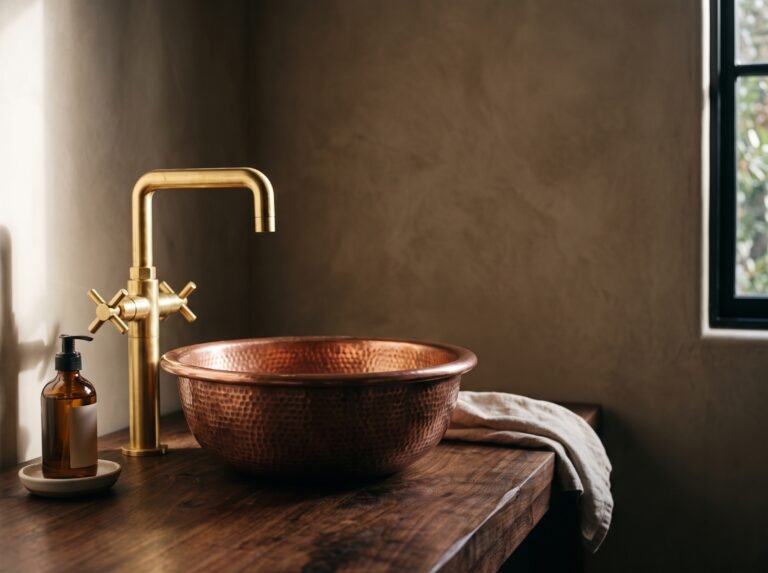
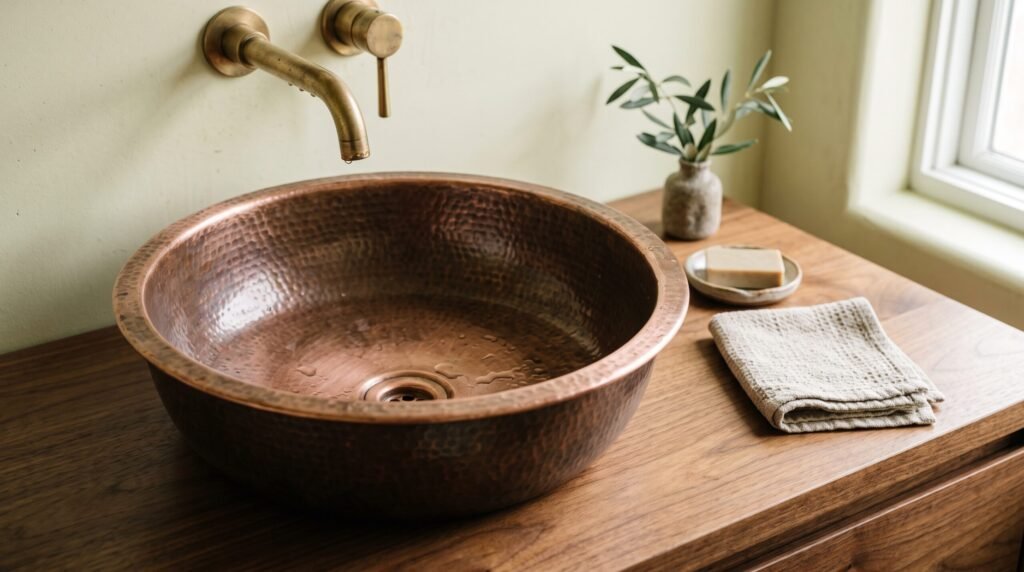
Kitchen sinks at the workshops come in the brown family. Green is a bathroom look, and the two below show the difference.


Will a copper sink turn green like the Statue of Liberty?
Almost never on its own, and not all over. The famous green needs years of rain and polluted or salty air, and a sink indoors gets neither.
The statue shows how slow it is even outdoors. History.com reports that within its first 15 years in New York Harbor, the Statue of Liberty went from a bright copper color to a dull, darker brown hue, and that only by 1903, people began noticing that Lady Liberty had started gradually developing a green patina. That was in sea air. Construction Canada, writing on copper roofs, gives the outdoor rule: in seacoast or industrial atmospheres like Regina, the natural patina generally forms in seven to 10 years, while in arid environments, the basic sulphate patina may never form. A kitchen is drier and cleaner than any of those.
What you can get indoors is small green spots. Fossil Blu lists where they appear: near the drain, under soap dispensers, around hard water deposits, where acidic foods sit too long. Hunker adds a bathroom cause, that cosmetics like toothpaste and shaving cream can strip the patina and sometimes cause a reaction that makes your farmhouse sink turn green. Sinkology, a copper sink brand, treats them as minor: if you notice green build-up (oxidation), don’t panic, and it suggests lifting it with a soft scrubber or even your fingernail before you clean the area.
So a green sink is something you buy, not something you wait for. Of the 121 copper sink listings we read at four workshops, 29 are sold with a green, verdigris or turquoise finish named in the title, and all 29 are bathroom basins. None of the 36 kitchen, farmhouse or bar sinks among those 121 listings is sold green. If you want green in a kitchen, you are asking a workshop for something they do not list, and you should ask how it will wear where pans and hands rub it.


Why does the patina look patchy, and will it even out?
Because some things lift it and others feed it, and a sink meets both every day. On a natural sink the patches usually blend back in a few days to a few weeks, while on a dark factory finish they fade but may stay a shade lighter.
The list of things that lift patina is long and very ordinary. Copper Sinks Online names any citrus fruits, tomatoes, vinegar or pickled foods, alcohol, spicy foods, coffee, and juices, along with sponges with a scrubby-side, and warns that toothpaste often contains peroxide or even bleach that will remove the patina finish off copper. Van Dyke’s lists Soft Scrub, Clorox Bleach, Drano, or Acids as products that leave a sink shiny.
The good news is that the metal repairs the color itself. Native Trails says that in a short time (usually just days) it will naturally re-patina itself, and Van Dyke’s that given time the copper sink will gradually return to the rich brown color and cover up spots and scratches. Copper Sinks Online is just as calm about food: leaving foods or liquids on the copper will not harm the sink, and the patina will return in time.
There is one exception, and it matters if you buy dark. A factory finish made with heat is darker than nature will make it, so a bright spot on it heals to natural brown, not back to the original. That is why the dark finishes come with a darkening recipe, covered below.
The daily routine that keeps patches small is in our copper sink care guide: rinse after use, mild soap, dry it if your water is hard, and do not let lemons or tomato sit in the bowl.
Can you keep the color your copper sink came with?
Mostly, with wax, as long as you accept that it slows the change rather than stopping it. Lacquer stops it completely, and almost every maker advises against lacquer on a kitchen sink.
Wax is a thin barrier between the copper and whatever lands on it. Copper Sinks Online says it will act as a temporary barrier to elements and substances that come into contact with the copper, and recommends using it sparingly and as directed, and apply once every 4-6 weeks, depending on the daily use of the copper sink. On a brown finish the same maker says you can maintain the even coloration by regular applications of Renaissance Wax or carnauba wax. Van Dyke’s gives the same advice for a bright sink: if you wish to slow the patina process, wax your sink.
How often depends on the maker and the finish, and the range is wide. CopperSmith tells owners of its rustic sinks to use a conditioning oil or natural carnauba wash once every six months and, for general care, to apply a thin layer of protective wax (specific to copper) once a year. Native Trails says that for extra protection, carnauba wax may be applied to its antique finish. A kitchen sink washed several times a day needs it far more often than a guest bathroom basin. Because food and dishes touch it, pick a wax sold for sinks: Copper Sinks Online stocks a food-grade one that it says helps delay tarnishing and oxidation of copper, bronze, and even wrought iron, and that contains no silicone or solvents.
Two cautions. First, wax holds whatever is under it, so wax only the color you want to keep; Copper Sinks Online is firm that if you have a shiny spot in a dark sink you should not wax your entire sink and should wax AROUND the shiny spots so that water and oxygen can get to the raw copper. Second, keeping a bright sink bright is real work. The same page says that keeping the bright shiny look will require regular polishing with a commercial copper polish, and CopperSmith gave up on it in its own range because keeping the copper bright was too difficult.
If you would rather do nothing at all, buy a finish that is already where you want it to end up. Both of these arrive aged.


Can you make a copper sink lighter or darker later?
Yes, both ways, and neither is permanent. Lightening means polishing the patina off, and darkening means speeding up the reaction with a darkener, then waxing to hold the result.
To go lighter, take the patina off. Copper Sinks Online says that most any copper cleaner (readily available at grocery or hardware stores) when used as directed, should remove all the discoloration and patina from the copper sink. Van Dyke’s suggests a copper polish like Wright‘s Copper Cream if the patina grows too dark, then fresh wax. CopperSmith uses a gentler method on its raw sinks, suggesting you scrub with fine wool or a Scotch Bright Pad once a month if you want to maintain the new copper look. Do not do this to a factory aged or green finish. You will strip a color you cannot easily put back.
To go darker, there are three routes, and all of them need patience. Copper Sinks Online names Jax Brown-Black Copper Darkener and Liver of Sulphur as products that jump start the process, and gives a home mix of 1/4 cup of ammonia and 1 teaspoon of salt, dabbed on the light area, left on for 30 minutes and then rinse off and repeat as needed. Liver of sulfur is the same chemistry jewelers use: the reference list of patina chemicals gives it as liver of sulfur (brown-black). Work with a window open, wear gloves, and test on the underside or a sample first.
The maker’s own advice is to wait before reaching for any of these. It says the BEST solution is to let the copper sink build patina back on its own, naturally over time, and that the products are not an instant solution to a shiny spot. Once the color matches, a thin coat of wax holds it.
What do the workshop listings tell you about patina?
Less than they should. In October 2026 we read every copper sink listing at Zayian, CopperKesh, Moroccan Interior and The House of Brass, 121 in total, and counted what each one says about the finish and how it will change.
Of the 121 copper sink listings, 78 use the word patina, but only 21 say in a sentence that the color will keep changing after you buy it. Eight of the 121 listings mention wax, and three of the 121 mention a lacquer or a sealant at all. Not one of the 121 listings lets you pick the finish as an option at checkout, so the finish is fixed by the listing you choose. The finish named in the titles of those 121 listings splits 29 green, 29 aged or dark, 1 bright and 62 with no finish word at all.
The one sealant claim is worth knowing about. A CopperKesh tub style basin answers its own question with our copper sinks come with a clear sealant to protect against tarnishing, while most of the shop’s other copper sink listings describe a living patina. If a sealed finish matters to you, ask in writing whether the exact sink you are buying is sealed, because it changes everything in this guide.
For comparison, a retailer that sells branded copper sinks, The Sink Boutique, lists 141 copper sinks, and 90 of those 141 listings link a copper wax product on the page. The workshops sell the sink. The branded makers also sell you the routine.
Our wider read of these stores, with the method and the dataset, is in the September 2026 listings study.
Can you get a discount on a copper sink?
Often, and on a copper farmhouse sink it is real money. Ten percent off a $1,500 sink is $150, which covers a year of wax and then some.
CopperKesh has been running KESH10 for 10 percent off with no minimum, and Zayian has been running free worldwide express shipping rather than a percentage. Codes in this category expire quietly, so we retest them and publish the date rather than the promise: the current state is on the CopperKesh and Zayian store pages, and how we verify codes explains the method.
So, which copper sink patina should you choose?
Choose the color you want to live with in a year, not the one in the photograph. If you like the bright pink of new copper, know that you are signing up to polish it, and wax it every few weeks to slow the browning.
If you want the least work, buy an aged or dark finish, rinse after use and wax a few times a year. If you want the full story of a living finish, buy raw copper, do nothing, and let it go brown in its own time. If you want green, buy it green, and put it in a bathroom.
Before you pay, ask the workshop two things the listings rarely say: whether the finish is sealed, and what they recommend if a spot goes bright. Then browse hammered copper sinks and copper vessel sinks with the codes we have checked, or start with is a copper sink a good idea if you are still deciding.
Get new tested codes by email
One email on Friday: the codes that passed our checkout test that week, the ones we pulled, and new guides. Quiet week, short email.