Unlacquered brass cabinet hardware is chosen for the way it ages, and returned for the way it measures. One number decides whether a pull can be fitted at all: center to center, the distance between the two screw holes. Everything else, the shape, the hammering, the patina, is a preference.
This guide covers the sizes, where hardware sits on a door or a drawer, which screws you need, and how the brass behaves once hands are on it every day. It also covers the gap we found in the catalogues: of 19 handmade cabinet hardware listings at the seven workshops we read in September 2026, 7 stated a center to center measurement, and all 7 came from one workshop.
What size cabinet pull do you need?
Take a third of the width of the drawer and buy the pull closest to it. On doors, a knob between 1 and 2 inches suits almost anything, and the size question only gets interesting on wide drawers.
Top Knobs, a hardware maker, gives the rule and the exceptions. Bar pulls should not exceed 1/3 of the length of a cabinet door or width of a drawer, and standard size knobs range between 1-2 inches in diameter and will complement cabinet doors of any size. By drawer width, they put one pull 3-5 inches in length at the centre of a drawer under 16 inches, and for drawers of 16 to 32 inches suggest two smaller pulls 5-7 inches in length or one larger pull 9-12 inches long. Past 32 inches you are into a pull longer than 12 inches.
San Diego Hardware, a supplier that has been fitting this stuff for decades, works to the same proportion, calling for a pull approximately 1/3 the length of the drawer and pulls between 5-7″ for uppers.
Here is the whole sizing job in one place:
| What | The number | Source |
|---|---|---|
| Pull length, general rule | About 1/3 of the drawer width, never more | Top Knobs |
| Drawer under 16 in | One pull, 3 to 5 in, centred | Top Knobs |
| Drawer 16 to 32 in | Two pulls 5 to 7 in, or one pull 9 to 12 in | Top Knobs |
| Drawer over 32 in | A pull longer than 12 in | Top Knobs |
| Knob diameter | 1 to 2 in, 1.25 in most common | Top Knobs |
| Upper doors | Pulls 5 to 7 in | San Diego Hardware |
| Slab door hole | Equidistant from bottom and side, about 2 in | San Diego Hardware |
| Cup pull centers | Commonly 3 in, which is 76 mm | Rod & Rails listings |
| Screws | 8-32 machine screws, 1-1/4 to 1-3/4 in | Rockler |
What does center to center actually mean?
It is the distance from the middle of one screw hole to the middle of the other, and it is the only dimension that decides whether a pull lands on holes that already exist. Overall length is what you see, center to center is what fits.
Top Knobs defines it as the industry standard for measuring pulls, the distance from the center of one screw hole to the center of the other screw hole. The practical trap is the mixed units. Three inches and 76 mm are the same size within a hair, so they swap freely. Four inches and 96 mm are not the same, and a pull sold in millimetres will not sit on holes drilled in inches without new holes and filled old ones.
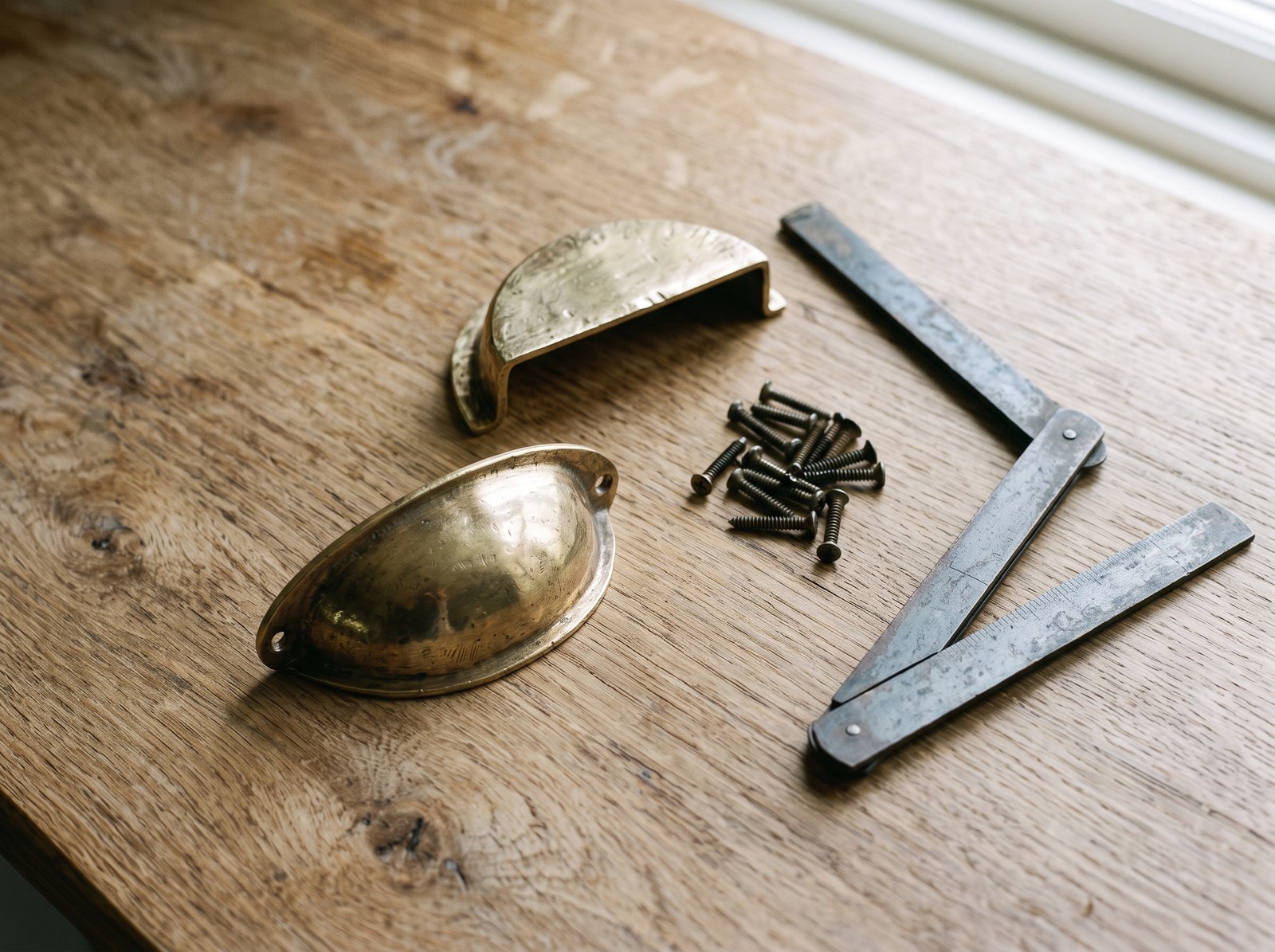
If you are replacing hardware rather than drilling fresh, measure your existing holes before you look at a single photograph. That measurement, not the style, is your shopping filter.
Where do knobs and pulls go on the door or drawer?
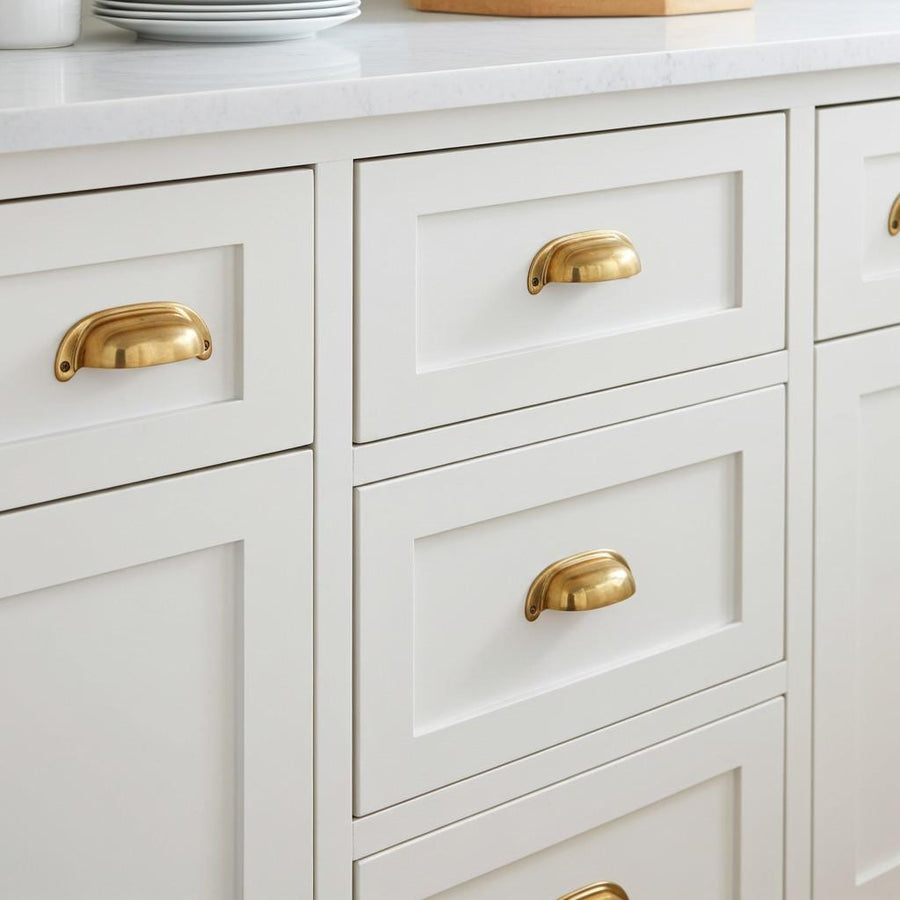
On a paneled door, line the fixing up with the rail. On a slab door, come in about 2 inches from the bottom and the side. On drawers, centre the hardware, and move it up towards the top rail on deep drawers.
San Diego Hardware sets it out plainly: most cabinet knobs today are installed by lining up the installation hole with the edge of the rail, while for pulls, you want the bottom of your pull to fall in line with the cabinet rail. For slab doors, you will want the hole placement to be equidistant from the bottom and side of the cabinet. 2″ is typically a good distance, and on drawers it is most common to center your hardware on shallow drawers and near the top of deeper drawers.
Do the whole kitchen with one drilling jig, not by eye. Hardware that is a quarter inch out on one door is the thing you will see every time you walk in.
Will handmade brass hardware fit your existing holes?
Often not, and most listings will not tell you either way. This is the single biggest difference between buying handmade and buying from a hardware brand.
In September 2026 we read every listing at seven small copper and brass workshops. Of the 19 cabinet hardware listings, 7 gave a center to center measurement, and all 7 were from one workshop, Rod & Rails. The rest describe the look, the metal and the finish, and leave the fixing to you.
The same workshop is also the only one that admits the tolerance, telling buyers that hole spacing may vary slightly due to the handmade nature of each piece, so please drill accordingly. That is an honest line, and it tells you what handmade means in practice: cast and finished by hand, so two pieces are close rather than identical.
What to do about it. If your holes are already drilled, ask the workshop for the center to center in writing and ask whether they can hold it across a batch. If you are drilling fresh, order first, measure the pieces that arrive, then drill.
What screws do you need?
For most cabinet pulls and knobs, 8-32 machine screws, in a length that matches the thickness of your drawer front. Handmade pieces sometimes break that rule, so check before you buy a box of the wrong thing.
Rockler sells the standard, describing them as #8-32 knob and pull machine screws in 1.25 in, 1.5 in, 1.625 in, 1.75 in lengths. A thicker drawer front, or one with an applied moulding, needs the longer screw, and it is worth buying a couple of lengths rather than making a second trip.
Handmade hardware may not use machine screws at all. One Rod & Rails cup pull tells buyers we recommend using a 6 mm wood screw for the best fit and strength, which is a different fixing method entirely and means it screws into the wood rather than bolting through it. Neither is wrong, but only one of them works with holes already drilled for machine screws.
How does unlacquered brass hardware age on a kitchen?
Faster than anywhere else in the house, because hands are on it several times a day, often with something on them. That is the point of the finish, and it is also the thing people are least prepared for.
Of the 19 listings we read, 12 warned that the finish would darken, 2 said it could be polished back, and 1 explained how to clean it. Nobody offered a lacquered version as an option. So the change is disclosed and the care is not, which is the same pattern we found across all 465 unlacquered brass listings in the September 2026 listings study.
The practical part: a kitchen pull darkens first where thumbs land, so a run of drawers develops a map of how your household cooks. If that sounds good, buy unlacquered. If it sounds like mess, buy lacquered and plan to redo the coating in a few years. The stages, timings and the one warning sign to watch for are in our guide to whether unlacquered brass tarnishes, and the day to day care is in how to clean unlacquered brass.
Cup pulls, knobs or bar pulls?
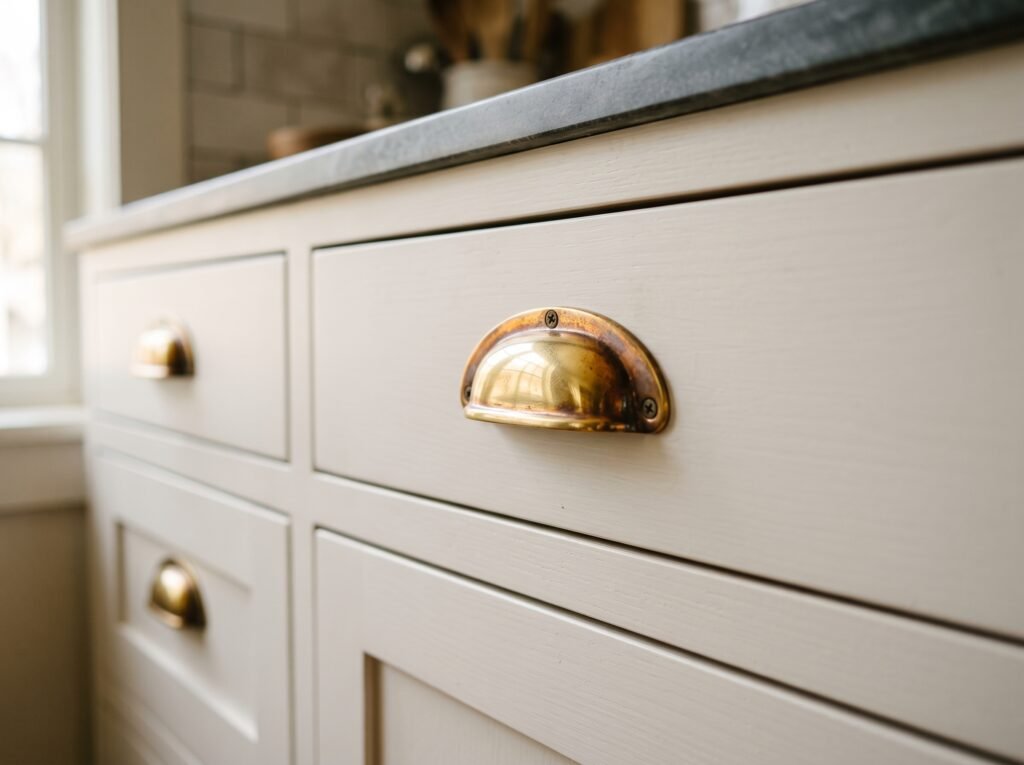
Cup pulls suit drawers and read as traditional, knobs suit doors and small drawers, and bar pulls suit wide drawers where you need to spread the force. Most kitchens end up mixing two of the three.
The handmade range is narrower than the mass market one. Across the seven catalogues, the cabinet hardware we found runs from $35 to $90, median $60, and the choice is mostly cup pulls, simple knobs and gallery rails. A hammered unlacquered brass cup pull at $35 and a half moon cup pull at $40 are typical, and the half moon is one of the few that publishes its fixing: a center to center of 1-1/4 inches, an overall length of 3 inches and a projection of 0.7 inches.
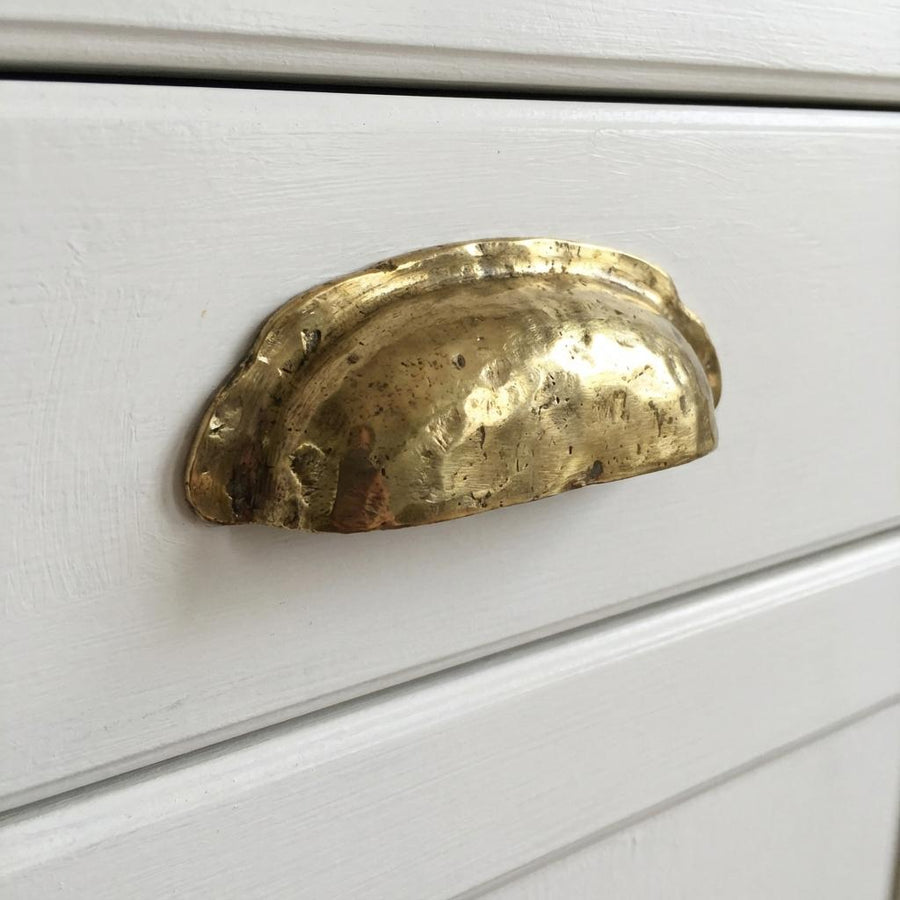
Count the pieces before you price it. A small kitchen with 8 doors and 10 drawers needs 18 pieces, so a $40 pull is a $720 decision, and that is where the discount matters.
Can you get a discount on brass cabinet hardware?
Yes at Rod & Rails, which is the workshop with both the widest cabinet hardware range and a code we have tested in a real basket. The amount and the date it was last checked are on the store page, since codes change.
Every code is put through a real checkout before it goes up, which is set out in how we verify codes. Check the current offer on the Rod & Rails store page, and browse the rest of the range in unlacquered brass cabinet hardware.
So, how do you choose brass cabinet hardware?
Measure your existing holes first, then pick a pull about a third of the drawer width, then choose the shape. Ask any handmade workshop for the center to center in writing, because most listings do not publish it and a beautiful pull that misses your holes by half an inch is a woodworking job.
After that it is a question about ageing. Unlacquered brass will darken where your hands go, and that is either the reason to buy it or the reason not to. Browse unlacquered brass cabinet hardware with the codes we have checked, and read does unlacquered brass tarnish before you commit a whole kitchen to it.
Get new tested codes by email
One email on Friday: the codes that passed our checkout test that week, the ones we pulled, and new guides. Quiet week, short email.