Hammered copper sinks hide small scratches, water marks and fingerprints better than smooth ones, because thousands of shallow dents break up the light that would otherwise show every mark. A smooth copper sink shows the same wear more plainly, and it also shows the patina moving across it as one broad surface. Neither one is scratch-proof, and the hammering is a smaller part of how well a sink lasts than the thickness of the copper.
This guide covers what the hammering actually is, whether it makes the metal any stronger, how each surface wears and ages, how much more work either one is, and which suits a kitchen or a bathroom. It does not repeat the basics of whether copper is right for you at all, which is in is a copper sink a good idea. In October 2026 we also read 133 copper sink listings at five small workshops, and the short answer to “should I buy smooth” is that you will struggle to find one.
What is the difference between a hammered and a smooth copper sink?
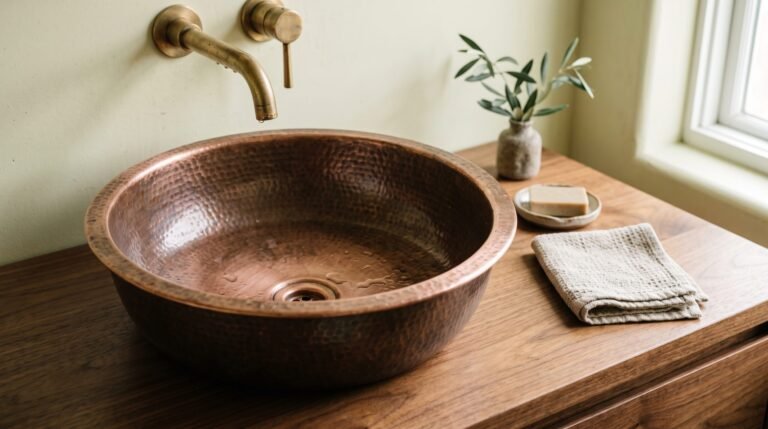
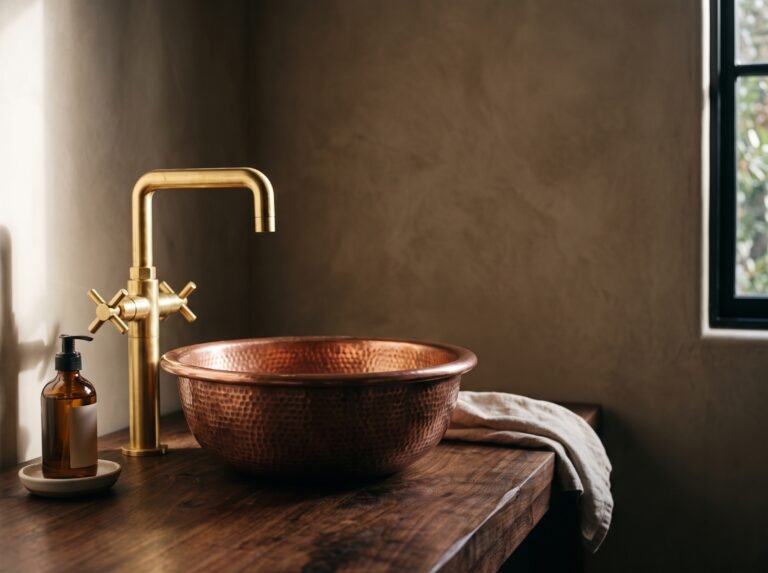
A hammered sink is covered in small dents left by a hammer, either from shaping the bowl by hand or from a deliberate finishing pass over the whole surface. A smooth sink has none, so the copper reads as one even plane, the way a new penny does.
The hammering is part of how a handmade sink gets its shape. In Santa Clara del Cobre, the Mexican town known for hammered copper, a reporter watching a coppersmith at work wrote that with a hammer and precise, even blows, he struck the copper until it began to take shape, and that occasionally, he reheated the piece and continued to hammer it into a small bowl. CopperSmith, an American maker of copper sinks, says its rustic look came from the same place: during visits to Santa Clara del Cobre in Mexico, CopperSmith observed artisans using hammering and heat to develop texture and tones in copper.
Smoothing is also done with a hammer, which surprises people. Metalworkers call it planishing, a metalworking technique that involves finishing the surface of sheet metal by finely shaping and smoothing it, done with soft, glancing blows. The same reference adds that if the metal begins to look dimpled, the worker is using too much force in individual hammer blows. So a hammered sink and a smooth one can come from the same bench. The difference is whether the maker chose to leave the marks or to work them flat.
There is a third surface you will see sold, which is a smooth body with a hammered panel. A maker of copper range hoods describes it as one of the most popular combinations features a smooth body paired with a hammered apron, and the same idea turns up on farmhouse sinks with a hammered front and a plain bowl, or the other way round. CopperSmith sells both surfaces and puts the visual difference simply: a hammered surface introduces movement and reflects light differently across the basin.
Does a hammered copper sink hide scratches better than a smooth one?
Yes, for small scratches, water marks and fingerprints, and every maker that sells both says so. It does not stop the scratches happening, and a deep gouge shows on any surface.
The reason is light. A smooth sink reflects light in one even sheet, so a fine scratch is a line cutting across it. On a hammered sink the light is already broken into hundreds of small highlights and shadows, and the same scratch disappears into them. Two sink makers print the same sentence on their spec sheets, that the hammered finish helps to hide small scratches that may occur over the lifetime of the sink, one of them MR Direct and the other Polaris. Havens, which sells hammered sinks in copper and stainless, says that the hammered texture helps conceal minor scratches and blemishes, keeping the sink looking pristine.
The workshops say it too. A Moroccan Interior farmhouse sink claims that the hammered finish not only adds depth but also helps to conceal minor scratches and water spots, and its undermount kitchen sink that the hammered detailing enhances its visual appeal while also helping to mask minor scratches and water spots over time.
The most careful statement comes from CopperSmith, which makes both surfaces and so has no reason to oversell either. It says a copper sink can still scratch, dent or develop surface variation, that these changes are often less visually disruptive on textured or naturally evolving finishes, and that copper should not be described as scratch-proof or dent-proof. Its warning about smooth copper is the one to remember: a smooth copper basin can make gradual tonal changes especially visible, and water marks and areas touched by food may contrast with the surrounding surface.
Copper also helps itself, on either surface. CopperSmith’s care sheet tells owners to leave the scratches or stains exposed to the air until the copper recovers itself to the original color; the time required for this process is a few weeks, and that the scratches will not be removed, but the scratches will not be visible once your sink changes back to the original color. The same maker is careful to add that patina does not physically repair them. A scratch on hammered copper darkens and vanishes into the texture. On smooth copper it darkens too, but the line is still there when the light catches it.
The two below are both small kitchen sinks at the same shop, one hammered and one smooth, which is about as close as a direct comparison gets.


Does hammering make a copper sink stronger?
A little, at the surface. Hammering work hardens copper, so the hammered skin resists denting better than soft, unworked sheet, but the thickness of the copper matters far more than the texture on it.
Work hardening is real metallurgy, not a sales line. It is defined as the process by which a material’s load-bearing capacity (strength) increases during plastic (permanent) deformation, and the strengthening occurs because of dislocation movements and dislocation generation within the crystal structure of the material. A University of Illinois materials lab shows it with copper wire: students hammer one piece flat and find that the hammered wire was harder to bend, but broke more easily, because the hammering produced many dislocations which became tangled, inhibiting the sliding of planes of atoms.
Coppersmiths have used this for centuries. A collector of French copper cookware explains that the all-over hammering on old pans is functional as well as decorative: it work hardens the copper on the outer surface of the pot, making it more resistant to deformation. He found that pieces shaped without it were softer, and that without that hardening, it was vulnerable to dents and deformation. His conclusion is that a working copper object needed hammering to give it a requisite toughness.
Two things keep this in proportion for a sink. First, heat undoes it. The same lab notes that when cold-worked metals are annealed (heated gently), new grains form from the cold worked structure and grow until they replace it with new, soft crystals, and the cookware collector describes annealing as undoing the work hardening and restoring the copper’s malleability and ductility. A sink that is hammered, then heated to weld a seam or to color the patina, has given some of that hardness back. Second, no workshop we read publishes a test showing how much harder its hammered sinks are.
What does protect a sink from dents is weight of copper. Hunker warns that lower grade models may dent and warp, and Native Trails sells one of its prep sinks on the claim that its 18-gauge copper resists denting better than thinner alternatives. Gauge runs backwards, so a lower number is thicker copper. A thin hammered sink will still dent where a heavy pan lands, and a thick smooth sink will shrug off the same pan. How to read a gauge, and which one to buy for a kitchen, is covered in our copper farmhouse sink buying guide.
Are hammered copper sinks hard to maintain?
No harder than smooth ones, and in daily life a little easier, because they show less between cleanings. The routine is the same for both: mild soap, a soft cloth, and drying the sink if your water is hard.
Makers that sell hammered sinks are consistent on this. Native Trails says its finish is easy because hammered copper is particularly simple since it doesn’t show fingerprints as stainless steel or shiny copper does. Havens says that a simple monthly wipe with a soapy sponge is often sufficient to keep the sink looking pristine, and Copper Sinks Online tells owners of its hand hammered sinks that basic cleaning after each use with a mild soap and water is sufficient.
The worry buyers raise is the dimples themselves: whether water and soap sit in them and leave rings. Havens answers it for its own sinks, saying they are designed for efficient drainage, preventing water from pooling in hammered areas. That is a slope built into the bowl, and it is worth asking a workshop about, because a shallow hammered bowl with a flat floor will hold drops in the low spots. Where that happens, the fix is the one every care guide gives for any copper sink. Fossil Blu says to dry your sink thoroughly after a rinse to prevent water spots, and Puracy explains why: drying the sink is a crucial step to prevent water spots and mineral deposits, which can dull the shine of the copper over time.
Two habits matter on both surfaces. Do not scrub. Sinkology recommends warm water, gentle dish soap, and a soft cloth, and Fossil Blu is blunt that steel wool and abrasive cleaners will leave scratches. Do not cut in it, because knives will leave permanent scratches, and that is the kind of mark no texture hides. The full routine, including what to do about bright spots, is in our copper sink care guide.
On a big kitchen sink, a bottom grid does more for wear than any texture, because the pans never touch the copper floor at all. This one is sold with its grid, and its photograph shows a hammered bowl even though the listing never uses the word.

How do hammered and smooth copper look as the patina develops?
Hammered copper ages unevenly on purpose: the raised points stay lighter where hands and water rub them, and the low spots darken, so the texture gets stronger with time. Smooth copper changes as one broad surface, which looks calm when it is even and shows every patch when it is not.
Makers use that difference deliberately. Copper Sinks Online describes how SoLuna makes its Rio Grande finish: it first creates the Dark Smoke patina on the sink, then buffs the patina off the ridges of the hammer marks, leaving the dark color in the low spots. Daily use does a gentler version of the same thing to any hammered sink, polishing the high points while the dimples hold their color. That is why a hammered sink can take a bright spot from lemon juice or a scouring pad and look like it was meant to be there.
A smooth sink has nowhere to put that variation. CopperSmith says plainly that a smooth copper basin can make gradual tonal changes especially visible, and it also notes that a changing tone may reduce a mark’s contrast on exposed copper, which works on both surfaces. One CopperKesh listing makes the same promise for its patinated basin, saying that copper keeps oxidizing over time, so the colour evolves and small scratches blend into the metal.
The practical rule follows from it. If you want a smooth sink, buy it already dark or already patinated, so the color has less distance left to travel and the patches have less contrast. A bright, polished, smooth sink is the one surface that shows everything, and it is also the one that needs polishing to stay bright. How each finish ages, and how to hold or change the color, is covered in depth in our copper sink patina guide.
These two bathroom basins show the two surfaces side by side. The smooth one is polished outside and colored inside, a look rather than a working finish.


Hammered or smooth: which is better in a kitchen, and which in a bathroom?
Hammered for a kitchen, almost always, because a kitchen sink takes pans, knives, acids and hard water every day. In a bathroom the choice is open, since a vessel basin sees soap and hands, and a smooth sink there is a style decision rather than a risk.
A kitchen farmhouse sink is the hardest working copper in a house. Pots land in it, cutlery slides across it, and tomato and lemon lift the patina in patches. Every one of those marks is softened by hammering. The workshops have clearly made the same judgment: of the 38 kitchen, farmhouse and bar sink listings in our read, 34 say they are hammered, and we found no smooth copper farmhouse sink at any of the five shops. If a smooth farmhouse sink is what you want, you are asking a workshop for a special order, and you should ask what gauge and what finish they would use, because a thin, bright, smooth apron is the surface that will show the most.
A bathroom is kinder. A vessel or wall hung basin mostly sees water and soap, toothpaste being the main thing that lifts patina, and nobody drops a cast iron pan in it. That leaves room for a smooth, polished bowl as a statement, or a smooth basin with a painted patina where the color carries the interest. CopperSmith’s advice applies in either room, to compare the selected texture and finish in person, since a photograph flattens texture and exaggerates shine.
There is also the look of the room. The range hood maker above says to choose smooth if you prefer a clean, modern, low-maintenance design, and that holds for a hood or a bathroom basin that nobody touches much. On a sink that is used hard, low maintenance is the hammered one. In a kitchen with a lot of flat, sleek surfaces, a hammered sink becomes the one piece with texture, which is usually the point of buying copper. In a busy, rustic room, a smooth sink can be the calm piece instead.
These two are the kind of hammered kitchen sink most shops sell, one from each of two workshops.


What are the pros and cons of hammered copper sinks?
The main pro is forgiveness: small scratches, water marks and fingerprints show less, and the patina ages in a way that suits the texture. The main con is choice: hammered is nearly all you can buy from small workshops, and it suits a rustic or traditional room more easily than a very sleek one.
Set side by side, the differences are smaller than the marketing suggests, and most of them come down to light. A hammered surface hides marks by scattering it, and a smooth one shows marks because it does not.
| Hammered copper sink | Smooth copper sink | |
|---|---|---|
| Small scratches | Lost in the texture | Show as lines when the light catches them |
| Water and food marks | Less visible between cleanings | Visible, especially on a bright finish |
| Fingerprints | Barely show | Show on a shiny finish |
| Dents | Surface is work hardened, but gauge decides | Gauge decides |
| Patina | Lighter high points, darker dimples, looks intended | One broad surface, patches show |
| Daily care | Mild soap, dry if water is hard | The same |
| What the workshops sell | Almost everything | Very little, mostly small or bathroom sinks |
Two cons are worth stating plainly. Hammering is not a substitute for thickness, and a thin hammered sink can still dent. The gauge advice in is a copper sink a good idea explains what to ask for. And the texture hides marks without preventing them, so the same care applies. Sinkology puts the realistic goal well: while it’s impossible to completely prevent discoloration, you can minimize spotting and maintain its original look with a little care.
The pros for smooth are real but narrower. It is the cleaner, more modern line, it suits a very minimal bathroom, and a smooth surface with a dark or painted finish hides more than you would expect, because the dark color does part of the work the texture would.
What do the workshop listings say about hammered and smooth sinks?
That hammered is the default, and that you choose the texture by choosing the listing. In October 2026 we read every copper sink listing at CopperKesh, Zayian, Moroccan Interior, Kinycraft and The House of Brass, 133 in total, and counted what each one says about its surface.
Of the 133 copper sink listings, 108 say the sink is hammered in the title or the description, and 58 of the 133 say it in the title. One of the 133 listings calls itself smooth, a CopperKesh double wall basin described as Smooth Copper exterior. None of the 133 listings offers hammered or smooth as a choice at checkout.
The 25 listings out of 133 that never use the word are not all smooth. We looked at the main photograph of each of those 25: 9 of the 25 show hammer marks anyway, including a CopperKesh farmhouse sink at $1,000, 4 of the 25 look plainly smooth, and the rest are covered in a painted patina that hides the surface either way. In kitchens the picture is starker. Of the 38 kitchen, farmhouse and bar sink listings, 34 say hammered, 2 more are hammered in their photographs, and the 2 that look smooth are small undermount bar sinks.
What the listings say about wear is thin. Nine of the 133 listings mention scratches, mostly to claim the hammering hides them, 4 of the 133 mention dents, and 21 of the 133 give a gauge. Ask for the gauge if it is missing, because it decides dents more than the texture does.
Counts for CopperKesh, Moroccan Interior, Kinycraft and The House of Brass were read on 31 October 2026, and for Zayian from a full copy of its catalog taken on 17 October 2026. Our wider read of these stores, with the method and the dataset, is in the September 2026 listings study.
Can you get a discount on a hammered copper sink?
Yes, at CopperKesh, which sells the widest range of hammered copper sinks in our read. Ten percent off its $630 hammered apron front sink is $63, and off its $1,000 aged farmhouse sink with a grid it is $100.
CopperKesh has been running KESH10 for 10 percent off with no minimum, and Kinycraft, which sells two copper sinks, JUSTGETDEAL for 10 percent off. Codes in this category expire quietly, so we retest them and print the date rather than a promise: the current state is on the CopperKesh and Kinycraft store pages, and how we verify codes explains the method.
So, hammered or smooth?
Hammered, if the sink will be used hard, which means almost every kitchen. It hides the small marks that daily cooking leaves, its patina looks intended rather than patchy, and it is what nearly every small workshop makes.
Choose smooth for a bathroom or a quiet bar sink where the clean line matters more than forgiveness, and buy it already dark or patinated so it has less to show. In either case, ask for the gauge before the texture, because a heavy smooth sink outlasts a thin hammered one.
Then browse hammered copper sinks and copper farmhouse sinks with the codes we have checked, or read our copper sink patina guide if the color is the part you are still deciding.
Get new tested codes by email
One email on Friday: the codes that passed our checkout test that week, the ones we pulled, and new guides. Quiet week, short email.