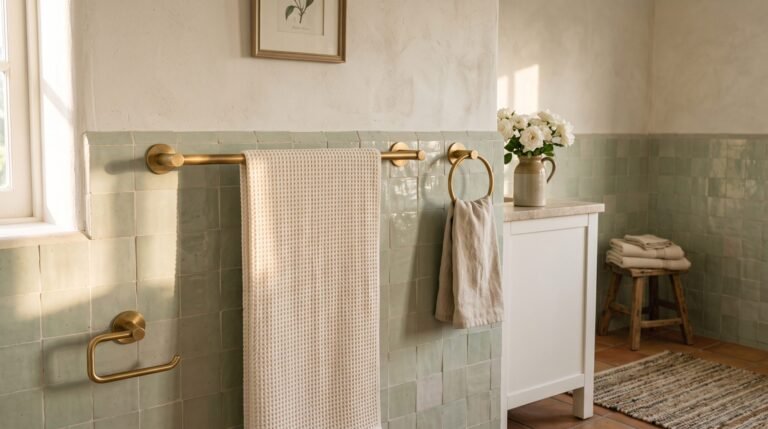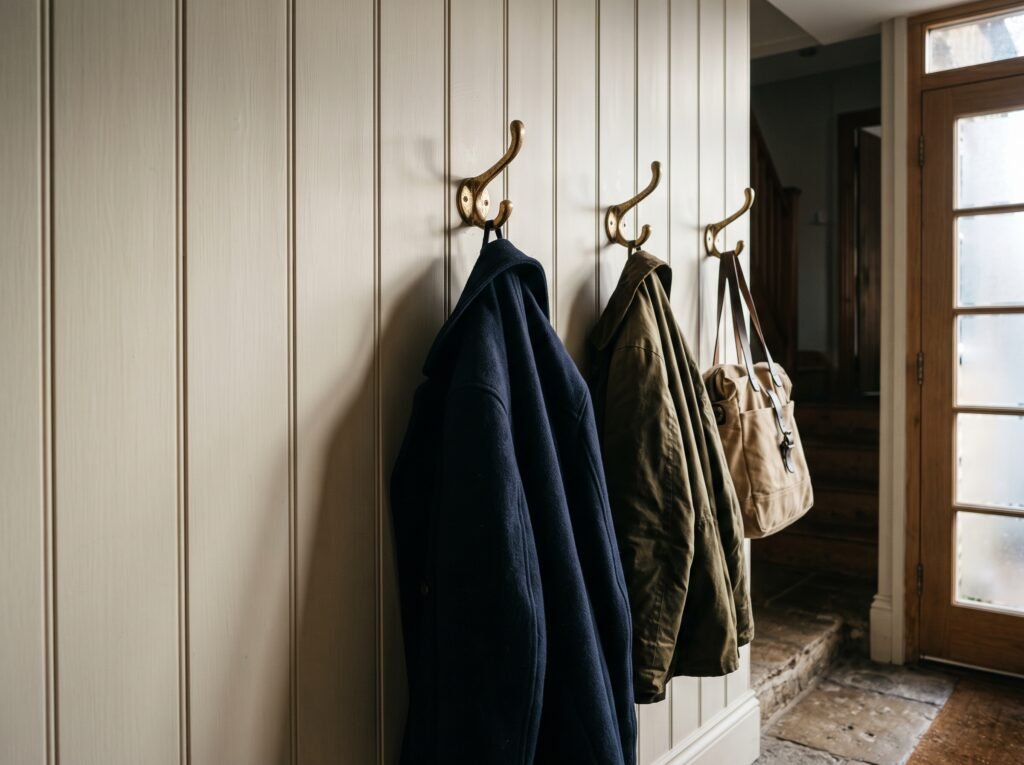
A brass coat rack wall mounted properly will outlast the house. The hook is rarely what fails: the wall is, because a wet winter coat on a hook pulls straight out against half an inch of plasterboard.
This guide covers how high to fix hooks and rails, how much weight a fixing really holds, what to ask a workshop before you buy, and why the number that matters is almost never published. Of the 48 handmade hook and rack listings we read in September 2026, 2 stated a load limit.
How high should a coat hook be?
For adults, 60 to 66 inches above the floor. Lower it to about 48 inches if a wheelchair user needs to reach it, and to 40 inches or less for young children.
The accessible figure is not a guess, it is written into the ADA standards. Section 603.4 says coat hooks shall be located within one of the reach ranges specified in 308, and section 308 sets those ranges: the high forward reach shall be 48 inches (1220 mm) maximum and the low forward reach shall be 15 inches (380 mm) minimum above the finish floor or ground, with the high side reach shall be 48 inches (1220 mm) maximum as well. The same section of the standards puts shelves 40 inches (1015 mm) minimum and 48 inches (1220 mm) maximum above the finish floor.
In a house nobody inspects your hallway, but the reasoning still holds: a hook at 48 inches is reachable by everyone, and a hook at 66 inches keeps a long coat off the floor. Hallways with both are the ones that work.
Here are the numbers in one place:
| What | Height or figure | Source |
|---|---|---|
| Coat hook, adults | 60 to 66 in above the floor | Common practice |
| Coat hook, accessible | 48 in maximum, 15 in minimum | ADA 308 |
| Shelf above hooks | 40 to 48 in | ADA 603.4 |
| Hooks for young children | 40 in or lower | Common practice |
| Single hanging rail | 66 in above the floor | Bob Vila |
| Double rail, top | 81 3/4 in | Bob Vila |
| Double rail, bottom | 40 1/2 in | Bob Vila |
| Rail clearance from the back wall | At least 12 in | Bob Vila |
| Shelf above a rail | At least 2 in above the rod | Bob Vila |
| Spacing between hooks | 8 to 12 in, so coats do not touch | Common practice |
| Wall studs, US framing | Usually 16 in on centre | IRC R602.3 |
| Toggle bolt in 1/2 in drywall | Up to 238 lb, manufacturer figure | Toggler |
How high do you hang a garment rail?
A single rail goes 66 inches above the floor, which clears a long coat. A double rail puts the top at about 81 inches and the bottom at 40.
Bob Vila gives the figures plainly: mount the rod 66 inches above the floor for a single rail, and for a double, mount the top rod 81¾ inches above the floor and the lower rod 40½ inches above the floor. Two details people forget: keep the rail at least 12 inches from the rear wall so clothes do not crush against it, and if a shelf sits above, leave a distance of at least 2 inches from the bottom of the shelf to the top of the rod so hangers can be lifted off.
An open brass rail in a bedroom follows the same numbers, and it has one extra demand: it is visible, so the length of the run matters. A rail that stops short of the wall looks accidental.
How much weight can a brass wall hook hold?
Far more than the wall it is screwed to. The brass is not the limit, the fixing is, and that is the part a listing never covers.
The manufacturer figures make the point. Toggler says its SNAPTOGGLE toggle bolt supports up to 238 lbs. in 1/2″ drywall and 802 lbs. in concrete. A plastic expansion plug, which is what comes in most hardware packets, is in a different world: tens of pounds, not hundreds.
Two things change that number in your hallway. Direction of pull matters, because a hook loaded straight out is pulling against the weak plane of plasterboard rather than pressing into it. And a wet winter coat with boots in the pockets weighs far more than the same coat dry.
So the rule: find a stud if you can. American framing puts studs 16 inches (406 mm) on center in most bearing walls, so a rack long enough to reach two studs is worth more than any anchor. Where there is no stud, use a toggle rather than a plastic plug, and buy for more than you plan to hang.
What do the handmade listings tell you about weight?
Almost nothing. We read every listing at seven small copper and brass workshops in September 2026, and of the 48 hooks, racks and rails, 2 stated a load limit.
That is the gap worth knowing before you order. The metal is rarely the problem: a solid cast brass hook is stronger than the screw it hangs on. But a workshop that has never tested a load also has no opinion about the fixings it supplies, and handmade pieces often arrive with short screws or none.
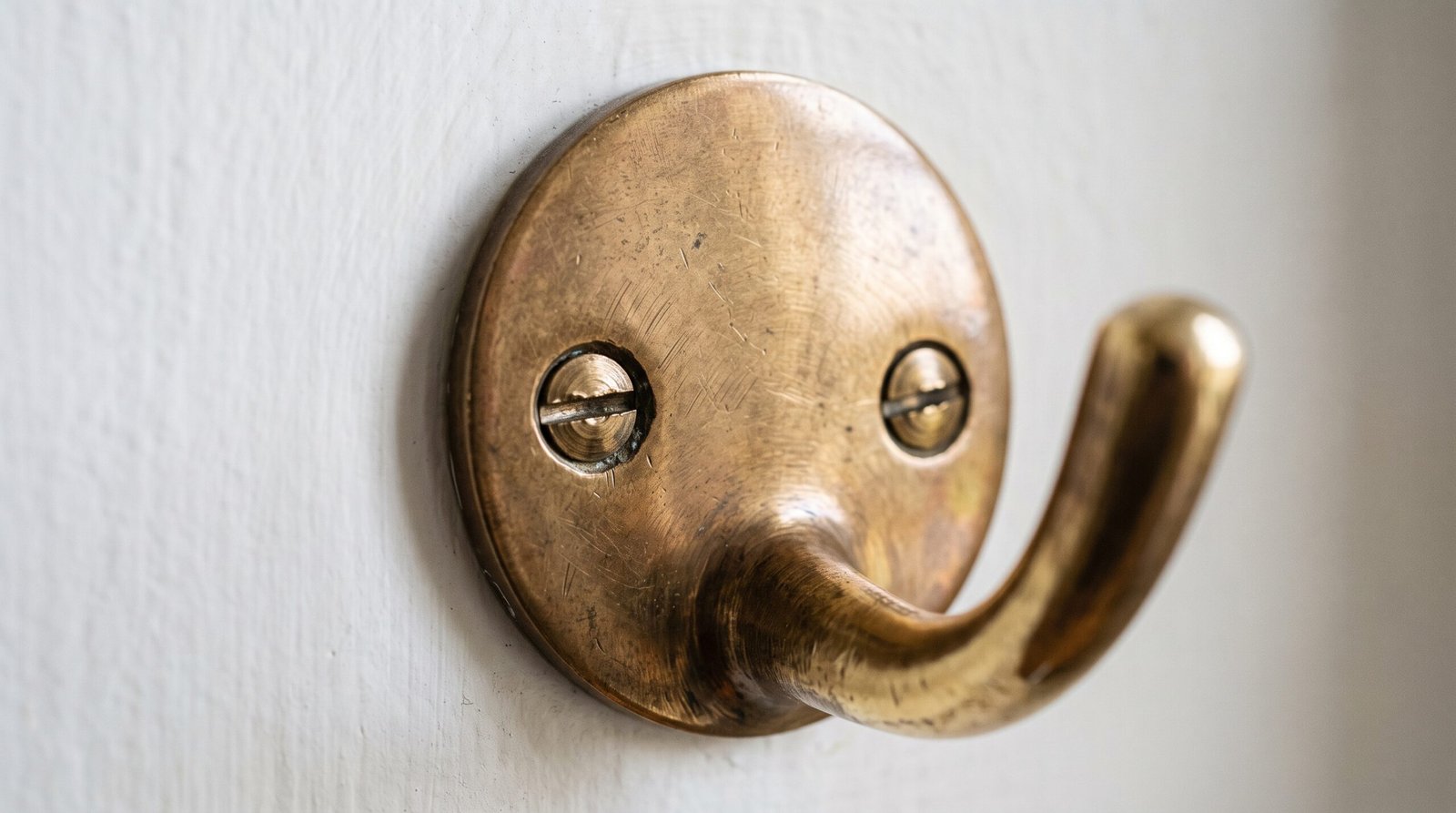
Ask three things in writing before you pay: what the backplate is drilled for, what fixings are supplied, and what the workshop has actually hung from it. The third question is the honest one, and the answer tells you whether they have tested anything.
What does a brass hook cost?
Between $44 and $750 across the seven catalogues, with a median of $96. Hooks and rails are the cheapest way into unlacquered brass in the whole category.
The spread is wide because the category runs from a single hook to a full pipe rail. A Zayian double wall hook at $76 is typical of the bottom, while a corner L shaped brass pipe clothes rail runs to $180 and a hammered backplate set of pipe hooks to $280.
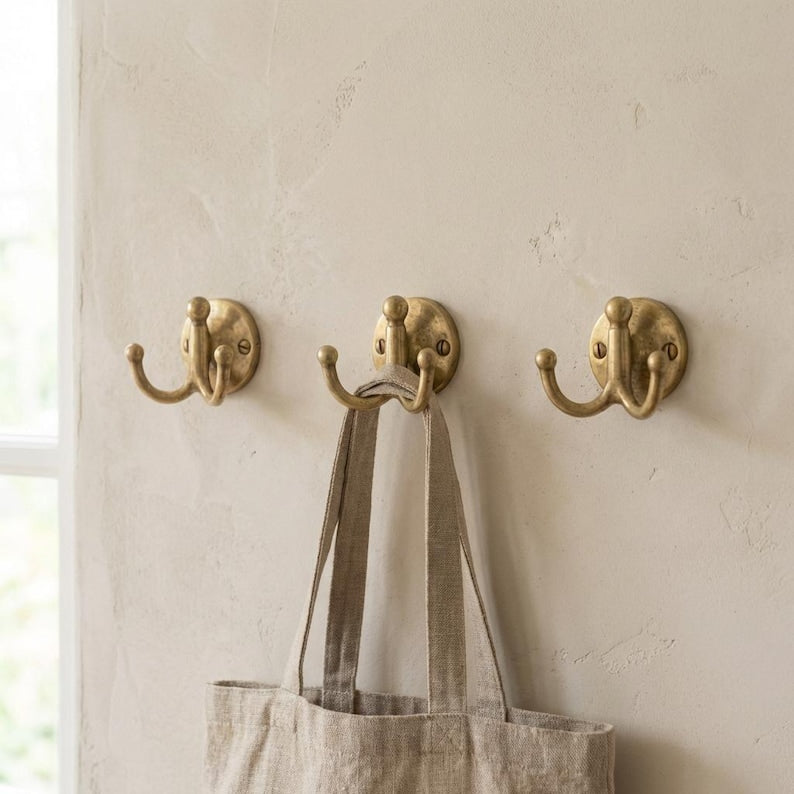
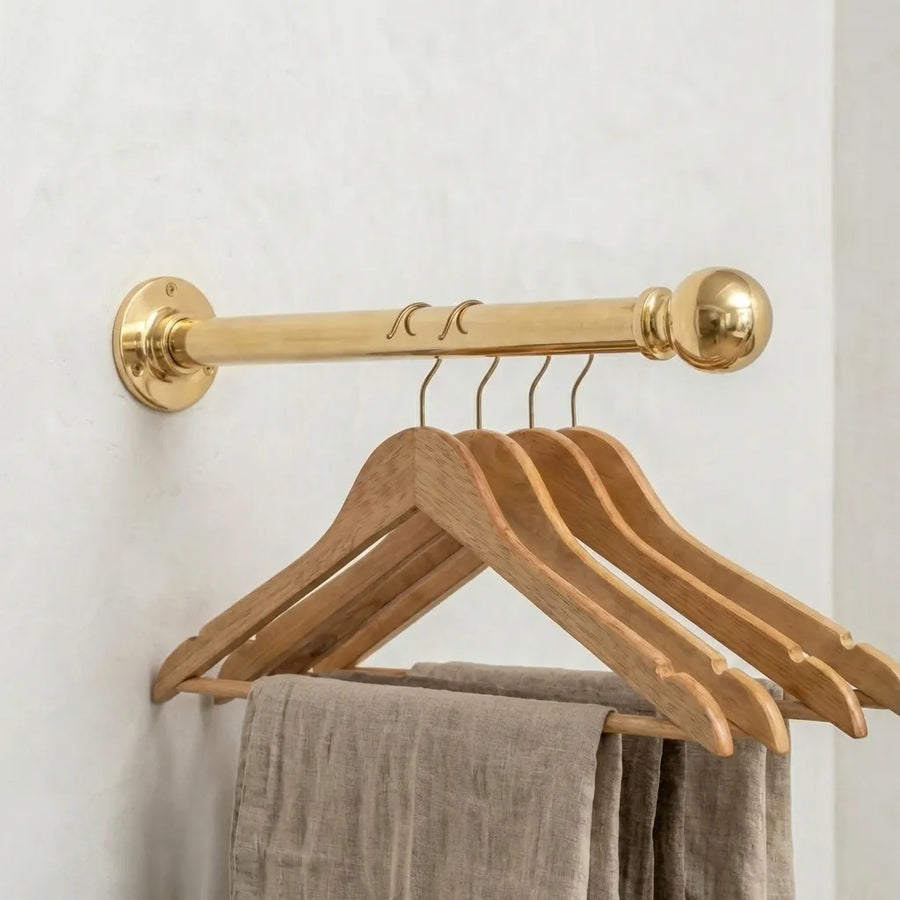
Compare that with a tap at $190 to $430 or a shower system at $440 to $1,300, and the case for starting here is obvious: for under a hundred dollars you find out whether you actually like living with a metal that changes.
Will they darken like the rest of the brass?
Yes, and faster than most pieces, because hands are on them every day. Of the 48 listings we read, 18 warned the finish would darken and 4 explained how to clean it.
A hook develops a bright patch exactly where fingers lift the coat off, with the rest going brown around it. Most people find that the best thing about it. If you want to slow it down, wax a few times a year, and if you want to stop it, buy lacquered and accept that the coating will eventually wear at that same bright patch.
The full timeline is in our guide on whether unlacquered brass tarnishes, and the care routine, including why vinegar is the wrong answer, is in how to clean unlacquered brass.
Where do hooks go wrong in a real house?
Three places: spacing, height above a radiator, and fixing into the wrong wall. All three are avoidable before you drill.
Space hooks 8 to 12 inches apart, or coats hang on each other and the row becomes one heap. Above a radiator, leave enough height that a coat does not sit on it. And in an old house, check what the wall actually is: lath and plaster behaves nothing like plasterboard, and a plastic plug in old lime plaster is a hole waiting to happen.
The same measuring logic applies to every other fitting in a bathroom, which we cover in our guide to towel bar, toilet paper holder and robe hook heights.
Can you get a discount on brass hooks and racks?
Yes at the stores we test. Rod & Rails has a code that works in a real basket, and CopperKesh was running a store wide code in September 2026.
On pieces this size the saving is small in dollars but large as a share, which is the point when you are buying six hooks rather than one tap. Check the current offer and the date it was last tested on the Rod & Rails and CopperKesh store pages, and read how we verify codes for the method.
So, what should you buy and where should it go?
Fix hooks at 60 to 66 inches for adults, add a lower row at 40 inches if children use the hallway, and keep 8 to 12 inches between them. Rails go at 66 inches single, 81 and 40 for a double, always 12 inches clear of the back wall.
Then spend your attention on the fixing rather than the hook. Find a stud, use a toggle where you cannot, and ask the workshop what they have actually hung from the piece. Browse brass towel bars and hooks with the codes we have checked, and read does unlacquered brass tarnish before you commit a whole hallway to a living finish.
Get new tested codes by email
One email on Friday: the codes that passed our checkout test that week, the ones we pulled, and new guides. Quiet week, short email.