Search how to clean a brass shower head and every answer says the same thing: soak it in vinegar overnight. That advice is written for chrome, and on unlacquered brass it strips the patina you paid for and leaves a blotchy, bright surface that takes months to settle again.
This guide covers what is actually blocking the holes, how to clear them without acid, how to deal with hard water marks, and the one situation where a short acid soak is reasonable. It also covers what the workshops tell you, which is not much: of the 46 brass and copper shower systems we read in September 2026, 5 stated a flow rate and 4 stated a thread size.
Can you clean a brass shower head with vinegar?
On a chrome or lacquered head, yes, and the makers say so. On unlacquered brass, no, because vinegar is an acid and the patina is a surface layer that acid removes.
Delta, whose finishes are coated, tells owners of blocked heads to try soaking the item in a 50/50 mixture of white vinegar and water, and says it will remove deposits while not harming the finish. That is true of their finishes. It is not a statement about raw brass.
For living finishes the same industry says the opposite. Newport Brass tells owners to simply wipe with a soft, water dampened cloth and warns: do not use any abrasive cleaners, alcohol, ammonia, detergents, or brass or silver polish on the Products. And because these finishes are meant to change, they sit outside the warranty entirely. California Faucets states that living finishes are expressly designed to tarnish and otherwise change appearance over time, while Waterstone confirms tarnishing or excessive wear of these finishes is therefore, not a defect, but a normal process, which is unavoidable.
So the question is not whether vinegar removes limescale. It does. The question is what else it removes, and on unlacquered brass the answer is the colour you have been growing. If you are not sure which finish you have, put a drop of vinegar on the back of the head where it does not show: if that spot turns brighter within a few minutes, the brass is bare and the soak is off.
Here is the whole job in one place:
| Situation | Do | Avoid |
|---|---|---|
| Daily care, unlacquered brass | Wipe with a soft damp cloth, dry after use | Leaving water to dry on the surface |
| Weekly clean | Mild soap and warm water, soft cloth | Detergents, ammonia, bleach, alcohol |
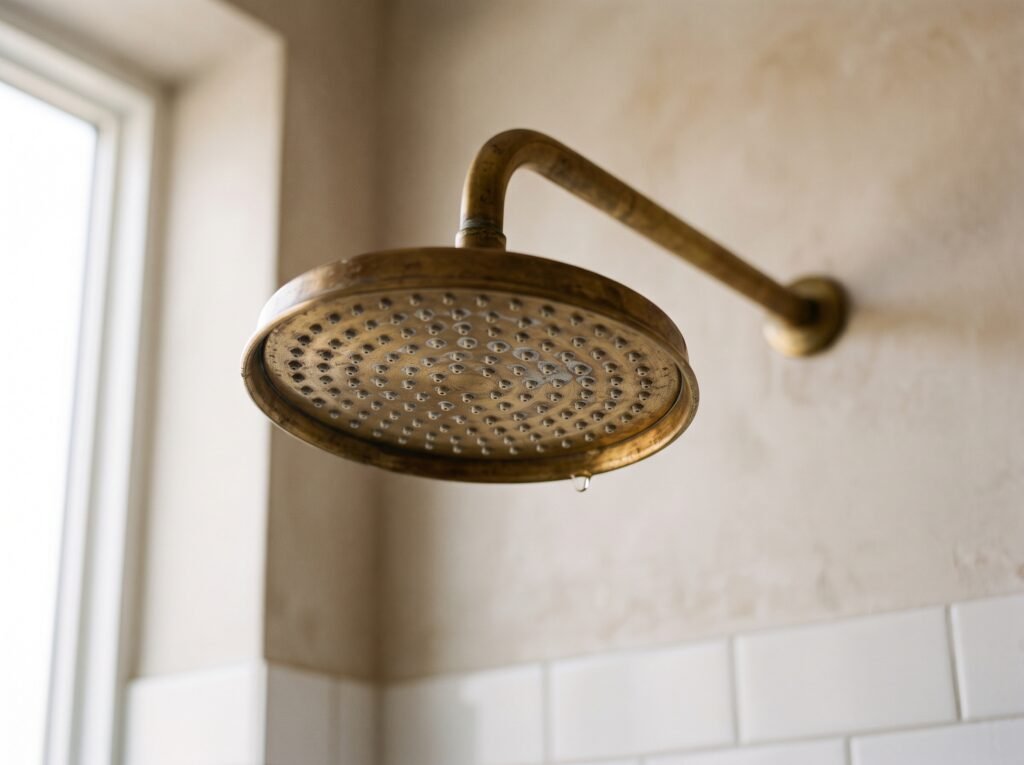
| Blocked spray holes | Rub the nozzles with a thumb or a soft toothbrush | Metal pins, wire, scouring pads |
| Heavy limescale, lacquered or chrome | 50/50 white vinegar and water soak | Full strength vinegar left overnight |
| Heavy limescale, unlacquered brass | Short soak of the face only, then rinse and dry, accepting it will brighten | Overnight soaking of the whole head |
| Hard water marks | Dry the piece, then buff with a dry cloth | Brass polish, which removes patina and metal |
| Slowing future marks | A wax coating a few times a year | Lacquer sprays sold for decoration |
| Restoring the shine deliberately | Brass polish, knowing it starts the ageing again | Doing it by accident with an acid soak |
What is actually blocking the holes?
Limescale, which is calcium and magnesium left behind when hard water dries. It builds at the spray holes because that is where water sits and evaporates between showers.
The United States Geological Survey defines it simply: the simple definition of water hardness is the amount of dissolved calcium and magnesium in the water, and hardness is caused by compounds of calcium and magnesium, and by a variety of other metals. Its classification puts 0 to 60 mg/L (milligrams per liter) as calcium carbonate is classified as soft, 61 to 120 as moderately hard, 121 to 180 as hard, and more than 180 mg/L as very hard.
This matters because it tells you how often you will be doing this. In soft water a brass head may never block. In very hard water it will need attention every few months, which is an argument for cleaning little and often rather than waiting for a blockage that needs acid.
Heat makes it worse, which is why a shower head blocks before a cold tap does. The USGS notes that when hard water is heated, such as in a home water heater, solid deposits of calcium carbonate can form, and that this scale can clog pipes. The same hardness is behind the white film on the brass: in hard water, it says, soap reacts with the calcium and leaves a residue. To find your own number, the USGS says local readings should be provided by the local health agency or local water utility, or by the vendor of a local water-softening system. Homes on a private well tend to sit at the hard end, because as water moves through soil and rock it dissolves small amounts of naturally-occurring minerals and carries them into the groundwater supply.
Once you know your band, set the routine to it. In soft water, a dry with a cloth after showers and a rub of the nozzles every few weeks is enough. In hard or very hard water, rub the nozzles weekly and take the head off to check the screen every few months. A whole house water softener is the only thing that stops the scale at the source; everything else in this guide is cleaning up after it.
How do you clear the holes without acid?
Rub them. Most shower heads are built so the deposits sit on rubber or brass nozzles you can reach with a thumb, and pushing the scale off by hand works better than people expect.
The routine, in order:
1. Run the shower hot for thirty seconds to soften the deposits. 2. Turn it off and rub each nozzle with your thumb, working across the face. 3. For anything left, use a soft toothbrush and warm soapy water. 4. Rinse, then dry the whole head with a cloth. Drying is the step everyone skips and it is the one that stops the marks coming back.
Shower makers design for exactly this. Delta says the soft rubber nozzles on its heads let any mineral residue to simply be wiped away for an instantly refreshed look, with no need for soaking or the aid of chemical cleaners. Handmade brass heads often have brass holes rather than rubber, so the same rub works but takes a little longer. Bob Vila’s method for stubborn spots is to cover your finger with a rag and gently scrape each nozzle to remove visible buildup, being careful not to damage the rubber surface.
Some guides, Bob Vila’s included, list a small sewing needle or straight pin for a hole that stays blocked. If you use one, only lift the scale out of the hole. Never push it in hard or twist it, because a widened or scratched hole sprays off line.
What if the holes are properly blocked?
Then you have a choice to make, and it is better to make it deliberately than to discover it afterwards. Either accept a brighter, patchier finish in exchange for flow, or take the head off and clean only the parts that do not show.
The gentler route: unscrew the head, and soak only the internal screen or filter, which is usually steel or plastic and does not care about acid. Deposits often collect there rather than on the face. Bob Vila makes the same point, that removing the head might be the best way to clean a clogged shower head, since you can both soak and scrub it well, and check and clean its screen filter.
If the face itself is blocked and rubbing has failed, a short soak of the face alone in 50/50 vinegar and water will clear it. Fifteen minutes, not overnight. Then rinse thoroughly, dry, and expect the soaked area to be noticeably brighter than the rest. It will darken again over the following months, unevenly at first.
What not to do is hang a bag of neat vinegar on the arm and leave it overnight, which is the advice all over the internet. On unlacquered brass that is a decision to restart the patina, made by accident.
How do you remove hard water marks from brass?
Dry it, then buff with a clean dry cloth. Most of what people call water marks on brass is mineral residue sitting on the surface, not damage, and it comes off with friction rather than chemistry.
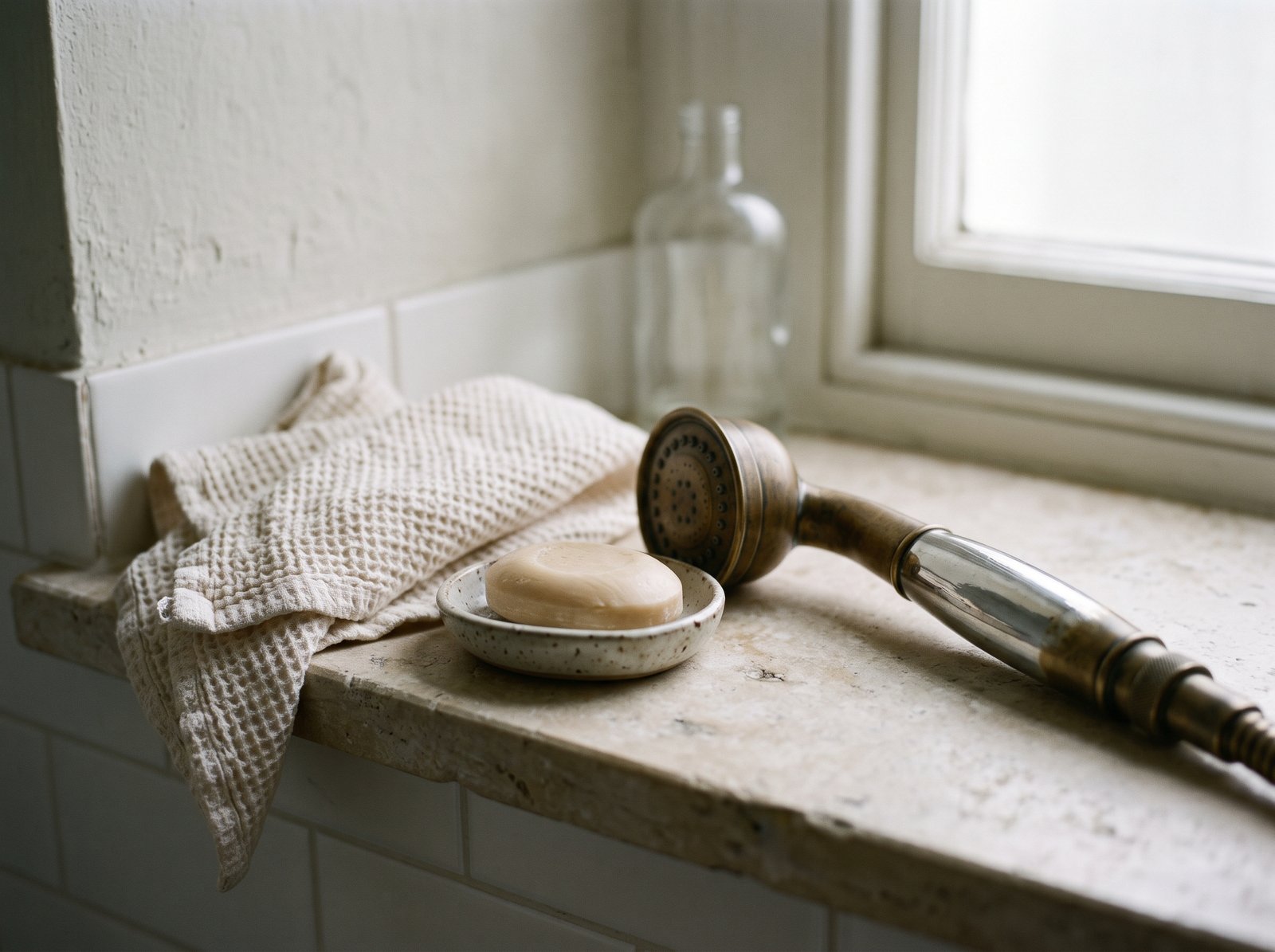
For anything that stays, mild soap and warm water on a soft cloth, then dry again. The Canadian Conservation Institute is blunt about the alternative: polishing, by contrast, is an abrasive operation that removes tarnish and some surface metal. A polish will clear the marks and the patina together, and a little metal each time.
To slow the marks down, the same source points at wax: a wax coating will provide some protection against both the environment and handling. A few times a year is enough. It buys slower change, not no change, which is the honest trade.
Should you polish it back to gold?
Only if you want to start again. Polishing is not maintenance on a living finish, it is a reset, and it puts you back at the beginning of an ageing process you have already paid for in time.
Perrin & Rowe describes the intent plainly: unlacquered brass is designed to age and develop a unique patina over time, enhancing its character and elegance. This is a natural occurrence and is not considered a defect. Newport Brass says the same of its living range: uncoated and living finishes such as Unlacquered Brass – Living (03N) and Weathered Copper (08W) do naturally weather and change color over time.
Polishing also costs metal. The Canadian Conservation Institute warns that repeated polishing results in loss of surface detail, and that many metal polishes contain ammonia, which can dissolve copper in some conditions, which matters because brass is mostly copper. If you do decide to polish, do the whole piece rather than a patch, or you will have a bright ring where the cloth went. And if your head is lacquered rather than unlacquered, do not polish it at all: polish cuts through the lacquer and leaves the brass underneath to tarnish in patches. The full timeline of what happens next, and the one warning sign that means something is actually wrong, is in our guide to whether unlacquered brass tarnishes.
Does the shower head come apart?
On most handmade brass systems, yes, and it is worth checking before you need to. A head that unscrews lets you clean the screen, replace a washer and descale without touching the outside at all. Bob Vila’s advice is that it’s always best to check the manufacturer’s instructions first and consider the type of shower head when removing it, and if a head is stuck, to protect the shower head’s finish by wrapping it in a rag or cloth before a wrench goes anywhere near it. Hold the shower arm with your other hand while you turn, so the pipe inside the wall does not turn with it. When you put it back, clean the old seal tape off the thread and wrap two or three turns of fresh tape in the direction the head screws on.
This is also where handmade and mass market part company. A Delta head has a parts diagram. A workshop piece often does not, which is why the thread size matters: a half inch standard thread means a replacement or a spare is available anywhere. Of the 46 shower systems we read across seven workshops in September 2026, 4 stated a thread size and 17 named the valve type.
Ask before you buy, and keep the answer. The four questions worth having in writing are the thread size, whether a valve is included, whether the cartridge is a standard part, and what the flow rate is.


What do the workshop listings tell you about cleaning?
Almost nothing, which is the pattern across this whole category. Most listings tell you the finish will change and stop there.
Across all 465 unlacquered brass listings we read in September 2026, 330 said the finish would darken and 65 explained how to clean it. So four out of five buyers are told to expect change and left to work out the care on their own, which is how vinegar advice written for chrome ends up on raw brass.
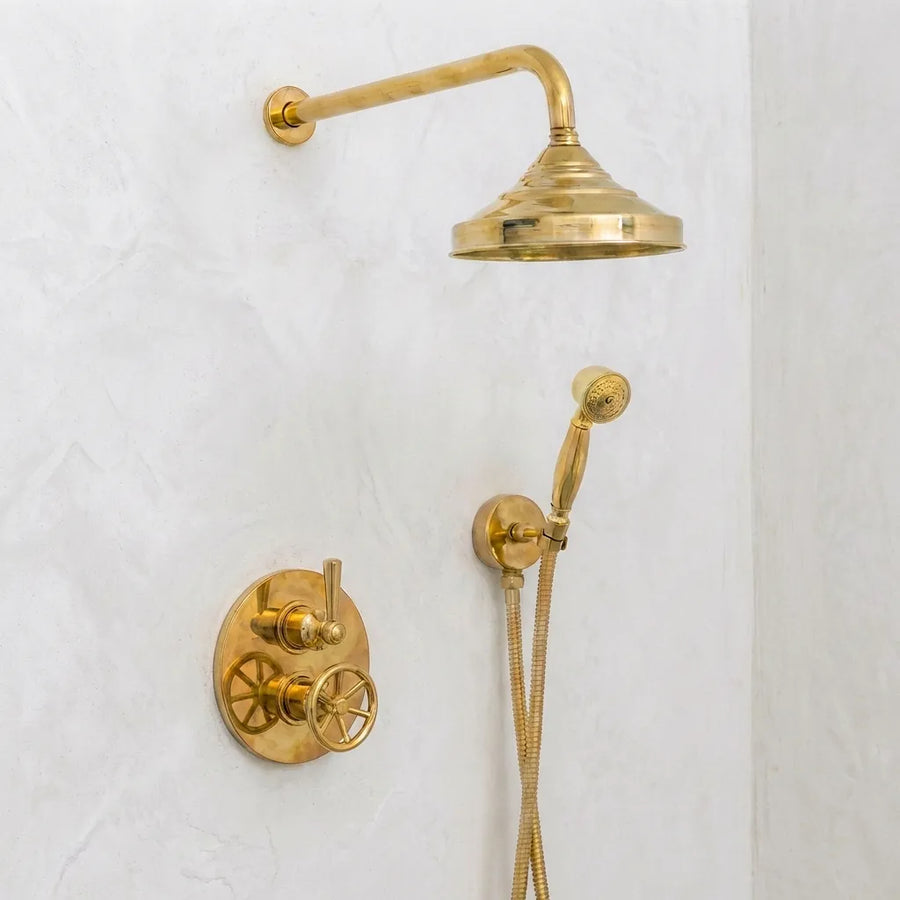
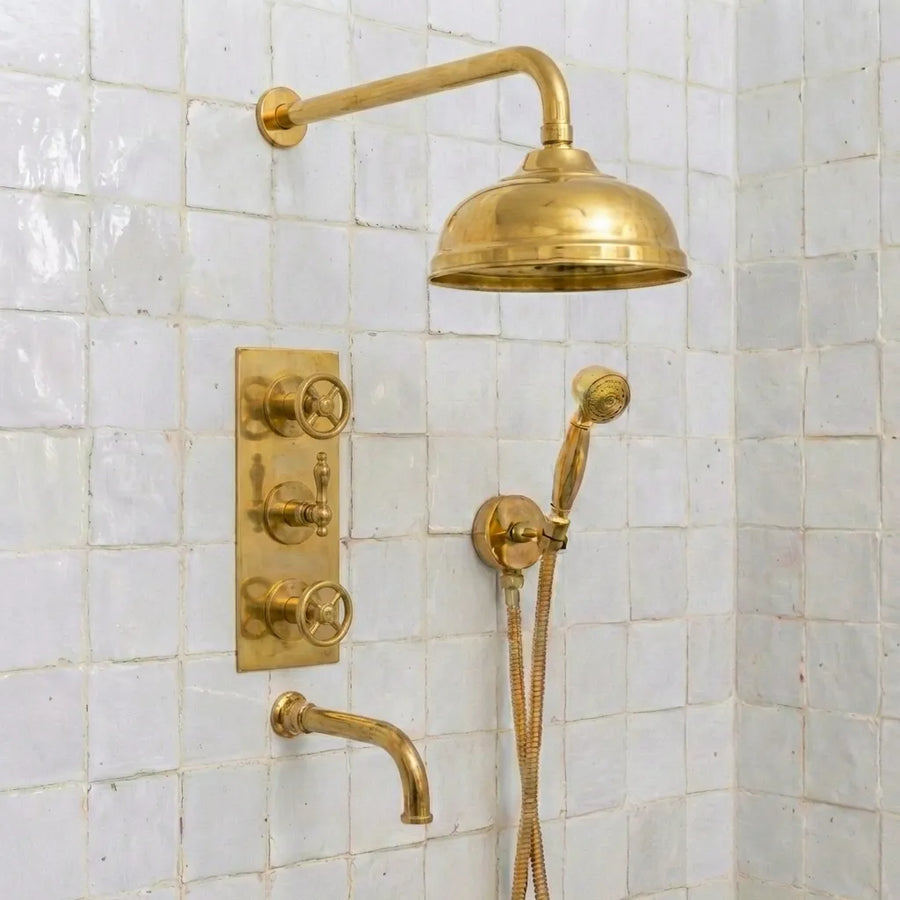
Shower systems in our read run from $440 to $1,300, median $640. A Zayian thermostatic brass shower system at $790 is typical of the upper end, with exposed pipework and a rain head, and a heritage wall mount system at $750 sits just below it. Both are solid brass, so both will darken, and both will need the cloth rather than the bottle.
The full read, with the method and the dataset, is in the September 2026 listings study.
Can you get a discount on a brass shower system?
Yes at the stores we test. In September 2026 Zayian was running free worldwide express shipping and CopperKesh had a store wide code, both checked in a real basket before publishing.
On a $790 shower system, free express shipping from Morocco is not a small line. Check the current offer and the date it was last tested on the Zayian and CopperKesh store pages, and read how we verify codes if you want the method.
So, how should you clean a brass shower head?
Soap, water, a soft cloth and a thumb over the nozzles, then dry it. That is the whole routine for unlacquered brass, and doing it weekly means you never face the blocked head that tempts you into acid.
Keep vinegar for chrome and lacquered finishes, where the makers recommend it. If you must use it on raw brass, soak the face for fifteen minutes and accept the brightness. Then browse brass shower systems with the codes we have checked, and read how to clean unlacquered brass for the rest of the fittings in the room.
Get new tested codes by email
One email on Friday: the codes that passed our checkout test that week, the ones we pulled, and new guides. Quiet week, short email.